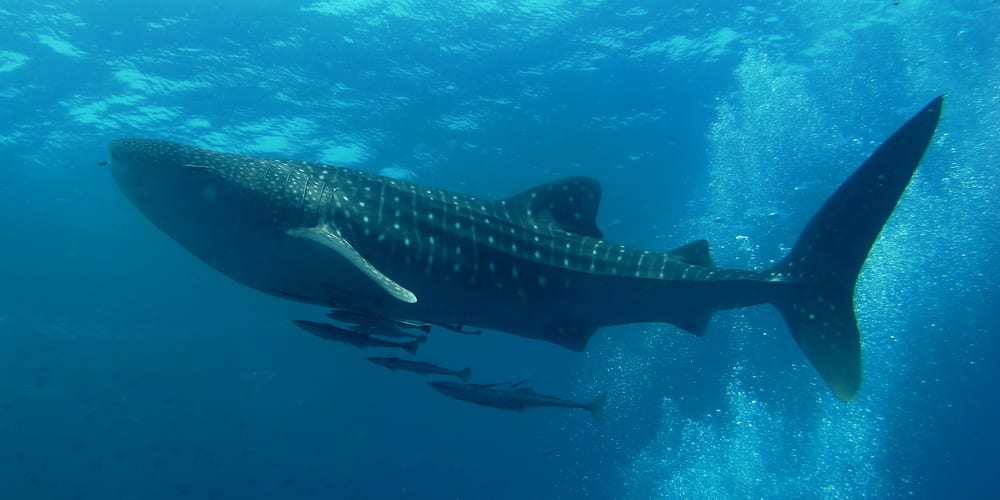
The whale shark (Rhincodon typus) is a slow-moving, filter-feeding carpet shark and the largest known extant fish species. An individual with a length of 18.8 m (61.7 ft) has been considered the largest reliably recorded. The whale shark holds many records for size in the animal kingdom, most notably being by far the largest living non-cetacean animal. It is the only living species of the genus Rhincodon and the only extant member of the family Rhincodontidae, which belongs to the subclass Elasmobranchii in the class Chondrichthyes. Before 1984, it was classified as Rhiniodon into Rhinodontidae. An extinct species, Rhincodon ferriolensis, was described in Europe (probably in Spain), in the Late Burdigalian stage.
The whale shark is an active filter feeder, primarily consuming plankton, krill, fish eggs, and small schooling fish such as sardines and anchovies. The shark can process over 6,000 liters of water per hour through its specialized sieve-like gill pads. Highly migratory, the whale shark travels thousands of miles across tropical oceans to exploit seasonal food sources, with large, predictable feeding aggregations occurring at coastal sites such as Ningaloo Reef in Western Australia, the Yucatan Peninsula in Mexico, and off the coast of Gujarat and Kerala in India. Despite its immense size, the whale shark is docile and poses no significant threat to humans. It is currently listed as an Endangered species on the IUCN Red List owing to a population decline of more than 50% over the last 75 years, primarily as a result of targeted fishing, bycatch in other fisheries, and collisions with large ships.
The biggest fish in the sea eats only the smallest things.
Description
Whale sharks possess a broad, flattened head with a large mouth and two small eyes located at the front corners. Unlike many other sharks, whale shark mouths are located at the front of the head rather than on the underside of the head. Their mouths can be exceptionally wide; a 12.1 m (39.7 ft) individual was reported to have a mouth measuring 1.55 m (5.1 ft) across. Whale shark mouths can contain over 300 rows of tiny teeth and 20 filter pads which it uses to filter feed. The spiracles are located just behind the eyes. Whale sharks have five large pairs of gills. Their skin is dark grey with a white belly marked with an arrangement of pale grey or white spots and stripes that is unique to each individual. The skin can be up to 15 cm (5.9 in) thick and is very hard and rough to the touch. The whale shark has three prominent ridges along its sides, which start above and behind the head and end at the caudal peduncle. The shark has two dorsal fins set relatively far back on the body, a pair of pectoral fins, a pair of pelvic fins and a single medial anal fin. The caudal fin has a larger upper lobe than the lower lobe (heterocercal).
Whale sharks have been found to possess dermal denticles on the surface of their eyeballs that are structured differently from their body denticles. The dermal denticles, as well as the whale shark's ability to retract its eyes deep into their sockets, serve to protect the eyes from damage.
Distribution and habitat
The whale shark inhabits all tropical and warm-temperate seas. The fish is primarily pelagic, and can be found in both coastal and oceanic habitats. Tracking devices have shown that the whale shark displays dynamic patterns of habitat utilization, likely in response to availability of prey. Whale sharks observed off the northeast Yucatan Peninsula tend to engage in inshore surface swimming between sunrise and mid-afternoon, followed by regular vertical oscillations in oceanic waters during the afternoon and overnight. About 95% of the oscillating period was spent in epipelagic depths (<200 metres (660 ft)), but whale sharks also took regular deep dives (>500 metres (1,600 ft)), often descending in brief "stutter steps", perhaps for foraging. The deepest recorded dive was 1,928 metres (6,325 ft). Whale sharks were observed to remain continuously at depths of greater than 50 metres (160 ft) for three days or more.
The whale shark is migratory and has two distinct subpopulations: an Atlantic subpopulation, from Maine and the Azores to Cape Agulhas, South Africa, and an Indo-Pacific subpopulation which holds 75% of the entire whale shark population. It usually roams between 30°N and 35°S where water temperatures are higher than 21 °C (70 °F) but have been spotted as far north as the Bay of Fundy, Canada and the Sea of Okhotsk north of Japan and as far south as Victoria, Australia.
Diet
The whale shark is a filter feeder – one of only three known filter-feeding shark species (along with the basking shark and the megamouth shark). It feeds on plankton including copepods, krill, chaetognaths, jellyfish, fish eggs, Christmas Island red crab larvae and small nektonic life, such as small squid or fish (sardines, anchovies, mackerels and small tunas). It also feeds on clouds of eggs during mass spawning of fish and corals. In addition, they have been found to ingest and partially digest Sargassum, thus making them omnivores. The many rows of vestigial teeth play no role in feeding. Feeding occurs either by ram filtration, in which the animal opens its mouth and swims forward, pushing water and food into the mouth, or by active suction feeding, in which the animal opens and closes its mouth, sucking in volumes of water that are then expelled through the gills. In both cases, the filter pads serve to separate food from water. These unique, black sieve-like structures are presumed to be modified gill rakers. Food separation in whale sharks is by cross-flow filtration, in which the water travels nearly parallel to the filter pad surface, not perpendicularly through it, before passing to the outside, while denser food particles continue to the back of the throat. This is an extremely efficient filtration method that minimizes fouling of the filter pad surface. Whale sharks have been observed "coughing", presumably to clear a build-up of particles from the filter pads.
Growth and reproduction
Growth, longevity, and reproduction of the whale shark are poorly understood.
Vertebral growth bands have been used to estimate the age, growth, and longevity of whale sharks. However, there was uncertainty as to whether vertebrae growth bands are formed annually or biannually. A 2020 study compared the ratio of Carbon-14 isotopes found in growth bands of whale shark vertebrae to nuclear testing events in the 1950–60s, finding that growth bands are laid down annually. The study found an age of 50 years for a 10 m (33 ft) female and 35 years for a 9.9 m (32 ft) male. Various studies looking at vertebrae growth bands and measuring whale sharks in the wild have estimated their lifespans from ~80 years and up to ~130 years.
Evidence suggests that males grow faster than females in the earlier stages of life but ultimately reach a smaller maximum size. Whale sharks exhibit late sexual maturity. One study looking at free-swimming whale sharks estimated the age at maturity in males at ~25 years.
Relationship with humans
Despite their great size, whale sharks pose no danger to humans. Younger whale sharks are gentle and can play with divers. Underwater photographers such as Fiona Ayerst have photographed them swimming close to humans without any danger. Although whale sharks are docile fish, touching or riding the sharks is strictly forbidden and fineable in most countries, as it can cause them serious harm.
Divers regularly encounter whale sharks in the Bay Islands in Honduras, Thailand, Indonesia (Bone Bolango, Cendrawasih Bay), the Philippines, the Maldives close to Maamigili (South Ari Atoll), the Red Sea, Western Australia (Ningaloo Reef, Christmas Island), Taiwan, Panama (Coiba Island), Belize, Tofo Beach in Mozambique, Sodwana Bay (Greater St. Lucia Wetland Park) in South Africa, the Galapagos Islands, Saint Helena, Isla Mujeres (Caribbean Sea), La Paz, Baja California Sur and Bahía de los Ángeles in Mexico, the Seychelles, West Malaysia, islands off eastern peninsular Malaysia, India, Sri Lanka, off the coast of Iran's Qeshm and Hengam islands in Persian gulf, Oman, Fujairah, Puerto Rico, and other parts of the Caribbean. Juveniles can be found near the shore in the Gulf of Tadjoura, near Djibouti, in the Horn of Africa.