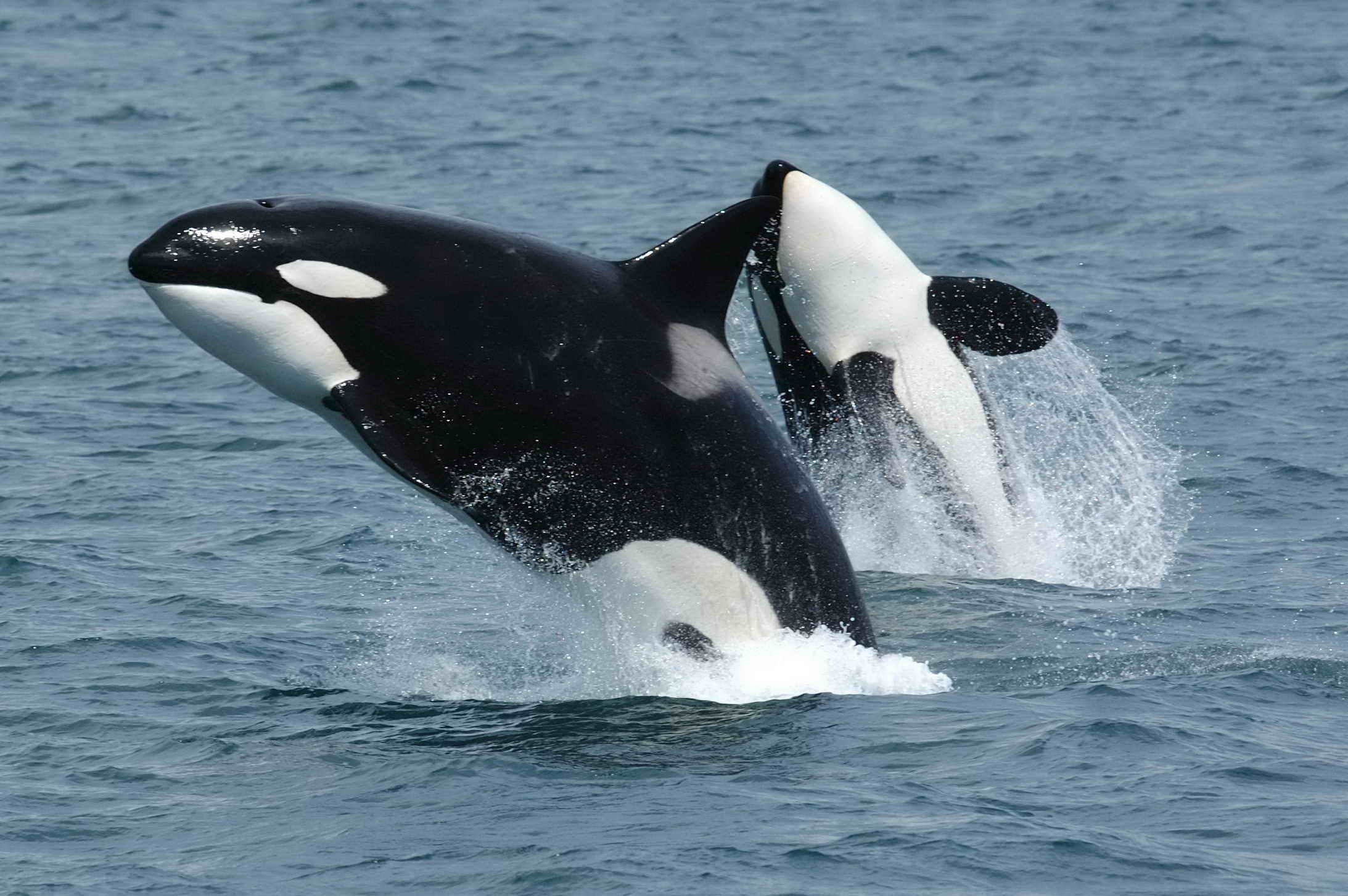
The orca (Orcinus orca), or killer whale, is a toothed whale and the largest member of the oceanic dolphin family. The only extant species in the genus Orcinus, it is recognizable by its distinct pigmentation; being mostly black on top, white on the bottom and having recognizable white eye patches. A cosmopolitan species, it inhabits a wide range of marine environments, from Arctic to Antarctic regions to tropical seas, but is more commonly documented in temperate or cooler coastal waters. Scientists have proposed dividing the global population into races, subspecies, or possibly even species.
Orcas are apex predators with a diverse diet. Individual populations often specialize in particular types of prey, including bony fish, sharks, rays, and marine mammals such as seals, dolphins, and whales. They are highly social, with some populations forming stable matrilineal family groups (pods). Their sophisticated hunting techniques and vocal behaviors, often unique to specific groups and passed down from generation to generation, are considered to be manifestations of animal culture. The most studied populations are off the west coast of North America, which include fish-eating "residents", mammal-eating "transients", and offshores.
The ocean's apex predator hunts in matriarchal pods.
Range and habitat
Orcas are found in all oceans and most seas. Due to their enormous range, numbers, and density, relative distribution is difficult to estimate, but they clearly prefer higher latitudes and coastal areas over pelagic environments. Areas which serve as major study sites for the species include the coasts of Iceland, Norway, the Valdés Peninsula of Argentina, the Crozet Islands, New Zealand and parts of the west coast of North America, from California to Alaska. Systematic surveys indicate the highest densities of orcas (>0.40 individuals per 100 km2) in the northeast Atlantic around the Norwegian coast, in the north Pacific along the Aleutian Islands, the Gulf of Alaska and in the Southern Ocean off much of the coast of Antarctica. They are considered "common" (0.20–0.40 individuals per 100 km2) in the eastern Pacific along the coasts of British Columbia, Washington and Oregon, in the North Atlantic Ocean around Iceland and the Faroe Islands.
Feeding
Orcas are apex predators, meaning that they themselves have no natural predators. They are sometimes called "wolves of the sea", because they hunt in groups like wolf packs. Orcas hunt varied prey including fish, cephalopods, mammals, seabirds, and sea turtles. Different populations or ecotypes may specialize, and some can have a dramatic impact on prey species. However, whales in tropical areas appear to have more generalized diets due to lower food productivity. Orcas spend most of their time at shallow depths, but occasionally dive several hundred metres depending on their prey. On average, an orca eats 227 kilograms (500 lb) each day.
Behaviour
Day-to-day orca behaviour generally consists of foraging, travelling, resting and socializing. Orcas frequently engage in surface behaviour such as breaching (jumping completely out of the water) and tail-slapping. These activities may have a variety of purposes, such as courtship, communication, dislodging parasites, or play. Spyhopping is a behaviour in which a whale holds its head above water to view its surroundings. They can also reach speeds of up to 15.5 m/s (56 km/h; 35 mph). Resident orcas swim alongside porpoises and other dolphins.
Orcas will engage in surplus killing, that is, killing that is not designed to be for food. As an example, a BBC film crew witnessed orcas in British Columbia playing with a male Steller sea lion to exhaustion, but not eating it.
Some orcas have been observed swimming with dead salmon on their heads, resembling hats.
Life cycle
Female orcas begin to mature at around the age of 10–13 and reach peak fertility around 20, experiencing periods of polyestrous cycling separated by non-cycling periods of three to 16 months. Females can often breed until age 40, followed by a rapid decrease in fertility. Orcas are among the few animals that undergo menopause and live for decades after they have finished breeding. The lifespans of wild females average 50 to 80 years. Some are claimed to have lived substantially longer: Granny (J2) was estimated by some researchers to have been as old as 105 years at the time of her death, though a biopsy sample indicated her age as 65 to 80 years. One of the oldest living orcas is Ocean Sun (identified as L25), a Southern Resident Orca, who is estimated to be more than 98 years old. It is thought that orcas held in captivity tend to have shorter lives than those in the wild, although this is subject to scientific debate.
Males mate with females from other pods, which prevents inbreeding. Gestation varies from 15 to 18 months. Mothers usually calve a single offspring about once every five years. In resident pods, births occur at any time of year, although winter is the most common. Mortality is extremely high during the first seven months of life, when 37–50% of all calves die. Weaning begins at about 12 months of age, and is complete by two years. According to observations in several regions, all male and female pod members participate in the care of the young.
Conservation
In 2008, the IUCN (International Union for Conservation of Nature) changed its assessment of the orca's conservation status from conservation dependent to data deficient, recognizing that one or more orca types may actually be separate, endangered species. Depletion of prey species, pollution, large-scale oil spills, and habitat disturbance caused by noise and conflicts with boats are the most significant worldwide threats. In January 2020, the first orca in England and Wales since 2001 was found dead with a large fragment of plastic in its stomach.
Like other animals at the highest trophic levels, the orca is particularly at risk of poisoning from bioaccumulation of toxins, including Polychlorinated biphenyls (PCBs). European harbour seals have problems in reproductive and immune functions associated with high levels of PCBs and related contaminants, and a survey off the Washington coast found PCB levels in orcas were higher than levels that had caused health problems in harbour seals. Blubber samples in the Norwegian Arctic show higher levels of PCBs, pesticides and brominated flame-retardants than in polar bears. A 2018 study published in Science found that global orca populations are poised to dramatically decline due to such toxic pollution.