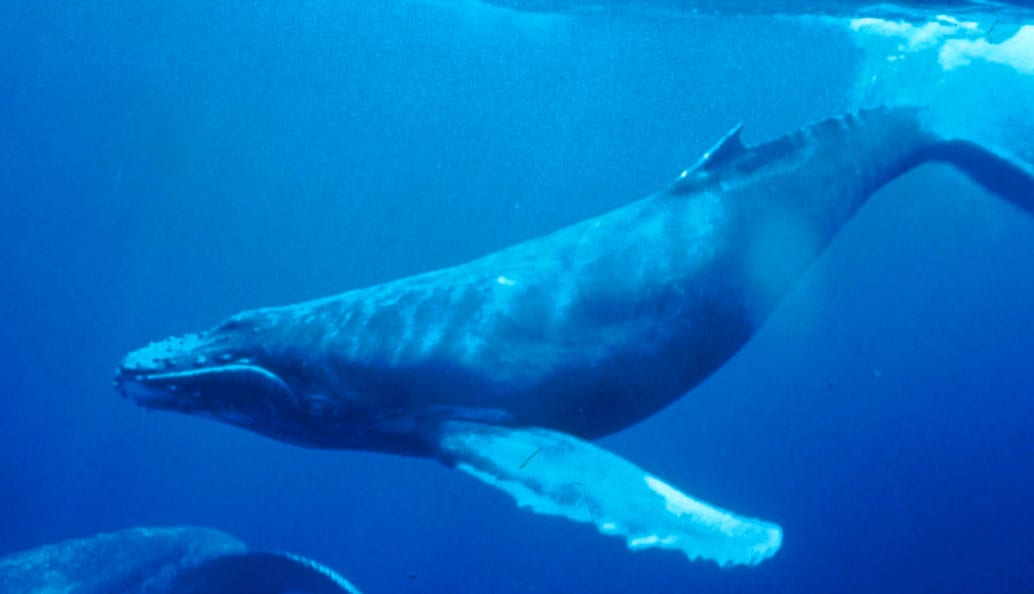
The humpback whale (Megaptera novaeangliae) is a species of baleen whale. It is a rorqual (a member of the family Balaenopteridae) and is the only species in the genus Megaptera. Adults range in length from 14–17 m (46–56 ft) and weigh up to 40 metric tons (44 short tons). The humpback has a distinctive body shape, with long pectoral fins and tubercles on its head. It is known for breaching and other distinctive surface behaviors, making it popular with whale watchers. Males produce a complex song that typically lasts from 4 to 33 minutes.
Found in oceans and seas around the world, humpback whales typically migrate between feeding areas towards the poles and breeding areas near the equator. Their diet consists mostly of krill and small fish, and they usually use bubbles to catch prey. They are polygynandrous breeders, with both sexes having multiple partners. Males will follow females and fight off rivals. Mothers give birth to calves in shallower water. Orcas are the main natural predators of humpback whales. The bodies of humpbacks host barnacles and whale lice.
Sings whole symphonies that travel across entire oceans.
Range
Humpback whales are found in marine waters worldwide, except for some areas at the equator and High Arctic and some enclosed seas. The farthest north they have been recorded is at 81°N around northern Franz Josef Land. They are usually coastal and tend to congregate in waters within continental shelves. Their winter breeding grounds are located around the equator; their summer feeding areas are found in colder waters, including near the polar ice caps. Humpbacks go on vast migrations between their feeding and breeding areas, often crossing the open ocean. The species has been recorded traveling up to 8,000 km (5,000 mi) in one direction.
In the North Atlantic, there are two separate wintering populations, one in the West Indies, from Cuba to northern Venezuela, and the other in the Cape Verde Islands and northwest Africa. During summer, West Indies humpbacks congregate off New England, eastern Canada, and western Greenland, while the Cape Verde population gathers around Iceland and Norway. There is some overlap in the summer ranges of these populations, and West Indies humpbacks have been documented feeding farther east. Whale visits into the Gulf of Mexico have been infrequent but have occurred in the gulf historically. They were considered to be uncommon in the Mediterranean Sea, but increased sightings, including re-sightings, indicate that more whales may colonize or recolonize it in the future.
Behavior and ecology
Humpback whale groups, aside from mothers and calves, typically stay together for days or weeks at the most. They are normally sighted in small groups, though large aggregations form during feeding and among males competing for females. Humpbacks may interact with other cetacean species, such as right whales, fin whales, and bottlenose dolphins. Humpbacks are highly active at the surface, performing aerial behaviors such as breaching, surface slapping with the tail fluke (lobtailing) and flippers, and peduncle throws, which involve the tail crashing sideways on the surface. These may be forms of play and communication, and may help to remove parasites. The species is a slower swimmer than other rorquals, cruising at 7.9–15.1 km/h (4.9–9.4 mph). When threatened, a humpback may speed up to 27 km/h (17 mph). Their proportionally long pectoral fins give them great propulsion and allow them to swim in any direction, independently of the movements of the tail. Humpbacks are able to flap and rotate their flippers in a manner similar to California sea lions.
Conservation status
As of 2018, the IUCN Red List lists the humpback whale as of least concern, with a worldwide population of around 135,000 whales, of which around 84,000 are mature individuals, and an increasing population trend. Regional estimates are around 13,000 in the North Atlantic, 21,000 in the North Pacific, and 80,000 in the southern hemisphere. For the isolated population in the Arabian Sea, only around 80 individuals remain, and this population is considered to be endangered. In most areas, humpback whale populations have recovered from historic whaling, particularly in the North Pacific. Such recoveries have led to the downlisting of the species' threatened status in the United States, Canada, and Australia. In Costa Rica, Ballena Marine National Park was established for humpback protection. Similarly, the Hawaiian Islands Humpback Whale National Marine Sanctuary was established in 1992 to protect the then endangered humpback whale and its habitat.
Characteristics
The adult humpback whale is generally 14–15 m (46–49 ft) long, though individuals up to 16–17 m (52–56 ft) long have been recorded. Females are usually 1–1.5 m (3 ft 3 in – 4 ft 11 in) longer than males. The species can reach body masses of 40 metric tons (44 short tons). The longest recorded lengths were 17.4 m (57 ft) for a male and 18.6 m (61 ft) for a female. However, records for humpback whales measuring 17–18 m (56–59 ft) are considered unlikely. Calves are born at around 4.3 m (14 ft) long with a mass of 680 kg (1,500 lb). The species has a bulky body with a thin rostrum and proportionally long flippers, each around one-third of its body length. It has a short dorsal fin that varies from nearly nonexistent to somewhat long and curved. Like other rorquals, the humpback has grooves between the tip of the lower jaw and the navel. The grooves are relatively few in number in this species, ranging from 14 to 35. The upper jaw is lined with baleen plates, which number 540–800 in total and are black in color.
Human relations
Humpback whales were hunted as early as the late 16th century. They were often the first whale species to be harvested in an area due to their coastal distribution. North Pacific kills alone are estimated at 28,000 during the 20th century. In the same period, over 200,000 humpbacks were taken in the Southern Hemisphere. North Atlantic populations dropped to as low as 700 individuals. In 1946, the International Whaling Commission (IWC) was founded to oversee the industry. They imposed hunting regulations and created hunting seasons. To prevent extinction, the IWC banned commercial humpback whaling in 1966. By then, the global population had been reduced to around 5,000. The Soviet Union deliberately under-recorded its catches: the Soviets reported catching 2,820 between 1947 and 1972, but the true number was over 48,000.