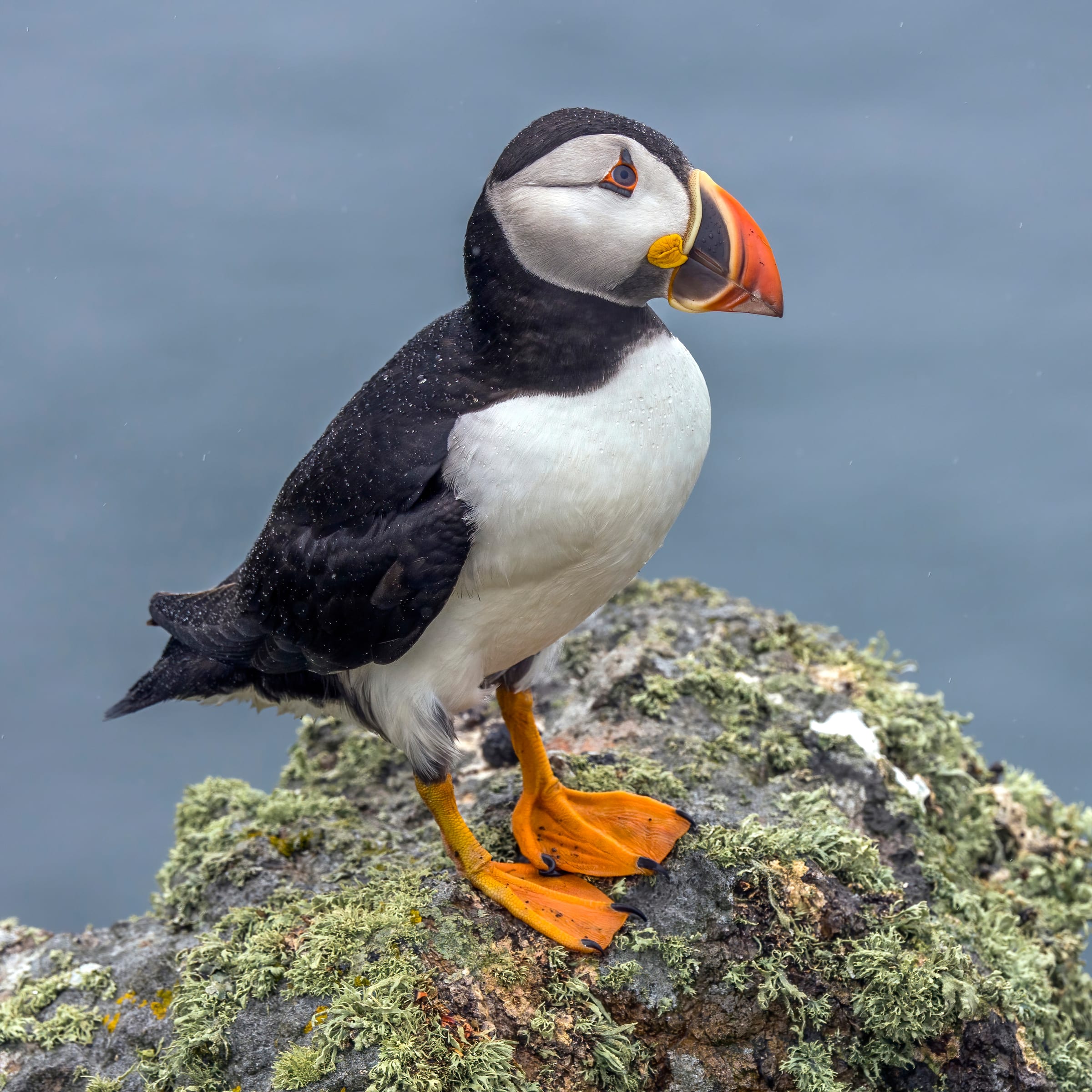
The Atlantic puffin (Fratercula arctica), also known as the common puffin, is a species of seabird in the auk family. It is the only puffin native to the Atlantic Ocean; two related species, the tufted puffin and the horned puffin, are found in the northeastern Pacific. The Atlantic puffin breeds in Russia, Iceland, Ireland, Britain, Norway, Greenland, Newfoundland and Labrador, Nova Scotia, and the Faroe Islands, and as far south as Maine in the west and France in the east. It is most commonly found in the Westman Islands, Iceland. Although it has a large population and a wide range, the species has declined rapidly, at least in parts of its range, resulting in it being rated as vulnerable by the IUCN. On land, it has the typical upright stance of an auk. At sea, it swims on the surface and feeds on zooplankton, small fish, and crabs, which it catches by diving underwater, using its wings for propulsion.
This puffin has a black crown and back, light grey cheek patches, and a white body and underparts. Its broad, boldly marked red-and-black beak and orange legs contrast with its plumage. It moults while at sea in the winter, and some of the brightly coloured facial characteristics are lost, with colour returning during the spring. The external appearances of the adult male and female are identical, though the male is usually slightly larger. The juvenile has similar plumage, but its cheek patches are dark grey. The juvenile does not have brightly coloured head ornamentation, its bill is narrower and is dark grey with a yellowish-brown tip, and its legs and feet are also dark. Puffins from northern populations are typically larger than those in the south, and these populations are generally considered to be a different subspecies.
A painted clown of the sea that flies underwater.
Description
The Atlantic puffin is sturdily built with a thick-set neck and short wings and tail. It is 28 to 30 cm (11 to 12 in) in length from the tip of its stout bill to its blunt-ended tail. Its wingspan is 47 to 63 cm (19 to 25 in) and on land it stands about 20 cm (8 in) high. The male is generally slightly larger than the female, but they are coloured alike. The forehead, crown, and nape are glossy black, as are the back, wings, and tail. A broad, black collar extends around the neck and throat. On each side of the head is a large, lozenge-shaped area of very pale grey. These face patches taper to a point and nearly meet at the back of the neck. The shape of the head creates a crease extending from the eye to the hindmost point of each patch, giving the appearance of a grey streak. The eyes look almost triangular because of a small, peaked area of horny blue-grey skin above them and a rectangular patch below. The irises are brown or very dark blue, and each has a red orbital ring. The underparts of the bird, the breast, belly, and under tail coverts, are white. By the end of the breeding season, the black plumage may have lost its shine or even taken on a slightly brown tinge. The legs are short and set well back on the body, giving the bird its upright stance when on land. Both legs and large webbed feet are bright orange, contrasting with the sharp, black claws.
Distribution
The Atlantic puffin is a bird of the colder waters of the North Atlantic Ocean. It breeds on the coasts of northwest Europe, the Arctic fringes, and eastern North America. More than 90% of the global population is found in Europe (4,770,000–5,780,000 pairs, equalling 9,550,000–11,600,000 adults) and colonies in Iceland alone are home to 60% of the world's Atlantic puffins. The largest colony in the western Atlantic (estimated at more than 260,000 pairs) can be found at the Witless Bay Ecological Reserve, south of St. John's, Newfoundland and Labrador. Other major breeding locations include the north and west coasts of Norway, the Faroe Islands, Shetland and Orkney, the west coast of Greenland, and the coasts of Newfoundland. Smaller-sized colonies are also found elsewhere in the British Isles, the Murmansk area of Russia, Novaya Zemlya, Spitzbergen, Labrador, Nova Scotia, and Maine. Islands seem particularly attractive to the birds for breeding as compared to mainland sites, likely to avoid predators.
Behaviour
Like many seabirds, the Atlantic puffin spends most of the year far from land in the open ocean and visits coastal areas only to breed. It is a sociable bird, and it usually breeds in large colonies.
Atlantic puffins lead solitary existences when out at sea, and this part of their lives has been little studied, as the task of finding even one bird on the vast ocean is formidable. When at sea, they bob about like a cork, propelling themselves through the water with powerful thrusts of their feet and keeping turned into the wind, even when resting and apparently asleep. They spend much time each day preening to keep their plumage in order and spread oil from their preen glands. Their downy under plumage remains dry and provides thermal insulation. In common with other seabirds, their upper surface is black and underside white. This provides camouflage, with aerial predators unable to locate the birds against the dark, watery background, and underwater attackers fail to notice them as they blend in with the bright sky above the waves.
Relationship with humans
The Atlantic puffin has an extensive range that covers over 1,620,000 km2 (625,000 sq mi) and Europe, which holds more than 90% of the global population, is home to 4,770,000–5,780,000 pairs (equalling 9,550,000–11,600,000 adults). In 2015, the International Union for Conservation of Nature upgraded its status from "least concern" to "vulnerable". This was caused by a review that revealed a rapid and ongoing population decline in its European range. Trends elsewhere are unknown, although, in 2018, the total global population was estimated at 12–14 million adult individuals. Some of the causes of population decline may be increased predation by gulls and skuas, the introduction of rats, cats, dogs, and foxes onto some islands used for nesting, contamination by toxic residues, drowning in fishing nets, declining food supplies, and climate change. On the island of Lundy, the number of puffins decreased from 3,500 pairs in 1939 to 10 pairs in 2000. This was mainly due to the rats that had proliferated on the island and were eating eggs and young chicks. Following the elimination of the rats, populations were expected to recover, and in 2005, a juvenile was seen, believed to be the first chick raised on the island for 30 years. In 2018, BirdLife International reported that the Atlantic puffin was threatened with extinction.
Taxonomy and etymology
The Atlantic puffin is a species of seabird in the order Charadriiformes. It is in the auk family, Alcidae, which includes the guillemots, typical auks, murrelets, auklets, puffins, and the razorbill. The rhinoceros auklet (Cerorhinca monocerata) and the puffins are closely related, together composing the tribe Fraterculini. The Atlantic puffin is the only species in the genus Fratercula to occur in the Atlantic Ocean. Two other species are known from the northeast Pacific, the tufted puffin (Fratercula cirrhata) and the horned puffin (Fratercula corniculata), the latter being the closest relative of the Atlantic puffin.