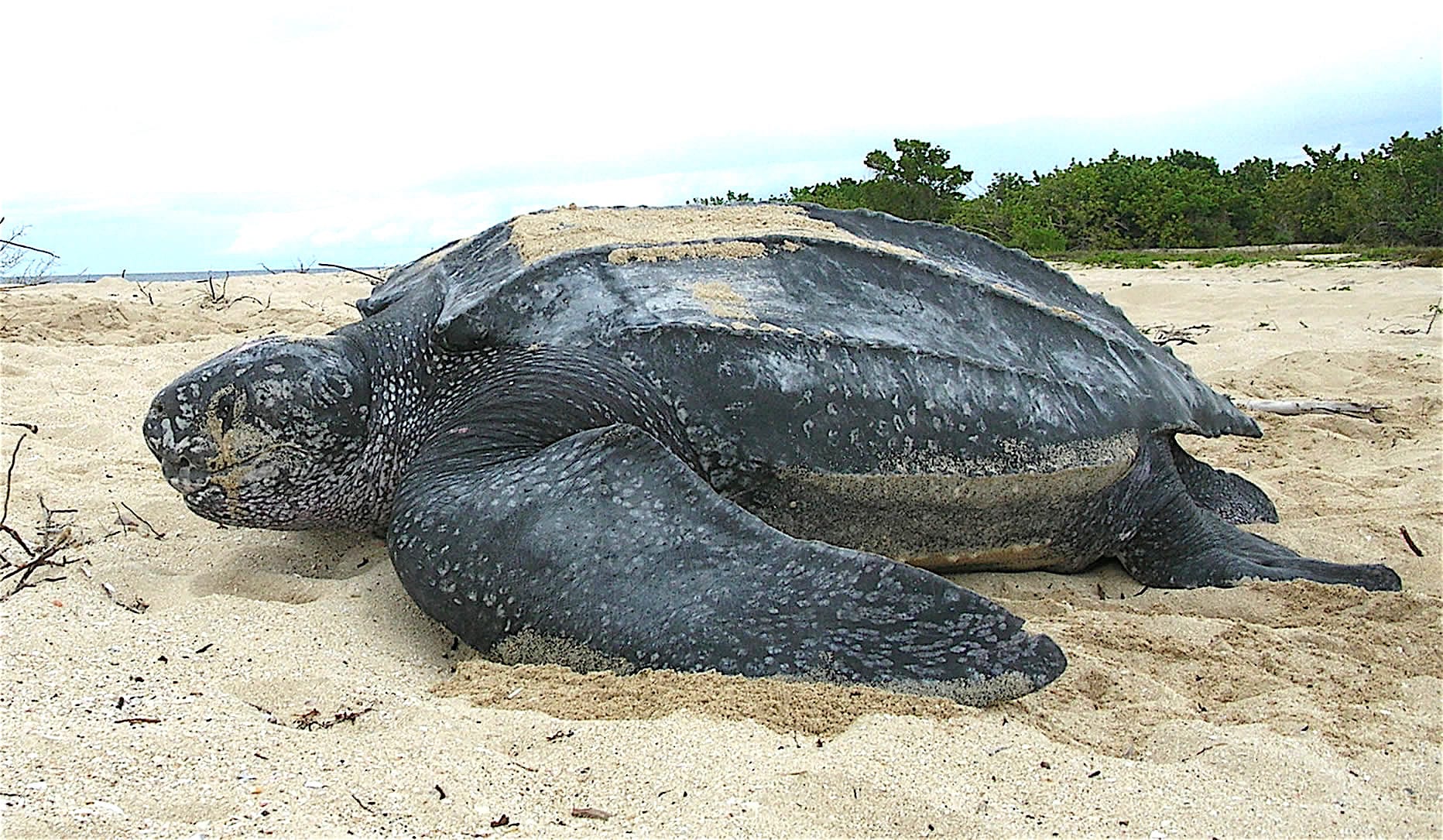
The leatherback sea turtle (Dermochelys coriacea), sometimes called the lute turtle, leathery turtle or simply the luth, is a large species of sea turtle. The largest of all living turtles and the heaviest non-crocodilian reptile, it reaches lengths of up to 2.7 metres (8 ft 10 in) and weights of 500 kilograms (1,100 lb). It is the only living species in the genus Dermochelys and family Dermochelyidae. It can easily be differentiated from other modern sea turtles by its lack of a bony shell; instead, its carapace is covered by oily flesh and flexible, leather-like skin, for which it is named. Leatherback turtles have a global range, although there are multiple distinct subpopulations. The species as a whole is considered vulnerable, and some of its subpopulations are critically endangered.
Crosses oceans on a single mission: a jellyfish dinner.
Anatomy and physiology
Leatherback turtles have the most hydrodynamic body of any sea turtle, with a large, teardrop-shaped body. A large pair of front flippers powers the turtles through the water. Like other sea turtles, the leatherback has flattened forelimbs adapted for swimming in the open ocean. Claws are absent from both pairs of flippers. The leatherback's flippers are the largest in proportion to its body among extant sea turtles. Leatherback's front flippers can grow up to 2.7 m (8.9 ft) from tip to tip in large specimens, the largest flippers (even in comparison to its body) of any sea turtle.
Distribution
The leatherback turtle is a species with a cosmopolitan global range. Of all the extant sea turtle species, D. coriacea has the widest distribution, reaching as far north as Alaska and Norway and as far south as Cape Agulhas in Africa and the southernmost tip of New Zealand. The leatherback is found in all tropical and subtropical oceans, and its range extends well into the Arctic Circle.
The three major, genetically distinct populations occur in the Atlantic, eastern Pacific, and western Pacific Oceans. While nesting beaches have been identified in the region, leatherback populations in the Indian Ocean remain generally unassessed and unevaluated.
Recent estimates of global nesting populations are that 26,000 to 43,000 females nest annually, which is a dramatic decline from the 115,000 estimated in 1980.
Ecology and life history
Leatherback sea turtles can be found primarily in the open ocean. Scientists tracked a leatherback turtle that swam from Jen Womom beach of Tambrauw Regency in West Papua of Indonesia to the US in a 20,000 km (12,000 mi) foraging journey over a period of 647 days. Leatherbacks follow their jellyfish prey throughout the day, resulting in turtles "preferring" deeper water in the daytime, and shallower water at night (when the jellyfish rise up the water column). This hunting strategy often places turtles in very frigid waters. One individual was found actively hunting in waters where temperatures were as low as 0.4 °C (32.7 °F). Following each foraging dive, the leatherback would return to warmer (17.5 °C (63.5 °F)) surface waters to regain body heat before continuing to dive into near-freezing waters. Leatherback turtles are known to pursue prey deeper than 1000 m—beyond the physiological limits of all other diving tetrapods except for beaked whales and sperm whales.
Their favored breeding beaches are mainland sites facing the deep water, and they seem to avoid those sites protected by coral reefs.
Conservation
Leatherback turtles have few natural predators once they mature; they are most vulnerable to predation in their early life stages. Birds, small mammals, and other opportunists dig up the nests of turtles and consume eggs. Shorebirds and crustaceans prey on the hatchlings scrambling for the sea. Once they enter the water, they become prey to predatory fish and cephalopods.
Leatherbacks have slightly fewer human-related threats than other sea turtle species, however, turtle-fishery interactions may play a larger role than previously recognized. Their flesh contains too much oil and fat to be considered palatable, reducing the demand. However, human activity still endangers leatherback turtles in direct and indirect ways. Directly, a few are caught for their meat by subsistence fisheries. Nests are raided by humans in places such as Southeast Asia. In the state of Florida, there have been 603 leatherback strandings between 1980 and 2014. Almost one-quarter (23.5%) of leatherback strandings are due to vessel-strike injuries, which is the highest cause of strandings.
Importance to humans
People around the world still harvest sea turtle eggs. Asian exploitation of turtle nests has been cited as the most significant factor for the species' global population decline. In Southeast Asia, egg harvesting in countries such as Thailand and Malaysia has led to a near-total collapse of local nesting populations. In Malaysia, where the turtle is practically locally extinct, the eggs are considered a delicacy. In the Caribbean, some cultures consider the eggs to be aphrodisiacs.
They are also a major jellyfish predator, which helps keep populations in check. This bears importance to humans, as jellyfish diets consist largely of larval fish, the adults of which are commercially fished by humans.
The turtle is known to be of cultural significance to some Indigenous peoples. The Seri people, from the Mexican state of Sonora, find the leatherback sea turtle culturally significant because they believe it is one of their five main creators. They devote ceremonies and fiestas to the turtle when one is caught and then released back into the environment. The Seri people have noticed the drastic decline in turtle populations over the years and created a conservation movement to help this. The group, made up of both youth and elders from the tribe, is called Grupo Tortuguero Comaac. They use both traditional ecological knowledge and Western technology to help manage the turtle populations and protect the turtle's natural environment.