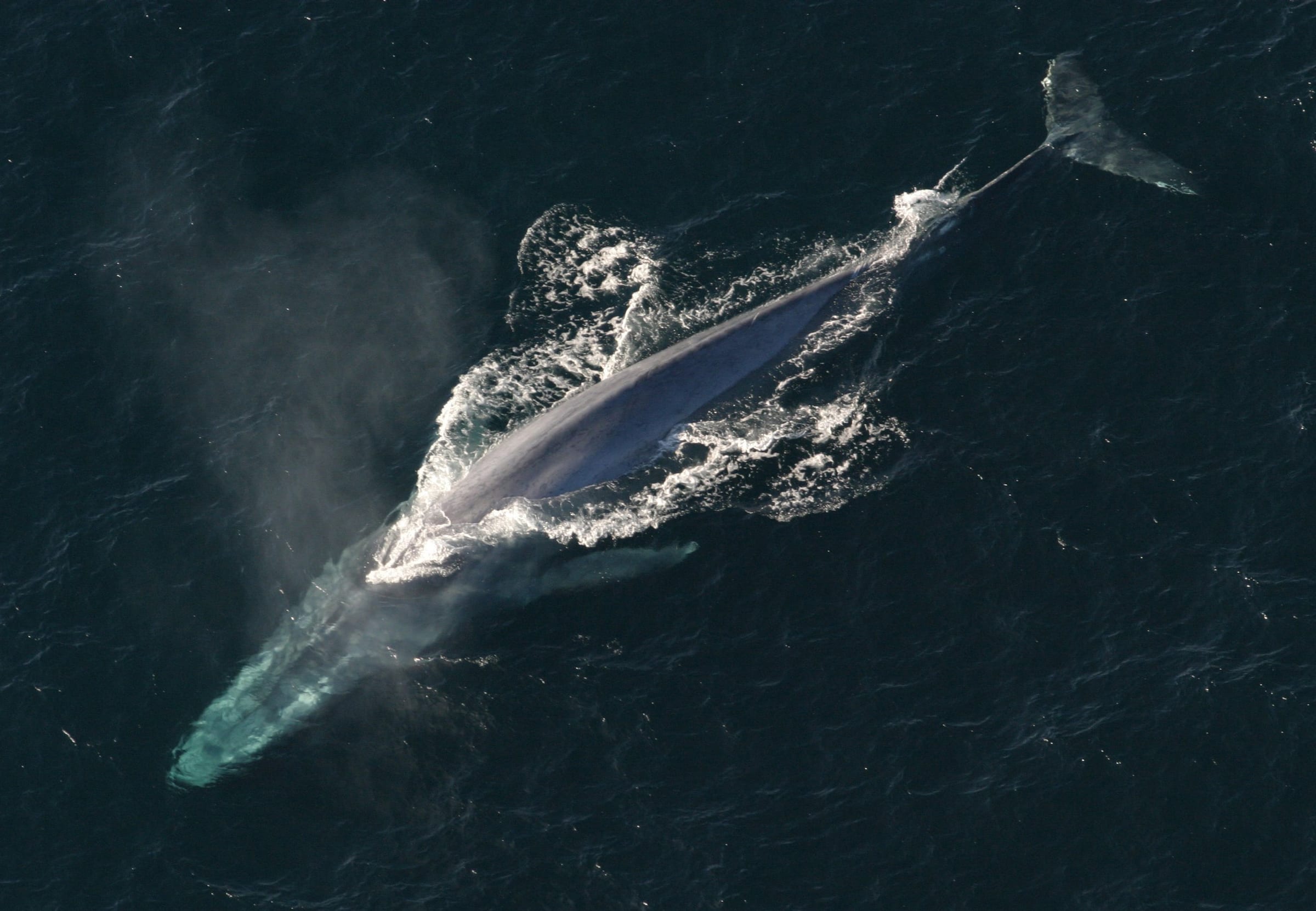
The blue whale (Balaenoptera musculus) is a species of baleen whale and the largest marine mammal in the rorqual family Balaenopteridae. Reaching a maximum confirmed length of 29.9–30.5 m (98–100 ft) and weighing up to 190–200 t (190–200 long tons; 210–220 short tons), it is the largest animal known to have ever existed. The blue whale's long and slender body can be of various shades of greyish-blue on its upper surface and somewhat lighter underneath. Four subspecies are recognized: B. m. musculus in the North Atlantic and North Pacific, B. m. intermedia in the Southern Ocean, B. m. brevicauda (the pygmy blue whale) in the Indian Ocean and South Pacific Ocean, and B. m. indica in the Northern Indian Ocean. There is a population in the waters off Chile that may constitute a fifth subspecies.
In general, blue whale populations migrate between their summer feeding areas near the poles and their winter breeding grounds near the tropics. There is also evidence of year-round residencies, and partial or age- and sex-based migration. Blue whales are filter feeders; their diet consists almost exclusively of krill. They are generally solitary or gather in small groups, and have no well-defined social structure other than mother–calf bonds. Blue whales vocalize, with a fundamental frequency ranging from 8 to 25 Hz; their vocalizations may vary by region, season, behavior, and time of day.
The largest animal that has ever lived on this planet.
Description
The blue whale is a slender-bodied cetacean with a broad U-shaped head; thin, elongated flippers; a small sickle-shaped dorsal fin located close to the tail, and a large tail stock at the root of the wide and thin flukes. The upper jaw is lined with 70–400 black baleen plates less than 1 m (3.3 ft) in length. The throat region has 60–88 grooves which allows the skin to expand during feeding. It has two blowholes that can squirt 9.1–12 meters (30–39 ft) up in the air. The skin has a mottled grayish-blue coloration, appearing blue underwater. The mottling patterns near the dorsal fin vary between individuals. The underbelly has lighter pigmentation and can appear yellowish due to diatoms in the water, which historically earned them the nickname "sulphur bottom".
Behavior and ecology
The blue whale is usually solitary, but can be found in pairs. When productivity is high enough, blue whales can be seen in gatherings of more than 50 individuals. Populations may go on long migrations, traveling to their summer feeding grounds towards the poles and then heading to their winter breeding grounds in more equatorial waters. The animals appear to use memory to locate the best feeding areas. There is evidence of alternative strategies, such as year-round residency, and partial (where only some individuals migrate) or age/sex-based migration. Some whales have been recorded feeding in breeding grounds. Blue whale typically swim at 2–8 km/h (1.2–5.0 mph) but may swim faster at 32–48 km/h (20–30 mph) during encounters with boats, predators or other individuals. However, it is unclear whether the blue whale can actually reach a speed of 10.9 m/s (39 km/h; 24 mph), and the most reliably reported maximum speed was 7.5 m/s (27 km/h; 17 mph). The maximum speed derived from satellite tracking data was 5.3 m/s (19 km/h; 12 mph). Their massive size limits their ability to breach.
Conservation
The global blue whale population is estimated to be 5,000–15,000 mature individuals and 10,000–25,000 total as of 2015. By comparison, there were at least 140,000 mature whales in 1926. There are an estimated total of 1,000–3,000 whales in the North Atlantic, 3,000–5,000 in the North Pacific, and 5,000–8,000 in the Antarctic. There are possibly 1,000–3,000 whales in the eastern South Pacific while the pygmy blue whale may number 2,000–5,000 individuals. Blue whales have been protected in areas of the Southern Hemisphere since 1939. In 1955, they were given complete protection in the North Atlantic under the International Convention for the Regulation of Whaling; this protection was extended to the Antarctic in 1965 and the North Pacific in 1966. The protected status of North Atlantic blue whales was not recognized by Iceland until 1960. In the United States, the species is protected under the Endangered Species Act.
Blue whales are formally classified as endangered under both the U.S. Endangered Species Act and the IUCN Red List. They are also listed on Appendix I under the Convention on International Trade in Endangered Species of Wild Fauna and Flora (CITES) and the Convention on the Conservation of Migratory Species of Wild Animals. Although, for some populations, there is not enough information on current abundance trends (e.g., pygmy blue whales), others are critically endangered (e.g., Antarctic blue whales).