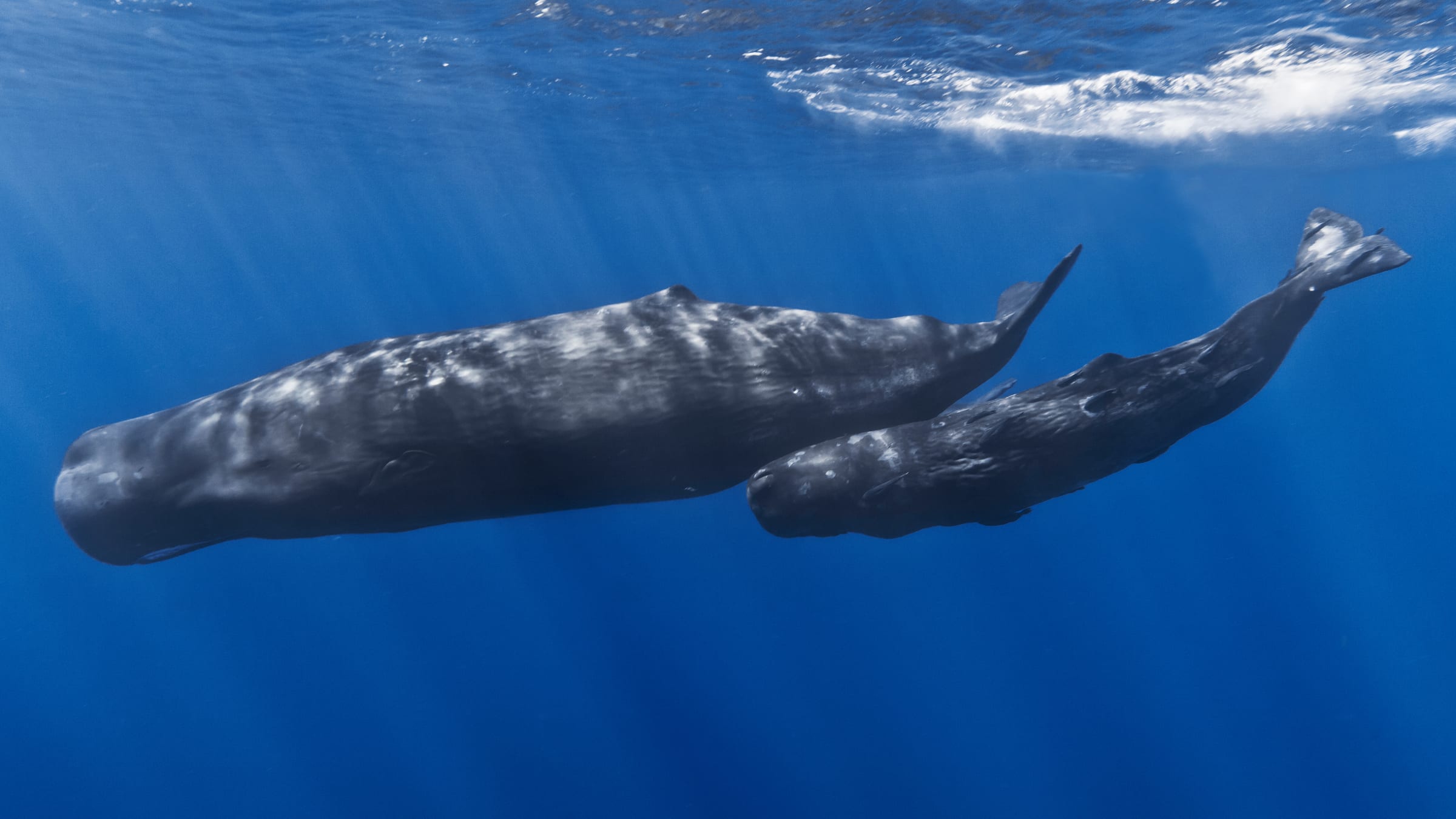
The sperm whale or cachalot (Physeter macrocephalus) is the largest of the toothed whales and the largest toothed predator. It is the only living member of the genus Physeter and one of three extant species in the sperm whale superfamily Physeteroidea, along with the pygmy sperm whale and dwarf sperm whale of the genus Kogia.
The sperm whale is a pelagic mammal with a worldwide range, and will migrate seasonally for feeding and breeding. Females and young males live together in groups, while mature males (bulls) live solitary lives outside of the mating season. The females cooperate to protect and nurse their young. Females give birth every four to twenty years and care for the calves for more than a decade. A mature, healthy sperm whale has no natural predators, although calves and weakened adults are sometimes killed by pods of orcas.
Dives two kilometres into the dark to wrestle giant squid.
Ecology
Sperm whales are among the most cosmopolitan species. They prefer ice-free waters over 1,000 metres (3,300 ft) deep. Although both sexes range through temperate and tropical oceans and seas, only adult males populate higher latitudes. Among several regions, such as along coastal waters of southern Australia, sperm whales have been considered to be locally extinct.
They are relatively abundant from the poles to the equator and are found in all the oceans. They inhabit the Mediterranean Sea, but not the Black Sea, while their presence in the Red Sea is uncertain. The shallow entrances to both the Black Sea and the Red Sea may account for their absence. The Black Sea's lower layers are also anoxic and contain high concentrations of sulphur compounds such as hydrogen sulphide. The first ever sighting off the coast of Pakistan was made in 2017. The first ever record off the west coast of the Korean Peninsula (Yellow Sea) was made in 2005. followed by one near Ganghwa Island in 2009.
Life cycle
Sperm whales can live 70 years or more. The oldest recorded living sperm whale was 77–80 years old. They are a prime example of a species that has been K-selected, meaning their reproductive strategy is associated with stable environmental conditions and comprises a low birth rate, significant parental aid to offspring, slow maturation, and high longevity.
How they choose mates has not been definitively determined. Bulls will fight with each other over females, and males will mate with multiple females, making them polygynous, but they do not dominate the group as in a harem. Bulls do not provide paternal care to their offspring but rather play a fatherly role to younger bulls to show dominance.
Vocalization complex
After Valentine Worthington and William E. Schevill confirmed the existence of sperm whale vocalization, further studies found that sperm whales are capable of emitting sounds at a source level of 236 decibels – making the sperm whale the loudest animal in the world.
When echolocating, the sperm whale emits a directionally focused beam of broadband clicks. Clicks are generated by forcing air through a pair of phonic lips (also known as "monkey lips" or "museau de singe") at the front end of the nose, just below the blowhole. The sound then travels backwards along the length of the nose through the spermaceti organ. Most of the sound energy is then reflected off the frontal sac at the cranium and into the melon, whose lens-like structure focuses it. Some of the sound will reflect back into the spermaceti organ and back towards the front of the whale's nose, where it will be reflected through the spermaceti organ a third time. This back and forth reflection which happens on the scale of a few milliseconds creates a multi-pulse click structure.
Biology
The sperm whale is the largest toothed whale and is among the most sexually dimorphic of all cetaceans. Both sexes are about the same size at birth, but mature males are typically 30% to 50% longer and three times as massive as females.
Newborn sperm whales are usually between 3.5 and 4.5 meters (11 and 15 ft) long. Female sperm whales are sexually mature at 8 to 9 meters (26 to 30 ft) in length, whilst males are sexually mature at 11 to 12 meters (36 to 39 ft). Female sperm whales are physically mature at about 10.6 to 11 meters (35 to 36 ft) in length and generally do not achieve lengths greater than 12 metres (39 ft). The largest female sperm whale measured up to 12.3–12.5 meters (40–41 ft) long, and an individual of such size would have weighed about 17 to 24 tonnes (19 to 26 short tons). Male sperm whales are physically mature at about 15 to 16 meters (49 to 52 ft) in length, and larger males can generally achieve 18 to 19 meters (59 to 62 ft). A male sperm whale measuring 18 meters (59 ft) in length is estimated to have weighed 57 tonnes (56 long tons; 63 short tons). By contrast, the second largest toothed whale (Baird's beaked whale) measures up to 12.8–13 meters (42–43 ft) and weighs up to 14 tonnes (15 short tons).
Social behaviour
Like elephants, females and their young live in matriarchal groups called pods, while bulls live apart. Bulls sometimes form loose bachelor groups with other males of similar age and size. As they grow older, they typically live solitary lives, only returning to the pod to socialize or to breed. Bulls have beached themselves together, suggesting a degree of cooperation which is not yet fully understood. The whales rarely, if ever, leave their group.
A social unit is a group of sperm whales who live and travel together over a period of years. Individuals rarely, if ever, join or leave a social unit. There is a huge variance in the size of social units. They are most commonly between six and nine individuals in size but can have more than twenty. Unlike orcas, sperm whales within a social unit show no significant tendency to associate with their genetic relatives. Females and calves spend about three-quarters of their time foraging and a quarter of their time socializing. Socializing usually takes place in the afternoon.
When sperm whales socialize, they emit complex patterns of clicks called codas. They will spend much of the time rubbing against each other. Tracking of diving whales suggests that groups engage in herding of prey, similar to bait balls created by other species, though the research needs to be confirmed by tracking the prey.