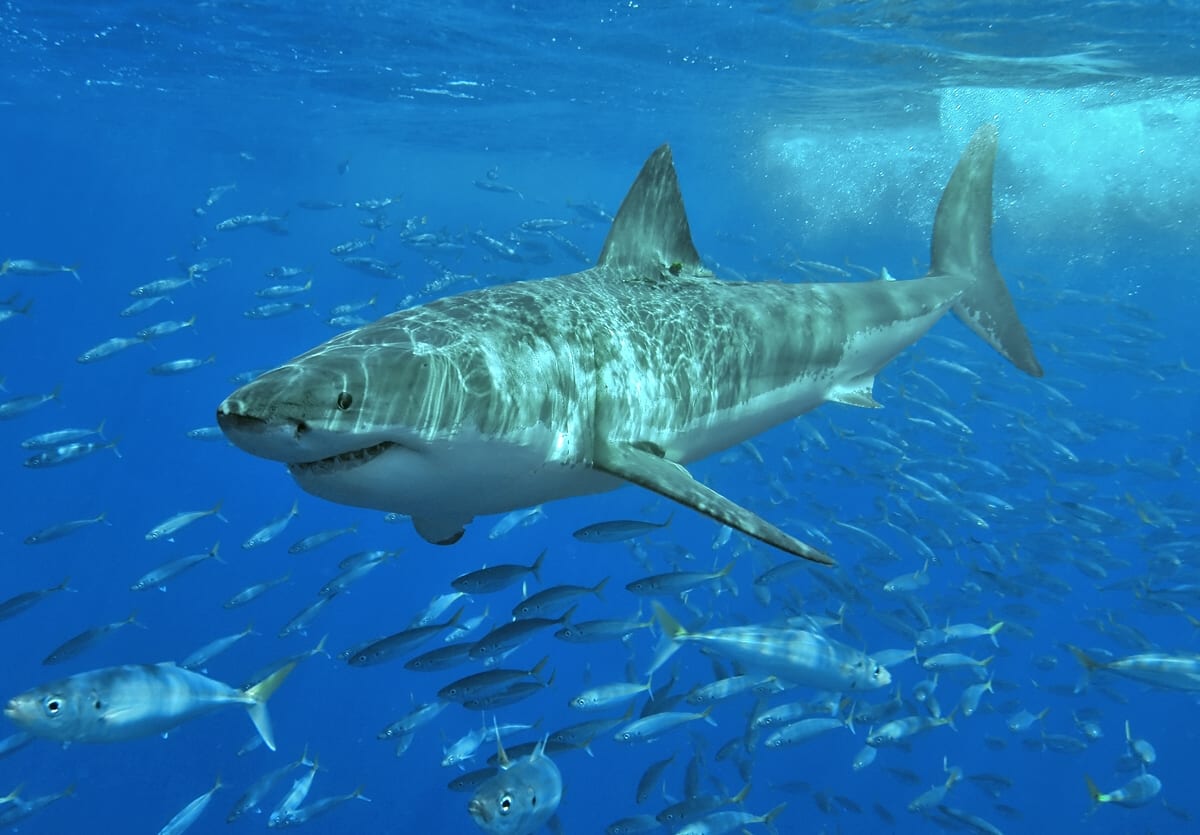
The great white shark (Carcharodon carcharias), also known as the white shark, white pointer, or great white, is a large shark. It is closely related to the mako sharks, the porbeagle, and the salmon shark. It is a robustly built species with a grayish upperside and a white underside. The white shark is one of the largest living shark and fish species, though it is still smaller than the whale shark and basking shark. It has about 300 triangular, serrated teeth that are continuously replaced. Its massive, fatty liver can reach over a quarter of its body weight, providing buoyancy and storing energy. The species is partially warm-blooded, an adaptation that allows it to remain active in colder waters.
White sharks inhabit tropical and temperate ocean waters around the world and can be found both near coasts and in the open ocean. Populations are most concentrated at the Pacific and Atlantic of North America and in the waters of southern Africa and Oceania. They are a highly migratory species, traveling between the coast and the open ocean and even between continents. The white shark preys on marine mammals such as seals and dolphins, as well as squid and fish, including other sharks. It also scavenges whale carcasses. Though normally an apex predator, the species is sometimes preyed on by orcas. White sharks are generally solitary, but may gather in aggregations, particularly at feeding sites. They may communicate and establish dominance hierarchies with body language. The species reproduces with pups hatching from eggs inside the female before being born live. Juvenile white sharks typically inhabit shallower water and are limited to feeding on smaller prey.
Three hundred serrated teeth and a sense of smell from miles away.
Appearance and anatomy
The white shark has a stocky, torpedo-shaped body with a short, cone-shaped snout. Its long gill slits do not reach around the head. It has a large triangular first dorsal fin, which partly lines up with the pectoral fins, and a tiny second dorsal fin. The tail fin has two lobes of similar size and a single ridge or keel, and the anal fin is tiny. The white shark has a countershaded coloration for camouflage; being dark on top, usually blue-gray or gray-brown, with a white underside. It also has black tips on the underside of the pectoral fins. There is evidence that the species can change pigments, adding dark pigment or melanin to blotches of white over the course of months. The skin is covered in dermal denticles (tooth-like scales), which are proportionally smaller than in other sharks and have a three-to-five-ridged surface, with each ridge having tips that point backwards.
The white shark is one of the largest living sharks and fish, but is smaller than the whale shark and basking shark. Female white sharks are mature at 4.6–4.9 m (15–16 ft) while males are mature at 3.4–4.0 m (11–13 ft). Females weigh 1,000–1,900 kg (2,200–4,200 lb) while males weigh 680–1,000 kg (1,500–2,200 lb).
Distribution and habitat
White sharks range from tropical to temperate and even colder waters around the world, with major populations in the northwestern and northeastern Pacific, western North Atlantic, the Mediterranean, southern African waters and Oceania. It is also present near the coasts of South America but appears to be uncommon. Shark expert Greg Skomal lists the Farallon Islands, California; Guadalupe Island, Mexico; Cape Cod, Massachusetts; Western Cape, South Africa; Neptune Islands, Australia; and both Stewart Island and the Chatham Islands, New Zealand, as major coastal feeding aggregations. Researchers have also identified an offshore feeding aggregation between western North America and Hawaii dubbed the White Shark Café.
White sharks can be found both along the coast and in the open ocean. They are typically close to the surface but may dive to depths of up to 1,300 m (4,300 ft). Deeper dives are more common in the open ocean. Coastal habitats used include nearshore archipelagos, offshore reefs, banks and shoals, and headlands. A 2018 study indicated that white sharks will congregate in patches of warm water in the open ocean. Juvenile white sharks are more limited to shallow coastal waters with temperatures between 14 and 24 °C (57 and 75 °F). Increased sightings of young sharks in areas where they were not previously common, such as Monterey Bay on the central California coast, suggest climate change may be forcing juveniles closer to the poles.
Behavior and ecology
White sharks are estimated to swim 2.88–4.86 km/h (1.79–3.02 mph) but can sprint up to 24.12 km/h (14.99 mph). One individual was recorded cruising at a sustained speed of 4.7 km/h (2.9 mph) while migrating, which is fast for a shark and more similar to fast-swimming tuna. White sharks display various surface behaviors. These include spyhopping (poking head out of the surface) to observe an object above the water, as well as 'repetitive aerial gaping' where a spyhopping shark repeatedly gapes its mouth while belly-up, possibly as a sign of frustration after missing a bait. How they sleep is not well understood. At night, one individual was recorded swimming slowly in one direction along a current with its mouth open.
Conservation
In 2018, the International Union for Conservation of Nature (IUCN) assessed the white shark as vulnerable worldwide, citing a population decline of 30–49% since approximately 1859. The species was further described as "moderately depleted" in 2021. The biggest threats to white sharks are accidental catching in fishing nets and the use of shark control measures—such as nets and traps—near beaches in Australia and South Africa. They nevertheless maintain a high survival rate when released from such gear. To regulate international trade, the species is listed under CITES Appendix II, requiring permits for the exchange of any specimens or parts. While a 2025 study estimated the global population at a minimum of roughly 5,800 individuals, co-author Gavin Naylor suggests the actual figure may be closer to 20,000.
Relationship with humans
Prior to the 1970s, the white shark as a species was known mostly to biologists and fishermen. The 1971 documentary Blue Water, White Death is credited with introducing the species to the public. Its popularity grew further following Peter Benchley's 1974 novel Jaws, and its 1975 film adaptation, directed by Steven Spielberg. Both works established the species' image as a dangerous man-eater, a characterization Benchley later regretted.
Compared to other fish, the white shark was not a significant commercial species. Although its meat was considered edible, the difficulty of capture made commercial fishing impractical. However, its size and reputation made it a popular target for sport fishing. Typically, sharks were lured with chum (ground bait) before being presented with a hook. Port Lincoln, South Australia, became a hub for white shark fishing in the 1950s. In 1959, a fisherman named Alf Dean caught a 1,208 kg (2,663 lb) shark there, setting the record for the largest fish caught by rod and reel. A larger shark caught in Streaky Bay was later disqualified due to the bait used.