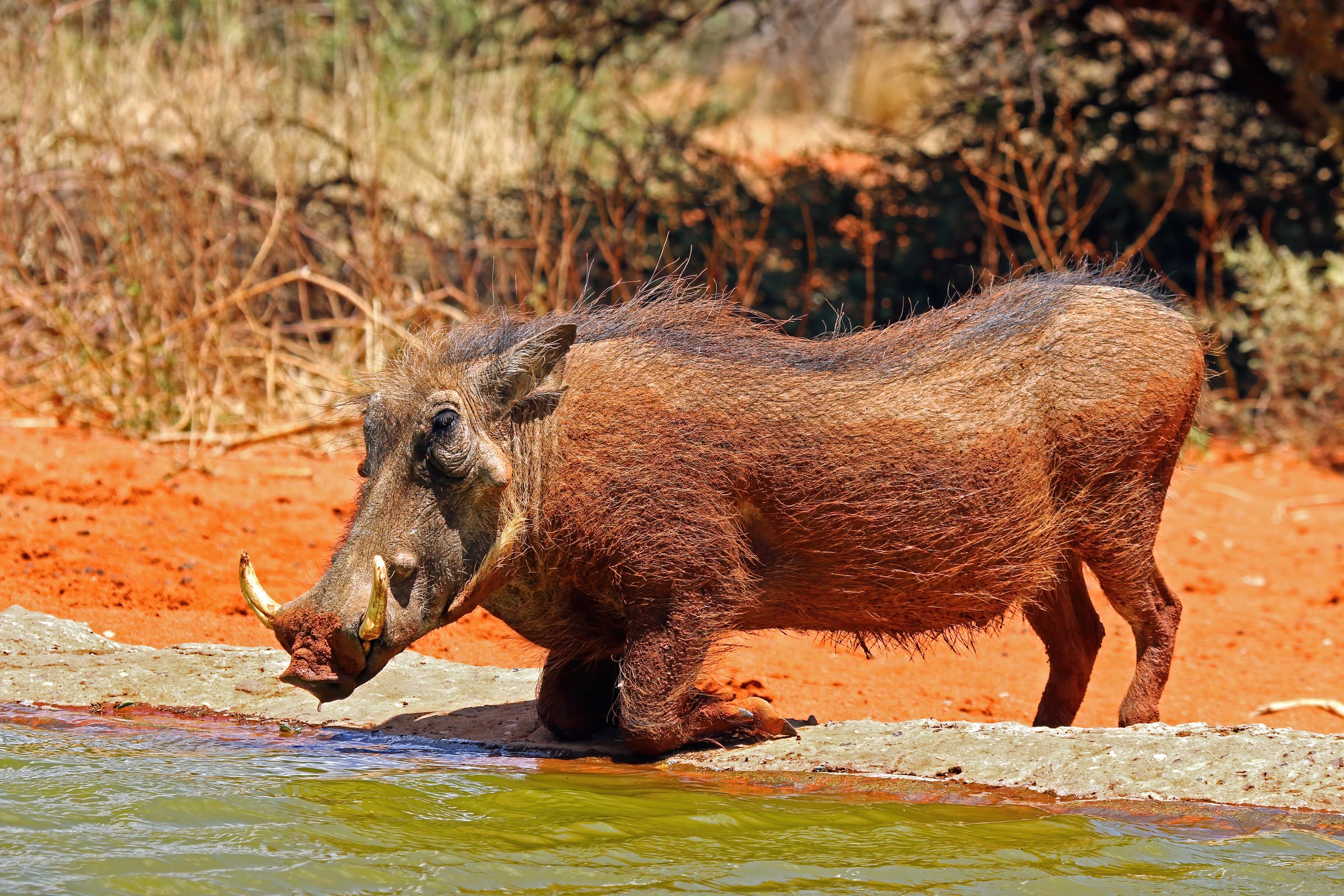
The common warthog (Phacochoerus africanus) is a wild member of the pig family (Suidae) found in grassland, savanna, and woodland in sub-Saharan Africa. In the past, it was commonly treated as a subspecies of P. aethiopicus, but today that scientific name is restricted to the desert warthog of northern Kenya, Somalia, and eastern Ethiopia.
Runs backwards into burrows so its tusks face the enemy.
Description
The common warthog is a medium-sized species, with a head-and-body length ranging from 0.9 to 1.5 m (2 ft 11 in to 4 ft 11 in), and shoulder height from 63.5 to 85 cm (25.0 to 33.5 in). Females, at 45 to 75 kg (99 to 165 lb), are smaller and lighter than males, at 60 to 150 kg (130 to 330 lb). A warthog is identifiable by the two pairs of tusks protruding from the mouth and curving upwards. The lower pair, which is far shorter than the upper pair, becomes razor-sharp by rubbing against the upper pair every time the mouth is opened and closed. The upper canine teeth can grow to 25.5 cm (10.0 in) long and have a wide elliptical cross section, being about 4.5 cm (1.8 in) deep and 2.5 cm (0.98 in) wide. A tusk will curve 90° or more from the root, and will not lie flat on a table, as it curves somewhat backwards as it grows. The tusks are not used for digging, but are used for combat with other hogs and in defense against predators – the lower set can inflict severe wounds.
Common warthog ivory is taken from the constantly growing canine teeth. The tusks, particularly the upper set, work in much the same way as elephant tusks with all designs scaled down. Tusks are carved predominantly for the tourist trade in eastern and southern Africa.
Ecology
The common warthog is the only pig species that has adapted to grazing and savanna habitats. Its diet is omnivorous, composed of grasses, roots, berries and other fruits, bark, fungi, insects, eggs and carrion. The diet is seasonably variable, depending on availability of different food items. During the wet seasons, warthogs graze on short perennial grasses. During the dry seasons, they subsist on bulbs, rhizomes, and nutritious roots.
Warthogs are powerful diggers, using both their snouts and feet. When feeding, they often bend their front feet backwards and move around on the wrists. Calloused pads that protect the wrists during such movement form early in the development of the fetus. Although they can dig their own burrows, they often occupy abandoned burrows of aardvarks and other animals. The common warthog commonly reverses into burrows, with its head facing the opening and ready to burst out if necessary. Common warthogs will wallow in mud to cope with high temperatures and huddle together to cope with low temperatures.
Conservation status
As of 1999, the common warthog population in southern Africa was estimated to be about 250,000. Typical densities range between 1 and 10 km2 (0.39 and 3.86 sq mi) in protected areas, but local densities of 77 km2 (30 sq mi) were found on short grass in Nakuru National Park in Kenya. The species is susceptible to drought and hunting (especially with dogs), which may result in localized extinctions. The common warthog is present in numerous protected areas across its extensive range.
As an invasive species
In 2020, it was noted that a population of warthogs, descendants of escaped individuals from game ranches, were running free in southern Texas in the United States.
Social behavior and reproduction
Common warthogs are not territorial, but instead occupy a home range. Common warthogs live in groups called sounders. Females live in sounders with their young and with other females. Females tend to stay in their natal groups, while males leave, but stay within the home range. Subadult males associate in bachelor groups, but males live alone when they become adults. Adult males only join sounders with estrous females. Warthogs have two facial glands: the tusk gland and the sebaceous gland. Common warthogs of both sexes begin to mark around six to seven months old. Males tend to mark more than females. They mark sleeping and feeding areas and waterholes. Common warthogs use tusk marking for courtship, for antagonistic behaviors, and to establish status.