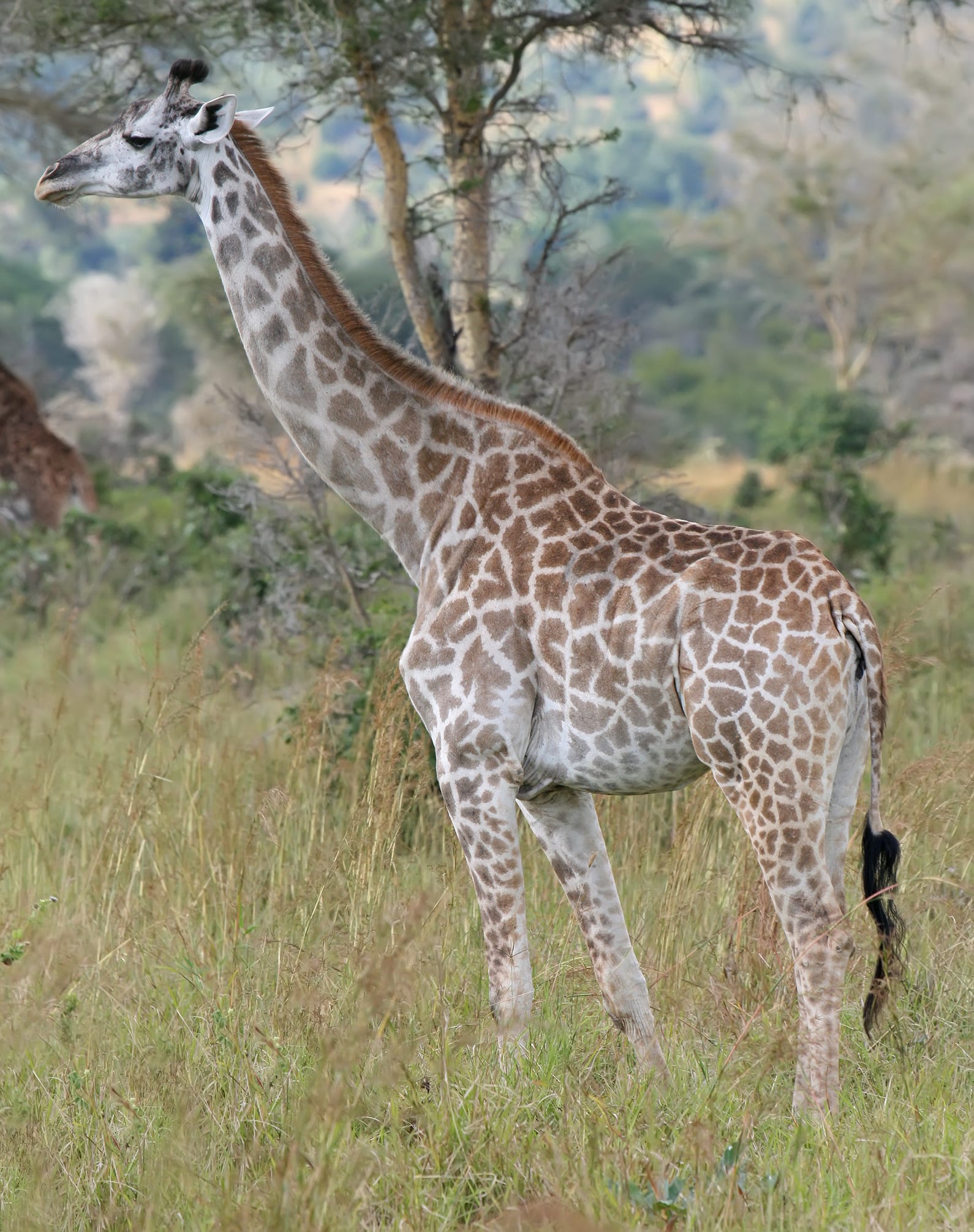
Giraffes (genus Giraffa) are large African hoofed mammals. They are the tallest living terrestrial animals and the largest ruminants on Earth. They are classified under the family Giraffidae, along with their closest extant relative, the okapi. Traditionally, giraffes have been thought of as one species, Giraffa camelopardalis, with nine subspecies. Most recently, researchers proposed dividing them into four extant species, with seven subspecies, which can be distinguished morphologically by their fur coat patterns. Six valid extinct species of Giraffa are known from the fossil record.
The distinguishing characteristics of giraffes are their extremely long neck and legs, horn-like ossicones, and spotted coat patterns. Their scattered range extends from Chad in the north to South Africa in the south and from Niger in the west to Somalia in the east. Giraffes usually inhabit savannahs and woodlands. Their food source is leaves, fruits, and flowers of woody plants, primarily acacia species, which they browse at heights most other ground-based herbivores cannot reach. Lions, leopards, spotted hyenas, and African wild dogs may prey upon giraffes. Giraffes live in herds of related females and their offspring or bachelor herds of unrelated adult males but are gregarious and may gather in large groups. Males establish social hierarchies through "necking", combat bouts in which they use the neck as a weapon. Dominant males gain mating access to females, which bear sole responsibility for rearing the young.
Walks the savanna at five and a half metres tall.
Anatomy
Fully grown giraffes stand 4.3–5.7 m (14–19 ft) tall, with males taller than females. The average weight is 1,192 kg (2,628 lb) for an adult male and 828 kg (1,825 lb) for an adult female. Despite its long neck and legs, its body is relatively short. The skin is mostly gray or tan, and can reach a thickness of 20 mm (0.79 in). The 80–100 cm (31–39 in) long tail ends in a long, dark tuft of hair and is used as a defense against insects.
The coat has dark blotches or patches, which can be orange, chestnut, brown, or nearly black, surrounded by light hair, usually white or cream coloured. Male giraffes become darker as they grow old. The coat pattern has been claimed to serve as camouflage in the light and shade patterns of savannah woodlands. When standing among trees and bushes, they are hard to see at even a few metres distance. However, adult giraffes move about to gain the best view of an approaching predator, relying on their size and ability to defend themselves rather than on camouflage, which may be more important for calves. Each giraffe has a unique coat pattern. Calves inherit some coat pattern traits from their mothers, and variation in some spot traits is correlated with calf survival. The skin under the blotches may regulate the animal's body temperature, being sites for complex blood vessel systems and large sweat glands. Spotless or solid-colour giraffes are very rare, but have been observed.
Behaviour and ecology
Giraffes usually inhabit savannahs and open woodlands. They prefer areas dominated by Acacieae, Commiphora, Combretum and Terminalia trees over Brachystegia which are more densely spaced. The Angolan giraffe can be found in desert environments. Giraffes browse on the twigs of trees, preferring those of the subfamily Acacieae and the genera Commiphora and Terminalia, which are important sources of calcium and protein to sustain the giraffe's growth rate. They also feed on shrubs, grass and fruit. A giraffe eats around 34 kg (75 lb) of plant matter daily. When stressed, giraffes may chew on large branches, stripping them of bark. Giraffes are also recorded to chew old bones.
During the wet season, food is abundant and giraffes are more spread out, while during the dry season, they gather around the remaining evergreen trees and bushes. Mothers tend to feed in open areas, presumably to make it easier to detect predators, although this may reduce their feeding efficiency. As a ruminant, the giraffe first chews its food, then swallows it for processing and then visibly passes the half-digested cud up the neck and back into the mouth to chew again. A giraffe requires less food than many other herbivores because the foliage it eats has more concentrated nutrients and it has a more efficient digestive system. The animal's faeces come in the form of small pellets. When it has access to water, a giraffe will go no more than three days without drinking.
Conservation status
In 2016, giraffes were assessed as Vulnerable from a conservation perspective by the International Union for Conservation of Nature (IUCN). In 1985, it was estimated there were 155,000 giraffes in the wild. This declined to over 140,000 in 1999. Estimates as of 2016 indicate there are approximately 97,500 members of Giraffa in the wild. The Masai and reticulated subspecies are endangered, and the Rothschild subspecies is near threatened. The Nubian subspecies is critically endangered. In 2025, the IUCN accepted four species of giraffe with seven subspecies.
The primary causes for giraffe population declines are habitat loss and direct killing for bushmeat markets. Giraffes have been extirpated from much of their historic range, including Eritrea, Guinea, Mauritania and Senegal. They may also have disappeared from Angola, Mali, and Nigeria, but have been introduced to Rwanda and Eswatini. As of 2010, there were more than 1,600 in captivity at Species360-registered zoos. Habitat destruction has hurt the giraffe. In the Sahel, the need for firewood and grazing room for livestock has led to deforestation. Normally, giraffes can coexist with livestock, since they avoid direct competition by feeding above them. In 2017, severe droughts in northern Kenya led to increased tensions over land and the killing of wildlife by herders, with giraffe populations being particularly hit.
Human relations
With its lanky build and spotted coat, the giraffe has been a source of fascination throughout human history, and its image is widespread in culture. It has represented flexibility, far-sightedness, femininity, fragility, passivity, grace, beauty and the continent of Africa itself.
Giraffes were depicted in art throughout the African continent. The Kiffians were responsible for a life-size rock engraving of two giraffes, dated 8,000 years ago, that has been called the "world's largest rock art petroglyph". Judging from evidence including incised clay pots, archaeologists now believe that, in the ancient Kushite societies located in Nubia, or what is now northern Sudan, giraffes may have featured in popular religion and women's religion, though not in elite or royal religion, and may have also had a connection to beliefs about the sun. The Tugen people of modern Kenya used the giraffe to depict their god Mda. The Egyptians gave the giraffe its own hieroglyph; 'sr' in Old Egyptian and 'mmy' in later periods. How the giraffe got its height has been the subject of various African folktales.