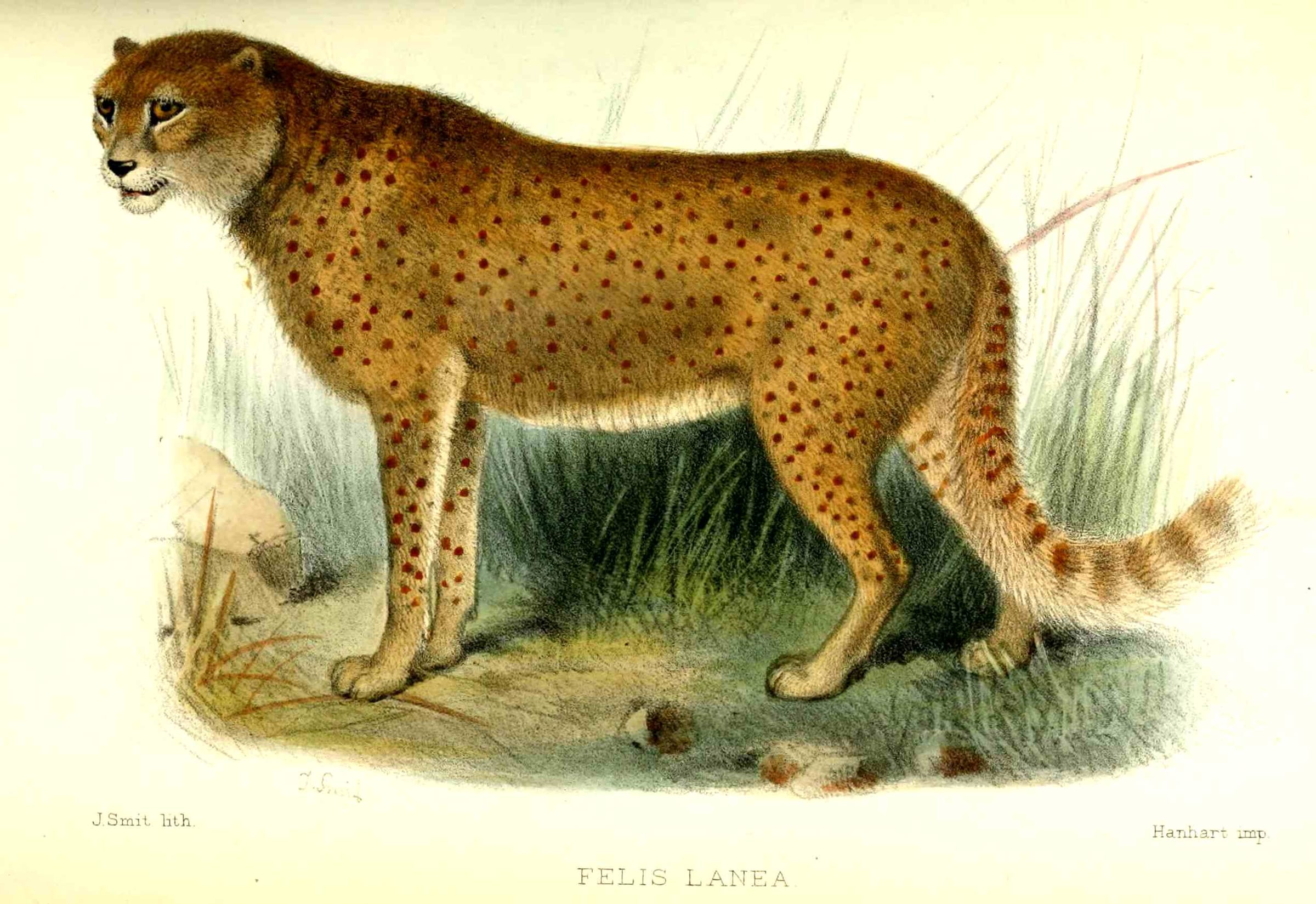
The cheetah (Acinonyx jubatus) is a species of large feline and the only living member of the genus Acinonyx. The cheetah is a pursuit predator and the fastest land animal, capable of running at 93–104 km/h (58–65 mph); it has evolved for speed, having powerful hindlimb muscles, long limbs and a flexible spine. The cheetah has a tawny to creamy white or pale buff fur that is marked with evenly spaced, solid black spots. The head is small and rounded, with a short snout and black tear-like facial streaks. It reaches 67–94 cm (2.20–3.08 ft) at the shoulder, and the head-and-body length is between 1.1 and 1.5 m (3 ft 7 in and 4 ft 11 in). Adults weigh between 21 and 65 kg (46 and 143 lb).
The cheetah was first scientifically described in the late 18th century. Four subspecies are recognised today that are native to Africa and central Iran. An African subspecies was introduced to India in 2022. It is now distributed mainly in small, fragmented populations in northwestern, eastern and southern Africa and central Iran. It lives in a variety of habitats such as savannahs in the Serengeti, arid mountain ranges in the Sahara, and hilly desert terrain.
Zero to a hundred kilometres an hour in three seconds.
Distribution and habitat
In eastern and southern Africa, the cheetah occurs mostly in savannas like the Kalahari and Serengeti. In central, northern and western Africa, it inhabits arid mountain ranges and valleys; in the harsh climate of the Sahara, it prefers high mountains, which receive more rainfall than the surrounding desert. The vegetation and water resources in these mountains support antelopes. In Iran, it occurs in hilly terrain of deserts at elevations up to 2,000–3,000 m (6,600–9,800 ft), where annual precipitation is generally below 100 mm (3.9 in); the primary vegetation in these areas is thinly distributed shrubs, less than 1 m (3 ft 3 in) tall.
The cheetah inhabits a variety of ecosystems and appears to be less selective in habitat choice than other felids; it prefers areas with greater availability of prey, good visibility and minimal chances of encountering larger predators. It seldom occurs in tropical forests. It has been reported at the elevation of 4,000 m (13,000 ft). An open area with some cover, such as diffused bushes, is probably ideal for the cheetah because it needs to stalk and pursue its prey over a distance. This also minimises the risk of encountering larger carnivores. The cheetah tends to occur in low densities typically between 0.3 and 3.0 adults per 100 km2 (39 sq mi); these values are 10–30% of those reported for leopards and lions.
Ecology and behaviour
Cheetahs are active mainly during the day, whereas that competitors such as spotted hyenas and lions are active mainly at night. These larger carnivores can kill cheetahs and steal their kills; hence, the diurnal tendency of cheetahs helps them avoid larger predators in areas where they are sympatric, such as the Okavango Delta. In areas where the cheetah is the major predator (such as farmlands in Botswana and Namibia), activity tends to increase at night. This may also happen in highly arid regions such as the Sahara, where daytime temperatures can reach 43 °C (109 °F). The lunar cycle can also influence the cheetah's routine—activity might increase on moonlit nights as prey can be sighted easily, though this comes with the danger of encountering larger predators. Hunting is the major activity throughout the day, with peaks during dawn and dusk. Groups rest in grassy clearings after dusk. Cheetahs often inspect their vicinity at observation points such as elevations to check for prey or larger carnivores; even while resting, they take turns at keeping a lookout.
Threats
The cheetah is threatened by several factors, like habitat loss and fragmentation of populations. Habitat loss is caused mainly by the introduction of commercial land use, such as agriculture and industry. It is further aggravated by ecological degradation, like woody plant encroachment, which is common in southern Africa. Moreover, the species apparently requires a sizeable area to live in as indicated by its low population densities. Shortage of prey and conflict with other species such as humans and large carnivores are other major threats. The cheetah appears to be less capable of coexisting with humans than the leopard. With 76% of its range consisting of unprotected land, the cheetah is often targeted by farmers and pastoralists who attempt to protect their livestock, especially in Namibia. Illegal wildlife trade and trafficking is another problem in some places (like Ethiopia). Some tribes, like the Maasai people in Tanzania, have been reported to use cheetah skins in ceremonies. Roadkill is a threat in areas where roads have been constructed in natural habitats or through protected areas; roadkilled cheetahs were found in Kalmand, Touran National Park and Bafq in Iran. The reduced genetic variability makes cheetahs more vulnerable to diseases; however, the threat posed by infectious diseases may be minor, given the low population densities and hence a reduced chance of infection.
Conservation
The cheetah has been classified as Vulnerable on the IUCN Red List; it is listed under Appendix I of the Convention on the Conservation of Migratory Species of Wild Animals and Appendix I of the Convention on International Trade in Endangered Species. The Endangered Species Act enlists the cheetah as Endangered.
Until the 1970s, cheetahs and other carnivores were frequently killed to protect livestock in Africa. Gradually the understanding of cheetah ecology increased and their falling numbers became a matter of concern. The De Wildt Cheetah and Wildlife Centre was set up in 1971 in South Africa to provide care for wild cheetahs regularly trapped or injured by Namibian farmers. By 1987, the first major research project to outline cheetah conservation strategies was underway. The Cheetah Conservation Fund, founded in 1990 in Namibia, put efforts into field research and education about cheetahs on the global platform. It runs a cheetah genetics laboratory, the only one of its kind, in Otjiwarongo;
"Bushblok" is an initiative to restore habitat systematically through targeted bush thinning and biomass utilisation. Several more cheetah-specific conservation programmes have since been established, like Cheetah Outreach in South Africa.
Phylogeny and evolution
The cheetah's closest relatives are the cougar (Puma concolor) and the jaguarundi (Herpailurus yagouaroundi). Together, these three species form the Puma lineage, one of the eight lineages of the extant felids; the Puma lineage genetically diverged from the rest 6.7 million years ago. The sister group of the Puma lineage is a clade of smaller Old World cats that includes the genera Felis, Otocolobus and Prionailurus.