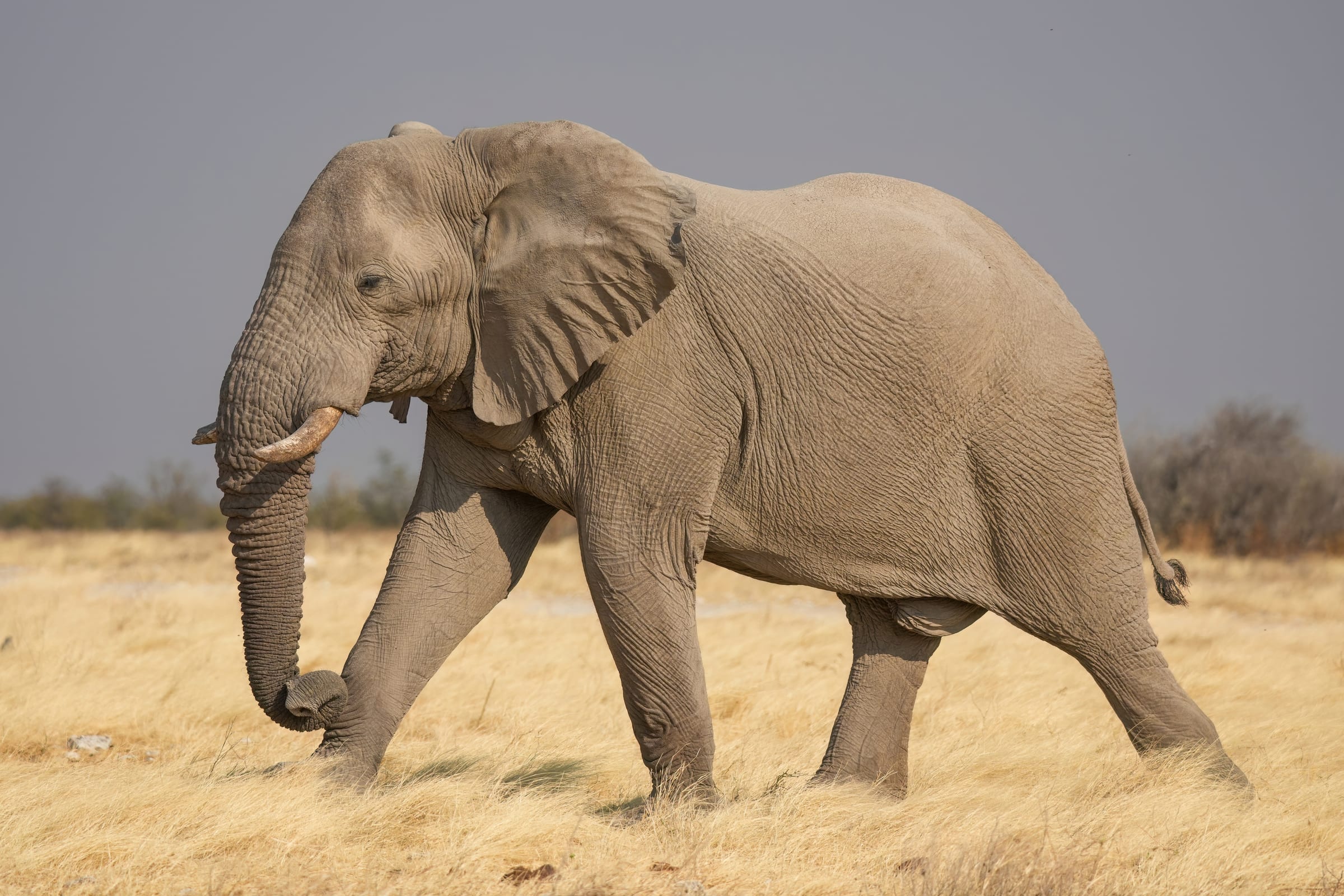
The African bush elephant (Loxodonta africana), also known as the African savanna elephant, is a species of elephant native to sub-Saharan Africa and the largest living terrestrial animal, with fully grown bulls reaching an average shoulder height of 3.04–3.36 m (10.0–11.0 ft) and a body mass of 5.2–6.9 t (5.7–7.6 short tons); the largest recorded specimen had a shoulder height of 3.96 m (13.0 ft) and an estimated body mass of 10.4 t (11.5 short tons). It is characterised by its long prehensile trunk with two finger-like processes; a concave back; large ears which help reduce body heat; and sturdy tusks that are noticeably curved. Its skin is grey with scanty hairs, and bending cracks which support thermoregulation by retaining water.
The African bush elephant inhabits a variety of habitats such as forests, grasslands, woodlands, wetlands and agricultural land. It is a mixed herbivore feeding mostly on grasses, creepers, herbs, leaves, and bark. The average adult consumes about 150 kg (330 lb) of vegetation and 230 L (51 imp gal; 61 US gal) of water each day. It is a social animal that lives in herds of cows and their offspring. Adult bulls usually live alone or in small bachelor groups. During the mating season, males undergo musth, a period of high testosterone levels and heightened aggression. The menstrual cycle of cows lasts three to four months, and gestation around 22 months, the longest of any mammal.
Mourns its dead and remembers every watering hole for a lifetime.
Description
The African bush elephant has grey skin with scanty hairs. Its large ears cover the whole shoulder, and can grow as large as 2 m × 1.5 m (6 ft 7 in × 4 ft 11 in).
Its large ears help to reduce body heat; flapping them creates air currents and exposes large blood vessels on the inner sides to increase heat loss during hot weather. The African bush elephant's ears are pointed and triangular shaped. Its occipital plane slopes forward. Its back is shaped markedly concave. Its sturdy tusks are curved out and point forward. Its long trunk or proboscis ends with two finger-like tips.
Distribution and habitat
The African bush elephant occurs in sub-Saharan Africa which includes Uganda, Kenya, Tanzania, Botswana, Zimbabwe, Namibia, Zambia, Angola, Malawi, Mali, Rwanda, Mozambique and South Africa. It moves between a variety of habitats, including subtropical and temperate forests, dry and seasonally flooded grasslands, woodlands, wetlands, and agricultural land from sea level to mountain slopes. In Mali and Namibia, it also inhabits desert and semi-desert areas.
Populations of African bush elephants are increasing in some areas such as the Kruger National Park, where an annual growth of 4.2% was recorded between 2003 and 2015. There are estimated to be at least 17,000 elephants in the park's vicinity, as of 2015–the most of any area in South Africa. The increase in population occurred after the discontinuation of culling in the mid-1990s. This large elephant population is considered a problem to both the environment and its creatures. As such, with the use of natural processes, conservationists aim to control the ever-growing population. In other places in southern Africa, the elephant population continues to increase. Botswana in particular hosts more African bush elephants than any other country, at 130,000. In a 2019 study, populations were found to be steady, though the authors also noted an unusual increase in carcasses, possibly due to a new wave of poaching which was uncommon at the time.
Behaviour and ecology
The core of elephant society is the family unit, which mostly comprises several adult cows, their daughters, and their prepubertal sons. Iain Douglas-Hamilton, who observed African bush elephants for 4.5 years in Lake Manyara National Park, coined the term 'kinship group' for two or more family units that have close ties. The family unit is led by a matriarch who at times also leads the kinship group. Groups cooperate in locating food and water, in self-defense, and in caring for offspring (termed allomothering). Group size varies seasonally and between locations. In Tsavo East and Tsavo West National Parks, groups are bigger in the rainy season and areas with open vegetation.
Aerial surveys in the late 1960s to early 1970s revealed an average group size of 6.3 individuals in Uganda's Rwenzori National Park and 28.8 individuals in Chambura Game Reserve. In both sites, elephants aggregated during the wet season, whereas groups were smaller in the dry season.
Young bulls gradually separate from the family unit when they are between 10 and 19 years old. They range alone for some time or form all-male groups. A 2020 study highlighted the importance of old bulls for the navigation and survival of herds and raised concerns over the removal of old bulls as "currently occur[ring] in both legal trophy hunting and illegal poaching".
Threats
The African bush elephant is threatened primarily by habitat loss and fragmentation following conversion of natural habitat for livestock farming, plantations of non-timber crops, and building of urban and industrial areas. As a result, human-elephant conflict has increased.
Poachers target foremost elephant bulls for their tusks, which leads to a skewed sex ratio and affects the survival chances of a population. Access of poachers to unregulated black markets is facilitated by corruption and periods of civil war in some elephant range countries. During the 20th century, the African bush elephant population was decimated. Poaching of the elephant has dated back to the years 1970 and 1980, which were considered the largest killings in history. The species is placed in harm's way due to the limited conservation areas provided in Africa. In most cases, the killings of the African bush elephant have occurred near the outskirts of the protected areas.
Conservation
Both African elephant species have been listed on Appendix I of the Convention on International Trade in Endangered Species of Wild Fauna and Flora since 1989. In 1997, populations of Botswana, Namibia, and Zimbabwe were placed on CITES Appendix II, as were populations of South Africa in 2000. Community-based conservation programmes have been initiated in several range countries, which contributed to reducing human-elephant conflict and increasing local people's tolerance towards elephants. Researchers discovered that playing back the recorded sounds of African bees is an effective method to drive elephants away from settlements.
In 1986, the African Elephant Database was initiated to collate and update information on the distribution and status of elephant populations in Africa. The database includes results from aerial surveys, dung counts, interviews with local people, and data on poaching.