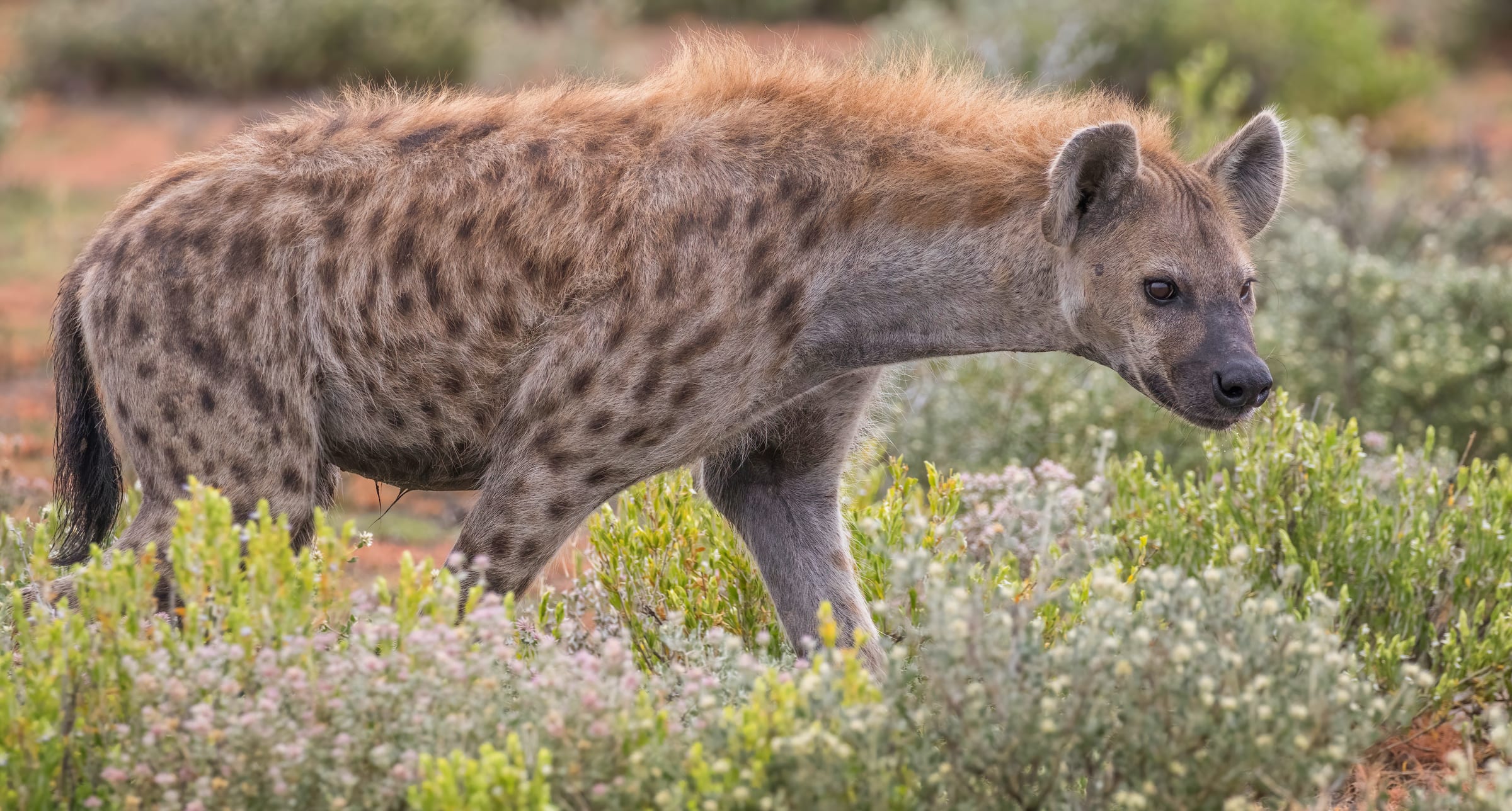
The spotted hyena (Crocuta crocuta), also known as the laughing hyena, is a hyena species, currently classed as the sole extant member of the genus Crocuta, native to sub-Saharan Africa. It is listed as being of least concern by the IUCN due to its widespread range and large numbers estimated between 27,000 and 47,000 individuals. The species is, however, experiencing declines outside of protected areas due to habitat loss and poaching. Populations of Crocuta, usually considered a subspecies of Crocuta crocuta, known as cave hyenas, roamed across Eurasia for at least one million years until the end of the Late Pleistocene. The spotted hyena is the largest extant member of the Hyaenidae, and is further physically distinguished from other species by its vaguely bear-like build, rounded ears, less prominent mane, spotted pelt, more dual-purposed dentition, fewer nipples, and pseudo-penis. It is the only placental mammalian species where females have a pseudo-penis and lack an external vaginal opening.
The spotted hyena is the most social of the Carnivora in that it has the largest group sizes and most complex social behaviours. Its social organisation is unlike that of any other carnivore, bearing closer resemblance to that of cercopithecine primates (baboons and macaques) with respect to group size, hierarchical structure, and frequency of social interaction among both kin and unrelated group-mates. The social system of the spotted hyena is openly competitive, with access to kills, mating opportunities and the time of dispersal for males depending on the ability to dominate other clan-members and form ally networks. Females provide only for their own cubs rather than assist each other, and males display no paternal care. However, the spotted hyena is also very cooperative with their clan-mates; often hunting, eating, and resting together, and making use of their numeracy and communication skills to fight off a common enemy. Spotted hyena society is matriarchal; females are larger than males and dominate them.
A matriarchal pack that laughs and crunches every bone.
Description
The spotted hyena has a strong and well-developed neck and forequarters, but relatively underdeveloped hindquarters. The rump is rounded rather than angular, which prevents attackers coming from behind from getting a firm grip on it. The head is wide and flat with a blunt muzzle and broad rhinarium. In contrast to the striped hyena, the ears of the spotted hyena are rounded rather than pointed. Each foot has four digits, which are webbed and have short, stout and blunt claws. The paw-pads are broad and flat, with the whole undersurface of the foot around them being naked. The tail is relatively short, being 300–350 mm (12–14 in) long, and resembles a pompom in appearance. Unusually among hyaenids, and mammals in general, the female spotted hyena is considerably larger than the male. Both sexes have a pair of anal glands which open into the rectum just inside the anal opening. These glands produce a white, creamy secretion which is pasted onto grass stalks by everting the rectum. The odour of this secretion is strong, smelling of boiling cheap soap or burning, and can be detected by humans several metres downwind. The spotted hyena has a proportionately large heart, constituting close to 1% of its body weight, thus giving it great endurance in long chases. In contrast, a lion's heart makes up only 0.45–0.57 percent of its body weight.
Range, habitat and population
The spotted hyena's distribution once ranged in Europe from the Iberian Peninsula to the Urals, where it remained for at least one million years. Remains have also been found in the Russian Far East, and it has been theorised that the presence of hyenas there may have delayed the colonisation of North America. During the Last Glacial Maximum, the spotted hyena also roamed Southeast Asia. The causes of the species' extirpation in Eurasia are still largely unknown. In Western Europe at least, the spotted hyena's extinction coincided with a decline in grasslands 12,500 years ago. Europe experienced a massive loss of lowland habitats favoured by spotted hyenas, and a corresponding increase in mixed woodlands. Spotted hyenas, under these circumstances, would have been outcompeted by wolves and humans which were as much at home in forests as in open lands, and in highlands as in lowlands. Spotted hyena populations began to shrink roughly 20,000 years ago, completely disappearing from Western Europe between 14 and 11,000 years ago, and earlier in some areas.
Behaviour
Spotted hyenas are social animals that live in large communities (referred to as "clans") which can consist of at most 80 individuals. Group-size varies geographically; in the Serengeti, where prey is migratory, clans are smaller than those in the Ngorongoro Crater, where prey is sedentary. Spotted hyena clans are more compact and unified than wolf packs, but are not as closely knit as those of African wild dogs.
Females usually dominate males, including in cases where low-ranking females generally dominate over high-ranking males, but they will also occasionally co-dominate with a male. There have also been cases in which a clan has been led by a male rather than a female. Cubs inherit the social rank of their mother and mirror the social associations she has with other clan members, and cubs can maintain these social associations with other clan members long after dependence on their mother. So when the matriarch passes away (or, in rare instances, disperses into another clan), their female cubs have the rank and social support by other clan members to become the new matriarch. It is typical for females to remain with their natal clan, thus large clans usually contain several matrilines, whereas males typically disperse from their natal clan at the age of 2½ years. When a male co-dominates with a female or is otherwise able to lead, this is because the male was born to the matriarch of the clan and has taken the rank directly below his mother.
Ecology
The spotted hyena is the most carnivorous member of the Hyaenidae. Unlike its brown and striped cousins, the spotted hyena is primarily a predator; this has been shown since the 1960s. One of the earliest studies to demonstrate their hunting abilities was done by wildlife ecologist Hans Kruuk, and he showed through a 7-year study of hyena populations in the Serengeti and Ngorongoro Crater that spotted hyenas hunt as much as lions, with later studies showing this tendency in many other areas of Africa. There are however large differences between populations, depending on their habitat, available prey species and the presence of other predators. Thus the estimated contribution from hunting to their diet ranges from at least half up to 98%, the remainder being from scavenging.
Communication
Spotted hyenas have a complex set of postures in communication. When afraid, the ears are folded flat, and are often combined with baring of the teeth and a flattening of the mane. When attacked by other hyenas or by wild dogs, the hyena lowers its hindquarters. Before and during an assertive attack, the head is held high with the ears cocked, mouth closed, mane erect and the hindquarters high. The tail usually hangs down when neutral, though it will change position according to the situation. When a high tendency to flee an attacker is apparent, the tail is curled below the belly. During an attack, or when excited, the tail is carried forward on the back. An erect tail does not always accompany a hostile encounter, as it has also been observed to occur when a harmless social interaction occurs. Although they do not wag their tails, spotted hyenas will flick their tails when approaching dominant animals or when there is a slight tendency to flee. When approaching a dominant animal, subordinate spotted hyenas will walk on the knees of their forelegs in submission. Greeting ceremonies among clan-members consist of two individuals standing parallel to each other and facing opposite directions. Both individuals raise their hind legs and lick each other's anogenital area. During these greeting ceremonies, the penis or pseudo-penis often becomes erect, in both males and females.