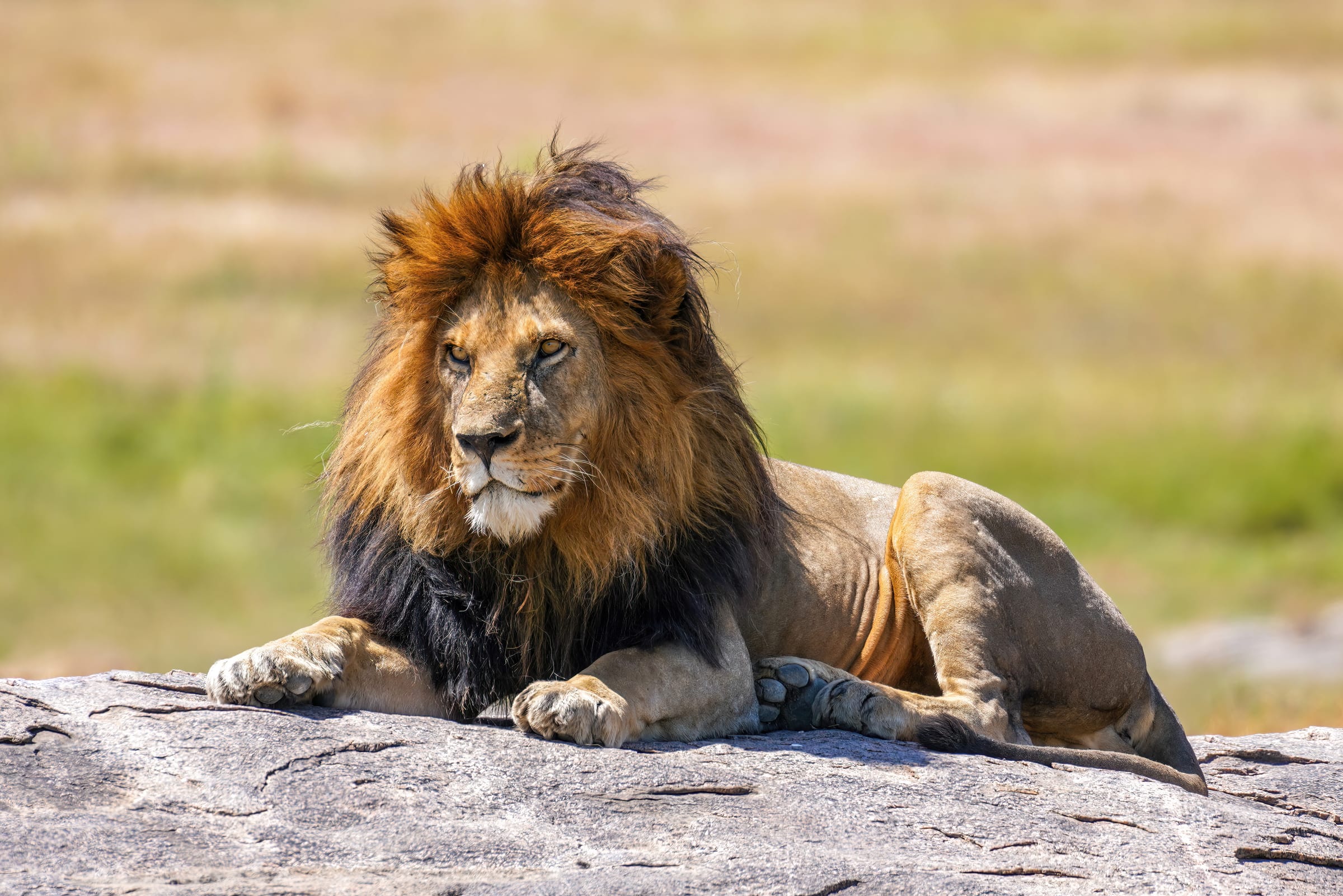
The lion (Panthera leo) is a large cat of the genus Panthera, currently ranging only in Sub-Saharan Africa and India. It has a muscular, broad-chested body; a short, rounded head; round ears; and a dark, hairy tuft at the tip of its tail. It is sexually dimorphic; adult male lions are larger than females and have a prominent mane that extends from the head to the shoulders and chest.
The lion inhabits grasslands, savannahs, and shrublands. It is an apex and keystone predator, preying mostly on medium-sized and large hooved mammals. It is usually more diurnal than other wild cats, but when persecuted, it adapts to being active at night and at twilight. It is a social species, forming groups called prides. A lion pride consists of related females and cubs, and a few or one adult male who is unrelated to the females. Groups of female lions usually hunt together. Adult males often compete to keep or gain their membership in the pride.
The only cat that hunts as a family, in roaring golden teams.
Description
The lion is a muscular, broad-chested cat with a short, rounded head, a reduced neck, and round ears; males have broader heads. The fur varies in colour from light buff to silvery grey, yellowish red, and dark brown. The colours of the underparts are generally lighter. A newborn lion has dark spots, which fade as the cub reaches adulthood, although faint spots may still be seen on the legs and underparts. The tail of all lions ends in a dark, hairy tuft that, in some lions, conceals an approximately 5 mm (0.20 in)-long, hard "spine" or "spur" composed of dermal papillae. The functions of the spur are unknown. The tuft is absent at birth, develops at around 5+1⁄2 months of age, and is readily identifiable at the age of seven months.
Its skull is very similar to that of the tiger. However, the frontal region is usually more depressed and flattened and has a slightly shorter postorbital region and broader nasal openings than those of the tiger. Due to the amount of skull variation in the two species, usually only the structure of the lower jaw can be used as a reliable indicator of species.
The skeletal muscles of the lion make up 58.8% of its body weight and represent the highest percentage of muscles among mammals. The lion has a high concentration of fast twitch muscle fibres, giving them quick bursts of speed but less stamina.
Distribution and habitat
African lions live in scattered populations across sub-Saharan Africa. The lion prefers grassy plains and savannahs, scrub bordering rivers, and open woodlands with bushes. It rarely enters closed forests. On Mount Elgon, the lion has been recorded up to an elevation of 3,600 m (11,800 ft) and close to the snow line on Mount Kenya. Savannahs with an annual rainfall of 300 to 1,500 mm (12 to 59 in) make up the majority of lion habitat in Africa, estimated at 3,390,821 km2 (1,309,203 sq mi) at most. Still, remnant populations are also present in tropical moist forests in West Africa and montane forests in East Africa. The Asiatic lion now survives only in and around Gir National Park in Gujarat, western India. Its habitat is a mixture of dry savannah forest and very dry, deciduous scrub forest.
In Africa, the range of the lion originally spanned most of the central African rainforest zone and the Sahara desert. In the 1960s, it became extinct in North Africa, except in the southern part of Sudan.
During the mid-Holocene, around 8,000-6,000 years ago, the range of lions expanded into Southeastern and Eastern Europe, partially re-occupying the range of the now extinct cave lion. In Hungary, the modern lion was present from about 4,500 to 3,200 years Before Present. In Ukraine, the modern lion was present from about 6,400 to 2,000 years Before Present. In Greece, it was common, as reported by Herodotus in 480 BC; it was considered rare by 300 BC and extirpated by AD 100.
Behaviour and ecology
Lions spend much of their time resting; they are inactive for about twenty hours per day. Although lions can be active at any time, their activity generally peaks after dusk with a period of socialising, grooming, and defecating. Intermittent bursts of activity continue until dawn, when hunting most often takes place. They spend an average of two hours a day walking and fifty minutes eating.
The lion is the most social of all wild felid species, living in groups of related individuals with their offspring. Such a group is called a "pride". Groups of male lions are called "coalitions". Females form the stable social unit in a pride and do not tolerate outside females. The majority of females remain in their birth prides while all males and some females disperse. The average pride consists of around 15 lions, including several adult females and up to four males and their cubs of both sexes. Large prides of up to 30 individuals have been observed. The sole exception to this pattern is the Tsavo lion pride that always had only one adult male. Prides act as fission–fusion societies, and members split into subgroups that keep in contact with roars.
Conservation
The lion is listed as Vulnerable on the IUCN Red List. The Indian population is listed on CITES Appendix I and the African population on CITES Appendix II.
Several large and well-managed protected areas in Africa host large lion populations. Where an infrastructure for wildlife tourism has been developed, cash revenue for park management and local communities is a strong incentive for lion conservation. Most lions now live in East and Southern Africa; their numbers are rapidly decreasing, and fell by an estimated 30–50% in the latter half of the 20th century. Primary causes of the decline include disease and human interference. In 1975, it was estimated that since the 1950s, lion numbers had decreased by half to 200,000 or fewer. Estimates of the African lion population range between 16,500 and 47,000 living in the wild in 2002–2004.
Interactions with humans
Lions are part of a group of exotic animals that have been central to zoo exhibits since the late 18th century. Although many modern zoos are more selective about their exhibits, there are more than 1,000 African and 100 Asiatic lions in zoos and wildlife parks around the world. They are considered an ambassador species and are kept for tourism, education, and conservation purposes. Lions can live over twenty years in captivity; for example, three sibling lions at the Honolulu Zoo lived to the age of 22 in 2007.
The first European "zoos" spread among noble and royal families in the 13th century, and until the 17th century were called seraglios. At that time, they came to be called menageries, an extension of the cabinet of curiosities. They spread from France and Italy during the Renaissance to the rest of Europe. In England, although the seraglio tradition was less developed, lions were kept at the Tower of London in a seraglio established by King John in the 13th century; this was probably stocked with animals from an earlier menagerie started in 1125 by Henry I at his hunting lodge in Woodstock, Oxfordshire, where according to William of Malmesbury lions had been stocked.