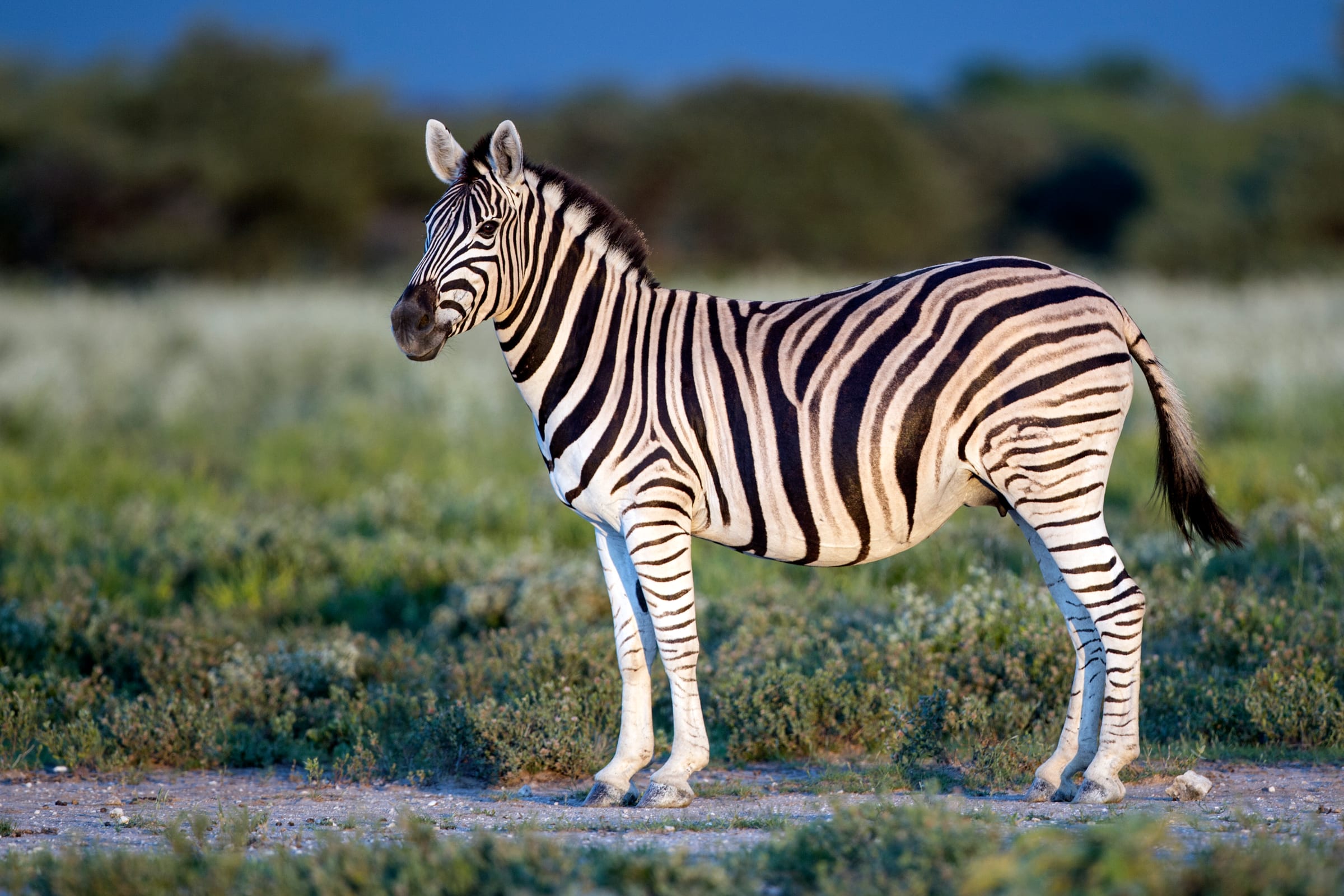
The plains zebra (Equus quagga, formerly Equus burchellii) is the most common and geographically widespread species of zebra. Its range is fragmented, but spans much of southern and eastern Africa south of the Sahara. Six or seven subspecies have been recognised, including the quagga which was thought to be a separate species. More recent research supports variations in zebra populations being clines rather than subspecies.
Plains zebras are intermediate in size between the larger Grévy's zebra and the smaller mountain zebra and tend to have broader stripes than both. Great variation in coat patterns exists between clines and individuals. The plains zebra's habitat is generally, but not exclusively, treeless grasslands and savanna woodlands, both tropical and temperate. They generally avoid desert, dense rainforest and permanent wetlands. Zebras are preyed upon by lions and spotted hyenas, Nile crocodiles and, to a lesser extent, leopards, cheetahs and African wild dogs.
Every stripe pattern is unique as a fingerprint.
Physical description
The plains zebra stands at a height of 127–140 cm (50–55 in) with a head-body length of 217–246 cm (85–97 in) and a tail length of 47–56.5 cm (18.5–22.2 in). Males weigh 220–322 kg (485–710 lb) while females weigh 175–250 kg (386–551 lb). The species is intermediate in size between the larger Grévy's zebra and the smaller mountain zebra. It is dumpy bodied with relatively short legs and a skull with a convex forehead and a somewhat concave nose profile. The neck is thicker in males than in females. The ears are upright and have rounded tips. They are shorter than in the mountain zebra and narrower than in Grévy's zebra. As with all wild equids, the plains zebra has an erect mane along the neck and a tuft of hair at the end of the tail. The body hair of a zebra is 9.4 ± 4 mm (0.37 ± 0.16 in), shorter than in other African ungulates.
Ecology
The plains zebra's range stops short of the Sahara from South Sudan and southern Ethiopia extending south along eastern Africa, as far as Zambia, Mozambique, and Malawi, before spreading into most southern African countries. They may have lived in Algeria in the Neolithic era. Plains zebras generally live in treeless grasslands and savanna woodlands, but can be found in a variety of habitats, both tropical and temperate. However, they are generally absent from deserts, dense rainforests, and permanent wetlands. They generally prefer Acacieae woodlands over Commiphora. They are water-dependent and live in more mesic environments than other African equids. They seldom wander 10–12 km (6.2–7.5 mi) from a water source. Zebras also live in elevations from sea level to 4,300 feet (1,300 m) on Mount Kenya.
Depending on the population, zebra herds may be sedentary, being highly dense with small ranges, or migratory, being less populated with separate, extensive dry and wet home ranges. When migrating, zebras appear to rely on some memory of the locations where foraging conditions were best and may predict conditions months before their arrival.
The loss of open grasslands due to woody plant encroachment increases predation risk and therewith habitat.
Behaviour
Plains zebras are nomadic and non-territorial, home ranges vary from 30 km2 (12 sq mi) to 600 km2 (230 sq mi), depending on the area and if the population is migratory. They are more active during the day and spend most of their time feeding. Other activities include dust bathing, rubbing, drinking and intermittent resting which is very brief. At night, zebra activity is subdued except when threatened by predators. They may rest or sleep laying down, while one individual keeps guard.
The plains zebra is highly social and usually forms small family groups called harems, which consist of a single stallion, several mares and their recent offspring. The adult membership of a harem is highly stable, typically remaining together for months to years. Groups of all-male "bachelors" also exist. These are stable groups of up to 15 males with an age-based hierarchy, led by a young male. These males stay in their groups until they are ready to start a harem. The bachelors prepare for their adult roles with play fights and greeting/challenge rituals, which take up most of their activities.
Human interactions
In 2016, the plains zebra was classified as near threatened by the IUCN. As of that year, the total population is estimated to be around 500,000 individuals. The species remains common throughout its range but has experienced population declines in 10 of the 17 countries where it is native. They are stable in Ethiopia, Malawi, and South Africa and possibly Angola; stable or increasing in Mozambique, Namibia and Eswatini; and decreasing in Botswana, DR Congo, Kenya, Rwanda, Somalia, South Sudan, Tanzania, Uganda, Zambia, and Zimbabwe. They are extinct in Burundi, Lesotho and possibly Somalia.
Zebras are threatened by hunting for their hide and meat, and habitat change from farming. They also compete with livestock for food, and fencing blocks migration routes. Civil wars in some countries have also caused declines in zebra populations. The zebra can be found in numerous protected areas across its range, including the Serengeti National Park in Tanzania, Tsavo and Masai Mara in Kenya, Hwange National Park in Zimbabwe, Etosha National Park in Namibia, and Kruger National Park in South Africa. Some stable populations live in unprotected areas.