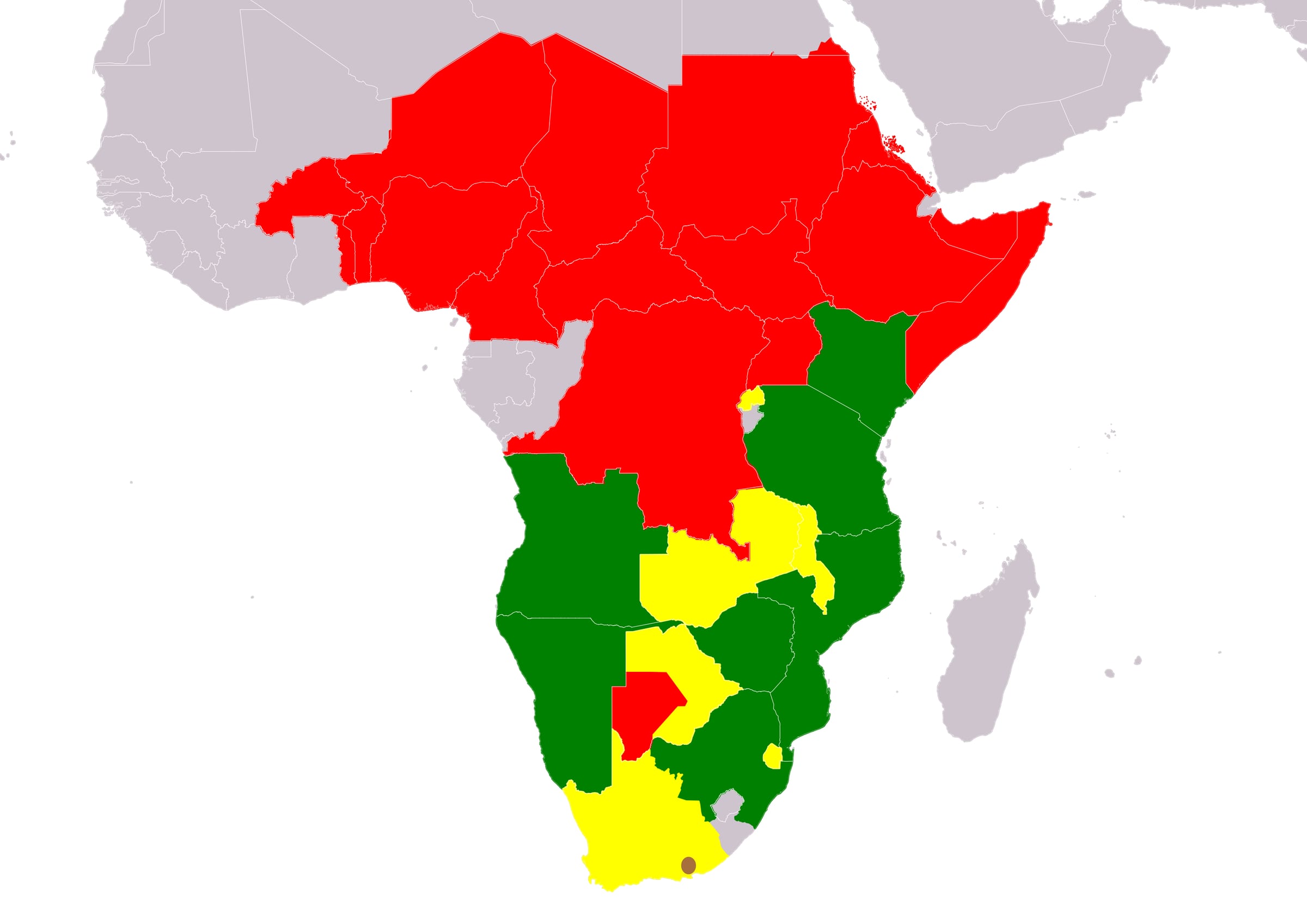
The black rhinoceros (Diceros bicornis), also called the black rhino or the hooked-lip rhinoceros, is a species of rhinoceros native to East and Southern Africa, including Angola, Botswana, Eswatini, Kenya, Lesotho, Malawi, Mozambique, Namibia, South Africa, Tanzania, Zambia, and Zimbabwe. Although the species is referred to as black, its colours vary from brown to grey. It is the only extant species of the genus Diceros.
The other rhinoceros native to Africa is the white rhinoceros (Ceratotherium simum). The word "white" in the name "white rhinoceros" is often said to be a misinterpretation of the Afrikaans word wyd (Dutch wijd) meaning wide, referring to its square upper lip, as opposed to the pointed or hooked lip of the black rhinoceros. These species are now sometimes referred to as the square-lipped (for white) or hook-lipped (for black) rhinoceros.
Charges first, eyesight second, and an armoured tank besides.
Description
An adult black rhinoceros stands 1.32–1.8 m (4.3–5.9 ft) high at the shoulder and is 2.8–3.75 m (9.2–12.3 ft) in length. An adult typically weighs from 800 to 1,400 kg (1,800 to 3,100 lb), however unusually large male specimens have been reported at up to 2.9 t (3.2 short tons). The cows are smaller than the bulls. Two horns on the skull are made of keratin with the larger front horn typically 50 cm (1.6 ft) long, exceptionally up to 135.9 cm (4.5 ft).
The longest known black rhinoceros horn measured nearly 1.5 m (4.9 ft) in length. Sometimes a third, smaller horn may develop. These horns are used for defense, intimidation, and digging up roots and breaking branches during feeding. The black rhino is smaller than the white rhino and close in size to the Javan rhino of Indonesia. It has a pointed and prehensile upper lip, which it uses to grasp leaves and twigs when feeding, whereas the white rhinoceros has square lips used for eating grass. The black rhinoceros can also be distinguished from the white rhinoceros by its size, smaller skull, and ears; and by the position of the head, which is held higher than the white rhinoceros, since the black rhinoceros is a browser and not a grazer.
Distribution
As with many other components of the African large mammal fauna, black rhinos probably had a wider range in the northern part of the continent in prehistoric times than today. However this seems to have not been as extensive as that of the white rhino. Unquestionable fossil remains have not yet been found in this area and the abundant petroglyphs found across the Sahara desert are often too schematic to unambiguously decide whether they depict black or white rhinos. Petroglyphs from the Eastern Desert of southeastern Egypt relatively convincingly show the occurrence of black rhinos in these areas in prehistoric times.
The natural range of the black rhino included most of southern and eastern Africa, except the Congo Basin, the tropical rainforest areas along the Bight of Benin, the Ethiopian Highlands, and the Horn of Africa. Its former native occurrence in the extremely dry parts of the Kalahari Desert of southwestern Botswana and northwestern South Africa is uncertain. It was abundant in an area stretching from Eritrea and Sudan through South Sudan to southeastern Niger, especially around Lake Chad. Its occurrence further to the west is questionable, although this is often claimed in literature.
Behavior
Black rhinos are generally thought to be solitary, with the only strong bond between a mother and her calf. In addition, bulls and cows have a consort relationship during mating, also subadults and young adults frequently form loose associations with older individuals of either sex. They are not very territorial and often intersect other rhino territories. Home ranges vary depending on season and the availability of food and water. Generally they have smaller home ranges and larger density in habitats that have plenty of food and water available, and vice versa if resources are not readily available. Sex and age of an individual black rhino influence home range and size, with ranges of cows larger than those of bulls, especially when accompanied by a calf. In the Serengeti home ranges are around 70 to 100 km2 (27 to 39 sq mi), while in the Ngorongoro it is between 2.6 to 58.0 km2 (1.0 to 22.4 sq mi). Black rhinos have also been observed to have a certain area they tend to visit and rest frequently called "houses" which are usually on a high ground level. These "home" ranges can vary from 2.6 km2 to 133 km2 with smaller home ranges having more abundant resources than larger home ranges.
Conservation
For most of the 20th century the continental black rhino was the most numerous of all rhino species. Around 1900 there were probably several hundred thousand living in Africa. During the latter half of the 20th century their numbers were severely reduced from an estimated 70,000 in the late 1960s to only 10,000 to 15,000 in 1981. In the early 1990s the number dipped below 2,500, and in 2004 it was reported that only 2,410 black rhinos remained. According to the International Rhino Foundation—housed in Yulee, Florida at White Oak Conservation, which breeds black rhinos—the total African population had recovered to 4,240 by 2008 (which suggests that the 2004 number was low). By 2009 the population of 5,500 was either steady or slowly increasing.
Threats
Today, there are various threats posed to black rhinos including habitat changes, illegal poaching, and competing species. Civil disturbances, such as war, have made mentionably negative effects on the black rhinoceros populations in since the 1960s in countries including, but not limited to, Chad, Cameroon, Rwanda, Mozambique, and Somalia. In the Addo Elephant National Park in South Africa, the African bush elephant (Loxodonta africana) is posing slight concern involving the black rhinoceroses who also inhabit the area. Both animals are browsers; however, the elephant's diet consists of a wider variety of foraging capacity, while the black rhinoceros primarily sticks to dwarf shrubs. The black rhinoceros has been found to eat grass as well; however, the shortening of its range of available food could be potentially problematic.
Black rhinos face problems associated with the minerals they ingest. They have become adjusted to ingesting less iron in the wild due to their evolutionary progression, which poses a problem when placed in captivity. These rhinoceroses can overload on iron, which leads to build up in the lungs, liver, spleen and small intestine.
Not only do these rhinoceros face threats being in the wild, but in captivity too. Black rhinoceros have become more susceptible to disease in captivity with high rates of mortality.