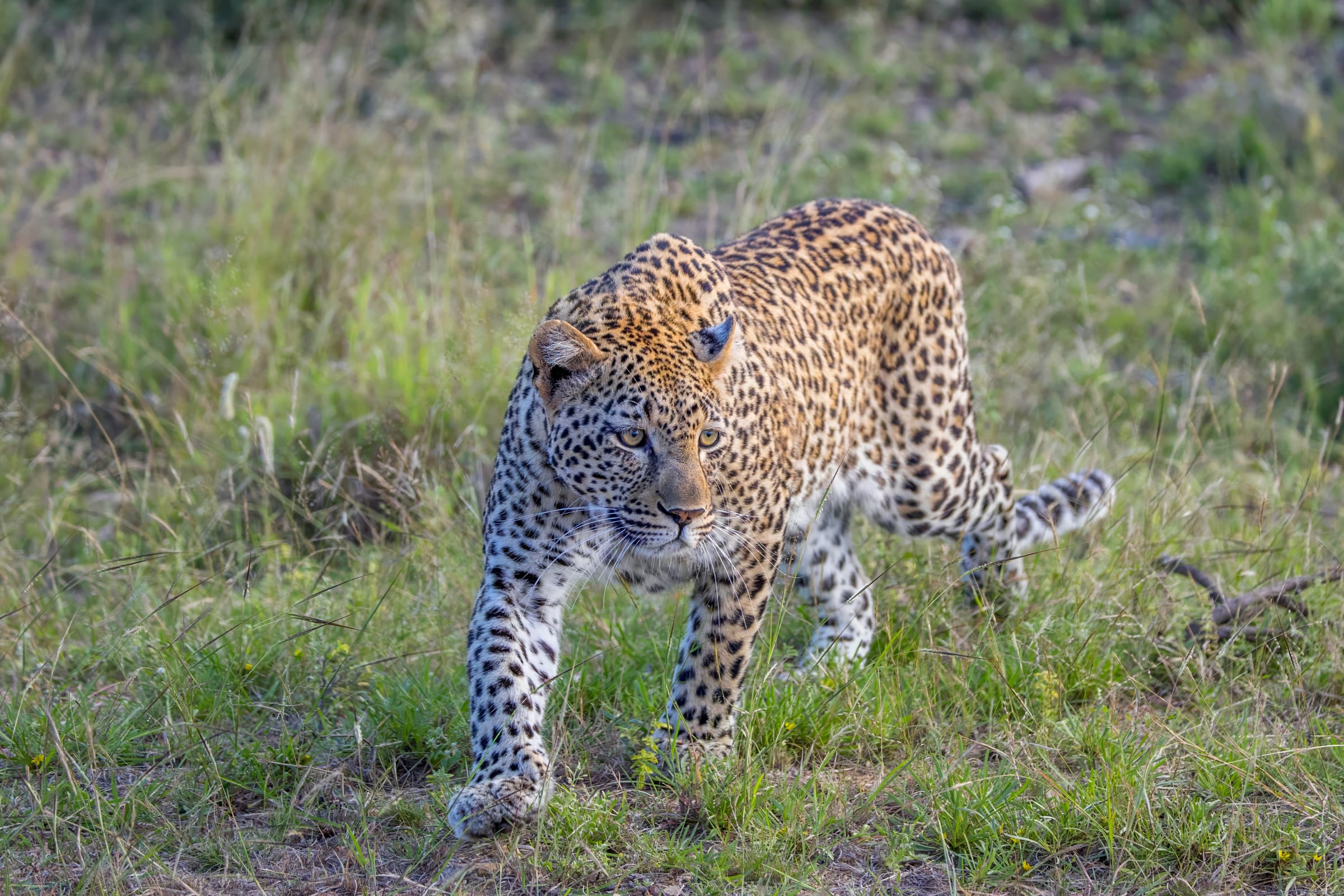
The African leopard (Panthera pardus pardus) is the nominate subspecies of the leopard, native to Africa. It is widely distributed in most of sub-Saharan Africa, but the historical range has been fragmented in the course of habitat conversion. Leopards have also been recorded in North Africa as well.
Hauls kills twice its weight up into the boughs of a tree.
Distribution and habitat
The African leopards inhabited a wide range of habitats within Africa, from mountainous forests to grasslands and savannahs, excluding only extremely sandy desert. It is most at risk in areas of semi-desert, where scarce resources often result in conflict with nomadic farmers and their livestock.
It used to occur in most of sub-Saharan Africa, occupying both rainforest and arid desert habitats. It lived in all habitats with annual rainfall above 50 mm (2.0 in), and can penetrate areas with less than this amount of rainfall along river courses. It ranges up to 5,700 m (18,700 ft), has been sighted on high slopes of the Ruwenzori and Virunga volcanoes, and observed when drinking thermal water 37 °C (99 °F) in the Virunga National Park.
The African leopard appears to be successful at adapting to altered natural habitat and settled environments in the absence of intense persecution. It has often been recorded close to major cities. But already in the 1980s, it has become rare throughout much of West Africa. Now, it remains patchily distributed within historical limits. During surveys in 2013, it was recorded in Gbarpolu County and Bong County in the Upper Guinean forests of Liberia.
Behavior and ecology
In Kruger National Park, male leopards and female leopards with cubs were more active at night than solitary females. The highest rates of daytime activity were recorded for leopards using thorn thickets during the wet season, when impala also used them. Leopards are generally most active between sunset and sunrise, and kill more prey at this time.
The leopard has an exceptional ability to adapt to changes in prey availability, and has a very broad diet. It takes small prey where large ungulates are less common. The known prey of leopards ranges from dung beetles to adult elands, which can reach 900 kg (2,000 lb). In sub-Saharan Africa, at least 92 prey species have been documented in leopard scat, including rodents, birds, small and large antelopes, hyraxes, hares, and arthropods. Leopards generally focus their hunting activity on locally abundant medium-sized ungulates in the 20 to 80 kg (44 to 176 lb) range, while opportunistically taking other prey. Average intervals between ungulate kills range from seven to 12–13 days.
Leopards often hide large kills in trees, a behavior for which great strength is required. There have been several observations of leopards hoisting carcasses of young giraffes, estimated to weigh up to 125 kg (276 lb), i.e. 2–3 times the weight of the leopard, up to 5.7 m (19 ft) into trees.
Threats
Throughout Africa, the major threats to leopards are habitat conversion and intense persecution, especially in retribution for real and perceived livestock loss.
The Upper Guinean forests in Liberia are considered a biodiversity hotspot, but have already been fragmented into two blocks. Large tracts are affected by commercial logging and mining activities, and are converted for agricultural use including large-scale oil palm plantations in concessions obtained by a foreign company.
The impact of trophy hunting on populations is unclear, but may have impacts at the demographic and population level, especially when females are shot. In Tanzania, only males are allowed to be hunted, but females comprised 28.6% of 77 trophies shot between 1995 and 1998. Removing an excessively high number of males may produce a cascade of deleterious effects on the population. Although male leopards provide no parental care to cubs, the presence of the sire allows females to raise cubs with a reduced risk of infanticide by other males. There are few reliable observations of infanticide in leopards, but new males entering the population are likely to kill existing cubs.
Conservation
The leopard is listed in CITES Appendix I. Hunting is banned in Zambia and Botswana, and was suspended in South Africa for 2016.
Leopard populations are present in several protected areas, including:
Taï National Park
Characteristics
The African leopard exhibits great variation in coat color, depending on location and habitat. Coat colour varies from pale yellow to deep gold or tawny, and sometimes black, and is patterned with black rosettes while the head, lower limbs and belly are spotted with solid black. Male leopards are larger, averaging 58 kg (128 lb) with 90 kg (200 lb) being the maximum weight attained by a male. Females weigh about 37.5 kg (83 lb) on average.
The African leopard is sexually dimorphic; males are larger and heavier than females. Between 1996 and 2000, 11 adult leopards were radio-collared on Namibian farmlands. Males weighed 37.5 to 52.3 kg (83 to 115 lb) only, and females 24 to 33.5 kg (53 to 74 lb). The heaviest known leopard weighed about 96 kg (212 lb), and was recorded in South West Africa.
According to Alfred Edward Pease, black leopards in North Africa were similar in size to lions. An Algerian leopard killed in 1913 was reported to have measured approximately 8 ft 10 in (2.69 m), before being skinned.