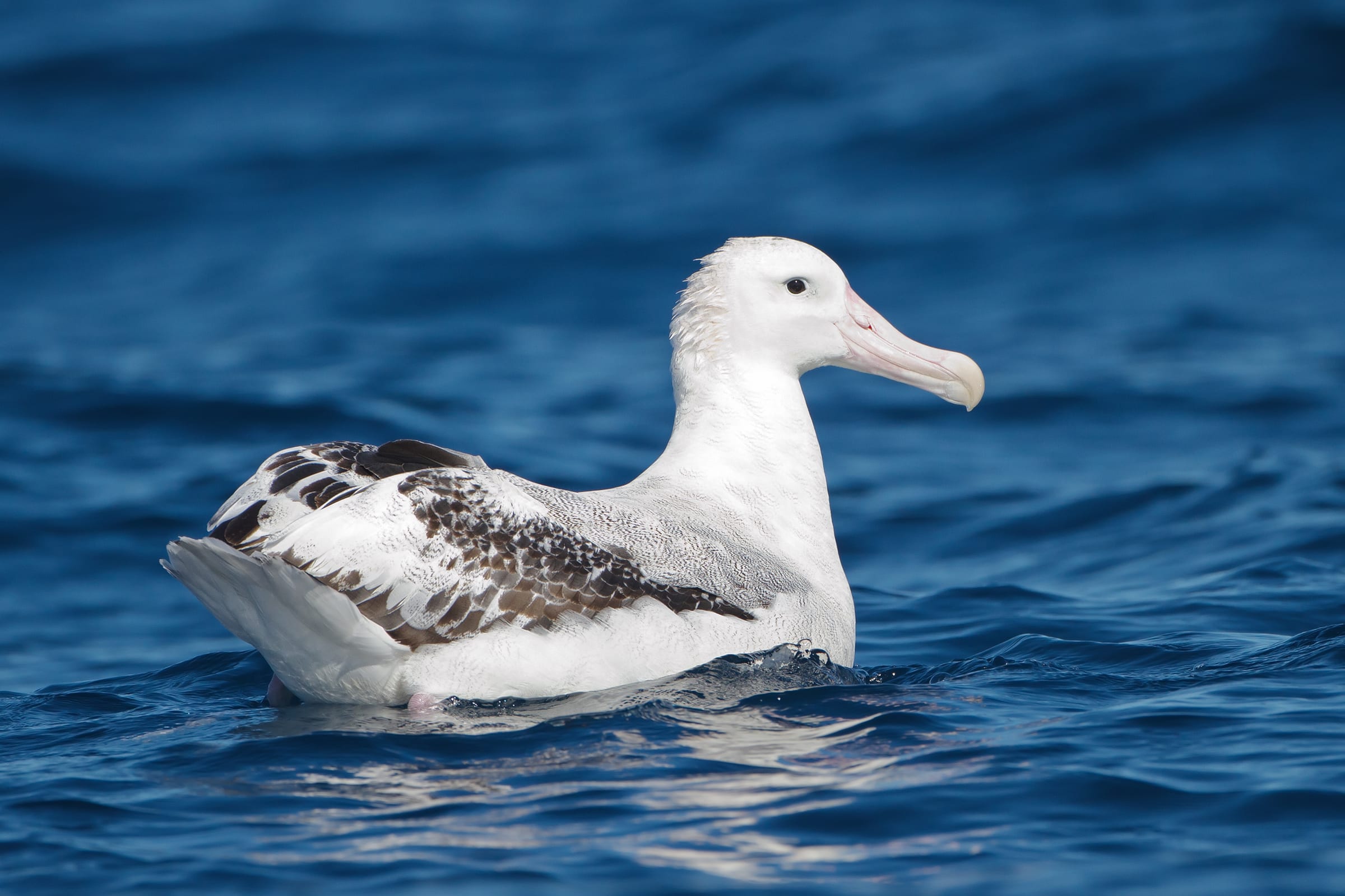
The snowy albatross (Diomedea exulans), also known as the wandering albatross, white-winged albatross, or goonie, is a large seabird from the family Diomedeidae; they have a circumpolar range in the Southern Ocean. It is the largest species of albatross and was long considered to be the same species as the Tristan albatross and the Antipodean albatross. Together with the Amsterdam albatross, it forms the wandering albatross species complex, which some began referring to more recently as "snowy".
The snowy albatross is one of the two largest members of the genus Diomedea (the great albatrosses), being similar in size to the southern royal albatross. It has the greatest known wingspan of any living bird and is also one of the most far-ranging birds. Some individual snowy albatrosses are known to circumnavigate the Southern Ocean three times in one year, covering more than 120,000 km (75,000 mi).
A three-and-a-half metre wingspan and oceans for a backyard.
Description
The plumage varies with age, with the juveniles starting chocolate brown. As they age they become whiter. The adults have white bodies with white and black wings. Males have whiter wings than females, with just the tips and trailing edges of the wings black. The snowy albatross is the whitest of the wandering albatross species complex, the other species having a great deal more brown and black on the wings and body, very closely resembling immature wandering albatrosses. The large bill is pink, as are the feet. They also have a salt gland that is situated above the nasal passage and helps desalinate their bodies, due to the high amount of ocean water that they imbibe. They excrete a high saline solution from their nose, which is a probable cause for the pink-yellow stain seen on some animals' necks.
Distribution and habitat
The snowy albatross breeds on South Georgia Island, Crozet Islands, Kerguelen Islands, Prince Edward Islands, and Macquarie Island, is seen feeding year-round off the Kaikōura Peninsula on the east coast of the South Island of New Zealand, and ranges in all the southern oceans from 28° to 60°. Some individual snowy albatrosses are known to circumnavigate the Southern Ocean three times, covering more than 120,000 km (75,000 mi), in one year. Snowy albatrosses spend most of their life in flight, landing only to breed and feed. Distances traveled each year are difficult to measure, but one banded bird was recorded traveling 6,000 km (3,700 mi) in twelve days.
Behavior
Snowy albatrosses travel vast distances to find food, and tend to feed further out in open oceans and in colder waters further south, whereas other albatross such as the related royal albatross tend to forage in somewhat shallower waters and closer to continental shelves. They feed at the surface, mainly during daylight hours, and are not well adapted for diving. During flight, speeds of 135 km/h (84 mph) have been recorded. They feed on cephalopods, small fish, and crustaceans. The species has been shown to be attracted to fishing vessels, foraging on bait, caught fish, and offal.
Relationship with humans
Sailors used to capture the birds for their long wing bones, from which they made tobacco pipe stems. The early explorers of the great Southern Sea were cheered by the companionship of the albatross in their dreary solitudes, and as shown in Coleridge's The Rime of the Ancient Mariner killing them was seen as extremely bad luck. The metaphor of "an albatross around his neck" also comes from the poem and indicates an unwanted burden causing anxiety or hindrance. In the days of sail the bird often accompanied ships for days, not merely following a ship, but wheeling in wide circles around it without ever being observed to land on the water. The bird would continue its flight, apparently untired, in tempestuous as well as moderate weather.
The Māori of New Zealand used albatrosses as a food source. They caught them using baited hooks. Because the wing bones of albatross are light but very strong, Māori used them to make a number of different items including kōauau (flutes), needles, tattooing chisel blades, and barbs for fish hooks.
The IUCN lists the snowy albatross as vulnerable status. Adult mortality is 5% to 7.8% per year as of 2003. It has an occurrence range of 64,700,000 km2 (25,000,000 sq mi), although its breeding range is only 1,900 km2 (730 sq mi).