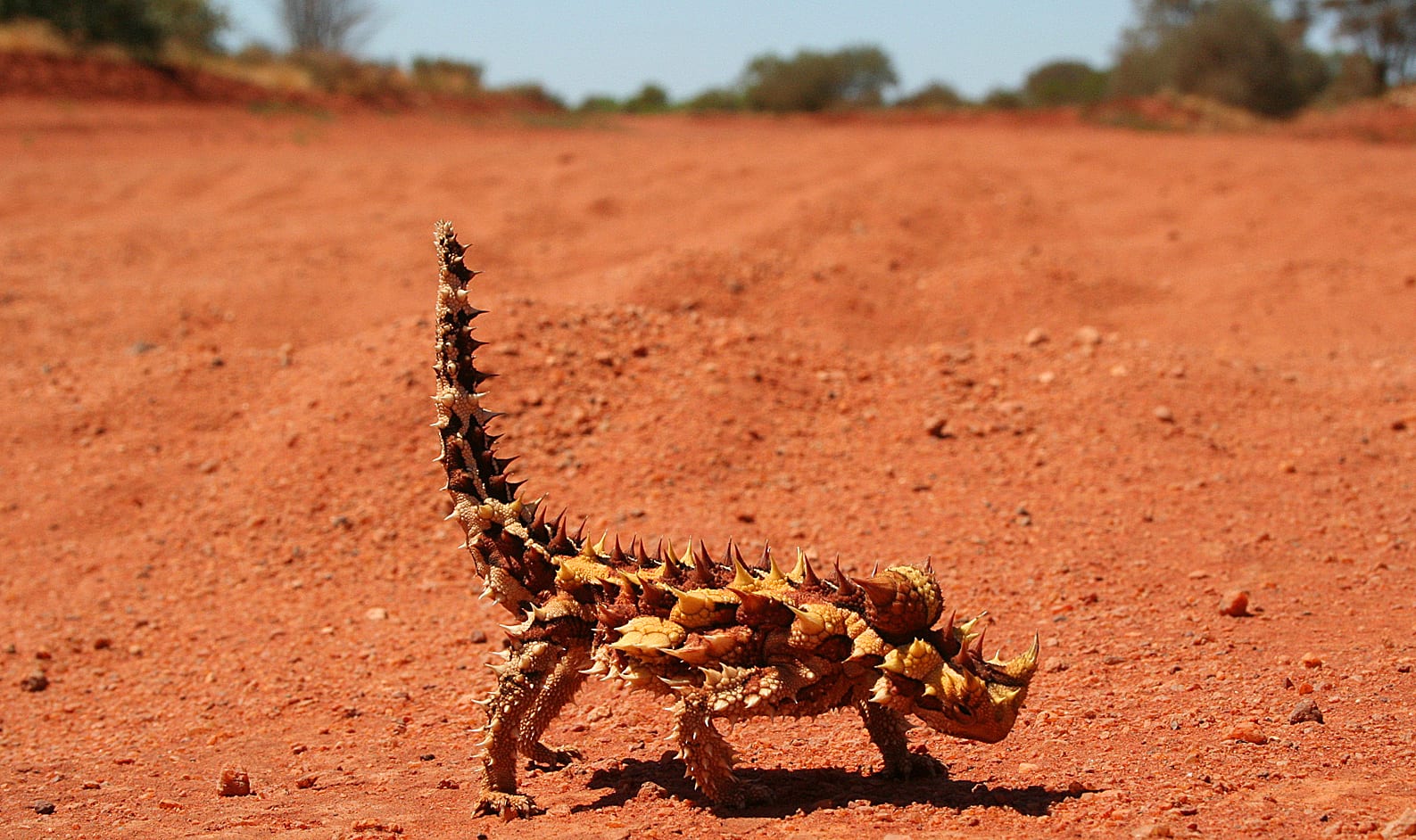
The thorny devil (Moloch horridus), also known commonly as the mountain devil, thorny lizard, thorny dragon, and moloch, is a species of lizard in the family Agamidae. The species is endemic to Australia. It is the sole species in the genus Moloch. It grows up to 21 cm (8.3 in) in total length (including tail), with females generally larger than males.
Drinks dew through its skin via tiny capillary grooves.
Description
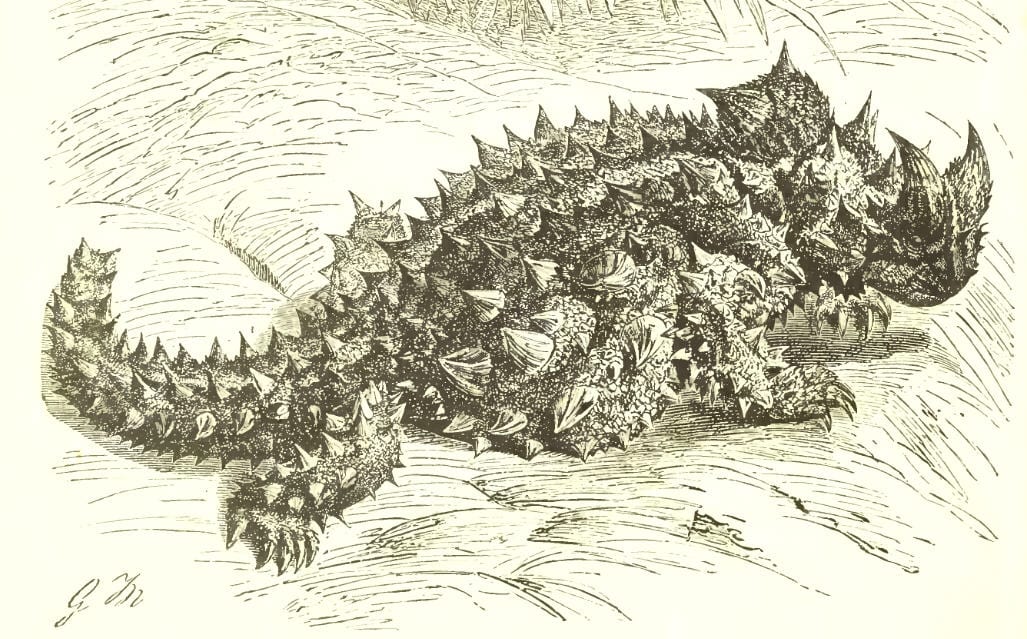
The thorny devil grows up to 21 cm (8.3 in) in total length (including tail), and can live for 15 to 20 years. The females are larger than the males. Most specimens are coloured in camouflaging shades of desert browns and tans. These colours change from pale colours during warm weather to darker colours during cold weather. The thorny devil is covered entirely with conical spines that are mostly uncalcified.
An intimidating array of spikes covers the entire upper side of the body of the thorny devil. These thorny scales also help to defend it from predators. Camouflage and deception may also be used to evade predation. This lizard's unusual gait involves freezing and rocking as it moves about slowly in search of food, water, and mates.
The thorny devil also features a spiny "false head" on the back of its neck, and the lizard presents this to potential predators by dipping its real head. The "false head" is made of soft tissue.
Distribution and habitat
The thorny devil usually lives in the arid scrubland and desert that covers most of central Australia, sandplain and sandridge desert in the deep interior and the mallee belt.
The habitat of the thorny devil coincides more with the regions of sandy loam soils than with a particular climate in Western Australia.
Diet
The thorny devil mainly subsists on ants, especially Ochetellus flavipes and other species in the Camponotus, Ectatomma, Iridomyrmex (especially Iridomyrmex rufoniger), Monomorium, Ochetellus, Pheidole, or Polyrhachis genera. Thorny devils often eat thousands of ants in one day.
The thorny devil collects moisture in the dry desert by the condensation of dew. This dew forms on its skin in the early morning as it begins to warm outside. Then the dew is channeled to its mouth by gravity and capillary action via the channels between its spines. During rainfalls, capillary action allows the thorny devil to absorb water from all over its body. Capillary action also allows the thorny devil to absorb water from damp sand. Absorption through sand is the thorny devil's main source of water intake.
Reproduction
The female thorny devil lays a clutch of three to ten eggs between September and December. She puts these in a nesting burrow about 30 cm underground. The eggs hatch after about three to four months.
Self-defense
The thorny devil is covered in hard, rather sharp spines that dissuade attacks by predators by making it difficult to swallow. It also has a false head on its back. When it feels threatened by other animals, it lowers its head between its front legs, and then presents its false head. Predators that consume the thorny devil include wild birds and goannas.