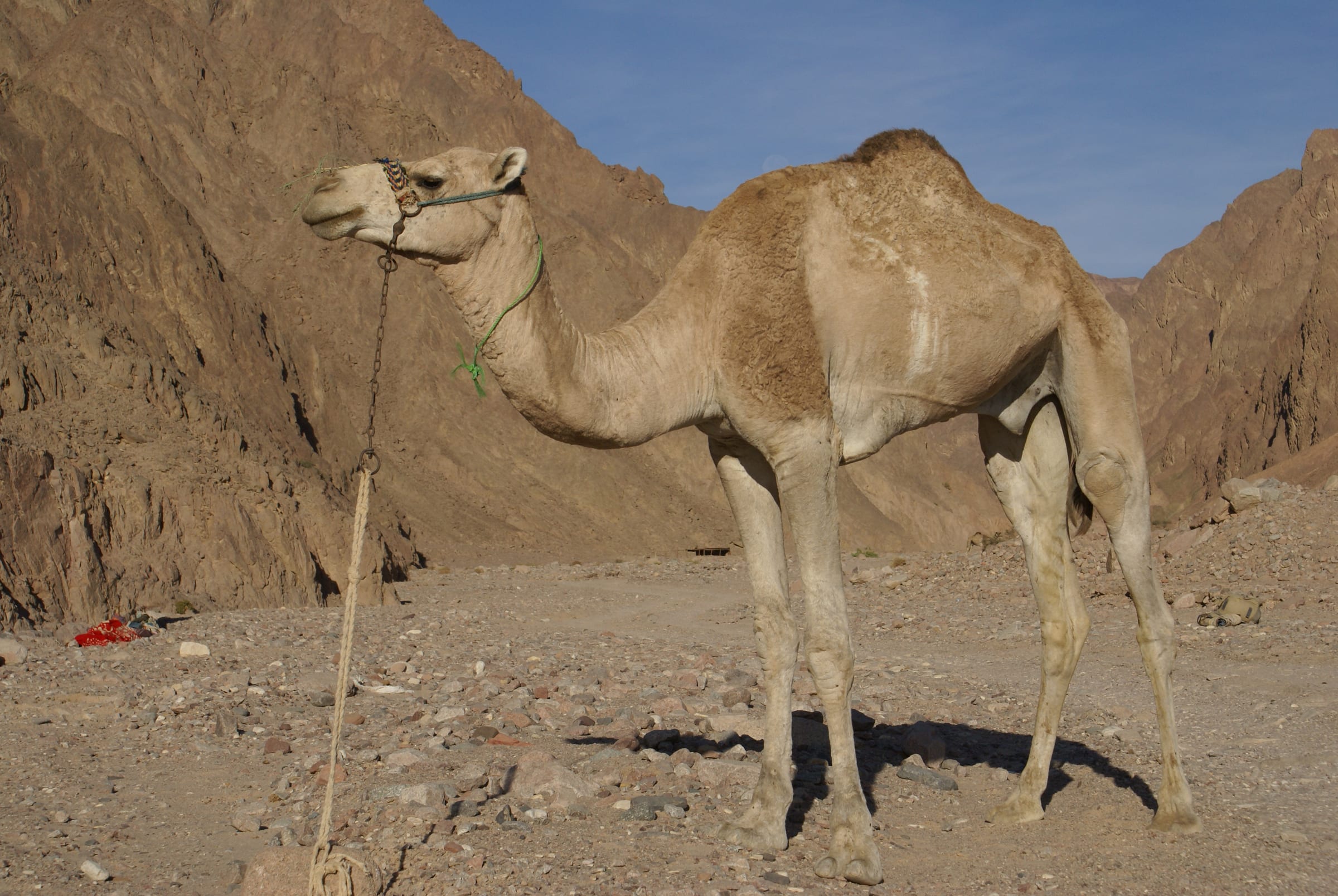
The dromedary (Camelus dromedarius), also known as the dromedary camel, Arabian camel and one-humped camel, is a large camel of the genus Camelus with one hump on its back. It is the tallest of the three camel species; adult males stand 1.8–2.4 m (5 ft 11 in – 7 ft 10 in) at the shoulder, while females are 1.7–1.9 m (5 ft 7 in – 6 ft 3 in) tall. Males typically weigh between 400 and 690 kg (880 and 1,520 lb), and females weigh between 300 and 540 kg (660 and 1,190 lb).
The dromedary's distinctive features include its long, curved neck, narrow chest, a single hump, and long hairs on the throat, shoulders, and hump. The coat is generally a shade of brown. The hump, 20 cm (7.9 in) tall or more, is made of fat bound together by fibrous tissue.
Drinks two hundred litres in three minutes and walks for weeks.
Range
Its range included hot, arid regions of northern Africa, Ethiopia, the Near East, and western and central Asia. The dromedary typically thrives in areas with a long dry season and a short wet season. They are sensitive to cold and humidity, though some breeds can thrive in humid conditions.
The dromedary was first domesticated in the southern Arabian Peninsula around 4000–3000 BC. In the ninth or tenth century BC, the dromedary became popular in the Near East. The Persian invasion of Egypt under Cambyses in 525 BC introduced domesticated camels to the area. The Persian camels were not well-suited to trading or travel over the Sahara; journeys across the desert were made on chariots pulled by horses. The dromedary was introduced into Egypt from south-western Asia (Arabia and Persia). The popularity of dromedaries increased after the Islamic conquest of North Africa. While the invasion was accomplished largely on horseback, new links to the Middle East allowed camels to be imported en masse. These camels were well-suited to long desert journeys and could carry a great deal of cargo, allowing substantial trans-Saharan trade for the first time. In Libya, dromedaries were used for transport and their milk and meat constituted the local diet.
Ecology
The dromedary is diurnal (active mainly during daylight); free-ranging herds feed and roam throughout the day, though they rest during the hottest hours around noon. The night is mainly spent resting. Dromedaries form cohesive groups of about 20 individuals, which consist of several females led by a dominant male. Females may also lead in turns. Some males either form bachelor groups or roam alone. Herds may congregate to form associations of hundreds of camels during migrations at the time of natural disasters. The males of the herd prevent female members from interacting with bachelor males by standing or walking between them and sometimes driving the bachelor males away. In Australia, short-term home ranges of feral dromedaries cover 50 to 150 km2 (19 to 58 sq mi); annual home ranges can spread over several thousand square kilometres.
Relationship with humans
The strength and docility of the dromedary make it popular as a domesticated animal. According to Richard Bulliet, they can be used for a wide variety of purposes: riding, transport, ploughing, and trading and as a source of milk, meat, wool and leather. The main attraction of the dromedary for nomadic desert-dwellers is the wide variety of resources they provide, which are crucial for their survival. It is important for several Bedouin pastoralist tribes of northern Arabia, such as the Ruwallah, the Rashaida, the Bani Sakhr and the Mutayr.
Camel urine and camel milk are used for medicinal purposes.
Although the role of the camel is diminishing with the advent of technology and modern means of transport, it is still an efficient mode of communication in remote and less-developed areas. The dromedary has been used in warfare since the 6th century BC. It is particularly prized for its capability to outrun horses in the deserts. Record of its use during the time of Alexander the Great indicate that dromedaries could cover up to 50 miles per day for a week and go for up to a month without water. An account by Aurelian also cited that, in his escape to Euphrates, Zenobia used a dromedary to outrun her pursuers after she was defeated at Palmyra.
Taxonomy and classification
The dromedary shares the genus Camelus with the Bactrian camel (C. bactrianus) and the wild Bactrian camel (C. ferus). The dromedary belongs to the family Camelidae. Ancient Greek philosopher Aristotle (fourth century BC) was the first to describe the species of Camelus. He named two species in his History of Animals; the one-humped Arabian camel and the two-humped Bactrian camel. The dromedary was given its current binomial name Camelus dromedarius by Swedish zoologist Carl Linnaeus in his 1758 publication Systema Naturae. In 1927, British veterinarian Arnold Leese classified dromedaries by their basic habitats; the hill camels are small, muscular animals and efficient beasts of burden; the larger plains camels could be further divided into the desert type that can bear light burdens and are apt for riding, and the riverine type – slow animals that can bear heavy burdens; and those intermediate between these two types.
Genetics and hybrids
The dromedary has 74 diploid chromosomes, the same as other camelids. The autosomes consist of five pairs of small to medium-sized metacentrics and submetacentrics. The X chromosome is the largest in the metacentric and submetacentric group. There are 31 pairs of acrocentrics. The dromedary's karyotype is similar to that of the Bactrian camel.
Camel hybridization began in the first millennium BC. For about a thousand years, Bactrian camels and dromedaries have been successfully bred in regions where they are sympatric to form hybrids with either a long, slightly lopsided hump or two humps – one small and one large. These hybrids are larger and stronger than their parents – they can bear greater loads. A cross between a first-generation female hybrid and a male Bactrian camel can also produce a hybrid. Hybrids from other combinations tend to be bad-tempered or runts.