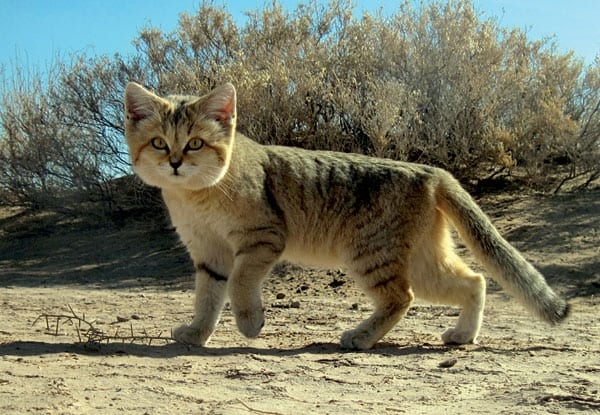
The sand cat (Felis margarita) is a small wild cat that inhabits sandy and stony deserts far from water sources. With its sandy to light grey fur, it is well camouflaged in a desert environment. Its head-and-body length ranges from 39–52 cm (15–20 in) with a 23–31 cm (9.1–12.2 in) long tail. Its 5–7 cm (2.0–2.8 in) short ears are set low on the sides of the head, aiding detection of prey moving underground. The long hair covering the soles of its paws insulates its pads against the extreme temperatures found in deserts.
The first sand cat known to scientists was discovered in the Algerian Sahara and described in 1858. To date, it has been recorded in several disjunct locations in Western Sahara, Morocco, Algeria, Niger, Chad, Egypt, the Arabian Peninsula and the Middle East. In Central Asia, it was first recorded in the Karakum Desert in 1925. The large gap between these two regions of its global range was partially closed in 1948, when a sand cat skin was found in an oasis of the Rub' al Khali in Oman. It is discontinuously distributed in the deserts of the Arabian Peninsula and the Middle East. In the early 1970s, sand cats were caught in southwestern Pakistan and exported to zoos worldwide. Due to its wide distribution and large population, it is listed as Least Concern on the IUCN Red List.
Furry paws that leave no print on burning sand.
Distribution and habitat
The sand cat inhabits both sandy and stony deserts. It is widely but not contiguously distributed in the deserts of North Africa and Southwest and Central Asia.
It prefers flat or undulating terrain with sparse vegetation of grasses or small bushes; it avoids bare and shifting sand dunes, where little prey is available.
In the Western Sahara, sand cats were sighted and photographed in the Dakhla-Oued Ed-Dahab region several times between 2005 and 2016.
Behaviour and ecology
The sand cat is solitary, except during the mating season and when a female has kittens. It makes loud, high-pitched and short rasping sounds, especially when seeking a mate. Its vocalizations are similar to those of the domestic cat. It communicates by urine spraying and using scent and scratch marks. It buries its feces and covers it with sand.
Its way of moving is distinct: with its belly close to the ground, it moves at a fast run punctuated with occasional leaps. It is capable of sudden bursts of speed and can sprint at speeds of 30–40 km (19–25 mi) per hour.
Four radio-collared sand cats in Israel moved long distances of 5–10 km (3.1–6.2 mi) in a single night. They were generally active throughout the night, hunting and travelling an average distance of 5.4 km (3.4 mi). They retired below ground at dawn and stayed in the burrow during the day. During the survey period, they used several burrows in their home ranges.
Threats
Habitat degradation and loss of sand dunes due to human activities are considered major threats to sand cat populations in Western Asia, where uncontrolled hunting and persecution of predators using poisoned baits are common practices. The sand cat's small-mammal prey-base depends on having adequate vegetation, which may experience large fluctuations due to drought or declines due to desertification and loss of natural vegetation.
Fencing of protected areas threatens the sand cat in Saudi Arabia, where several individuals were found stuck in fences.
In Iran, vulnerable arid ecosystems are being rapidly degraded by human settlement and activity, especially livestock grazing.
Conservation
Felis margarita is listed on CITES Appendix II. Hunting is prohibited in Algeria, Iran, Israel, Kazakhstan, Mauritania, Niger, Pakistan, and Tunisia. No legal protection exists in Egypt, Mali, Morocco, Oman, Saudi Arabia, and the United Arab Emirates. Previously having been classified as near threatened, it has been downlisted to least concern in 2016, as the estimated size of the global population exceeds the threshold for a threatened category; the extent of decline of the global population is unknown.
The Jerusalem Biblical Zoo started a sand cat reintroduction project in Israel's Arabah Desert. Several captive-born individuals from the zoo's population were kept in an acclimatization enclosure, but did not survive subsequent release into the wild.
Since the mid-1960s, sand cats were captured in Pakistan for trade and export to Europe until the Pakistani government ceased issuing permits in 1974.
Characteristics
The sand cat's fur is of a pale, sandy, isabelline colour, but much lighter on the lower part of the head, around the nose, throat, and on the belly. A faint reddish line runs from the outer corner of each eye across the cheeks. There are dark brown to blackish bars on the limbs, and the tail has a black tip with two or three dark rings alternating with buff bands. Markings vary between individuals: some have neither spots nor stripes, some are faintly spotted, some have both spots and stripes.
Its head is sandy brown. The large, greenish-yellow eyes are ringed with white, and the nose is blackish. Its whiskers are white and up to 8 cm (3.1 in) long.
Its ears are tawny at the base and tipped with black. Its outer ear is similar to that of a domestic cat, but its ear canal is about twice the size. The magnitude of acoustic input-admittance is about five times higher than of a domestic cat. Additionally, hearing sensitivity of the sand cat is about 8 decibels greater than that of the domestic cat.