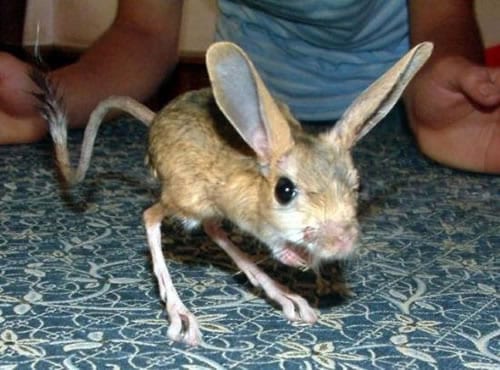
Jerboas ( ) are the members of the family Dipodidae. They are nocturnal hopping desert rodents found throughout North Africa and Asia. They tend to live in hot deserts.
When chased, jerboas can run at up to 24 km/h (15 mph). Some species are preyed on by little owls (Athene noctua) in central Asia. Most species of jerboas have excellent hearing that they use to avoid becoming the prey of nocturnal predators. The typical lifespan of a jerboa is around 2–3 years.
A mouse on kangaroo legs, hopping the dunes by moonlight.
Anatomy and body features
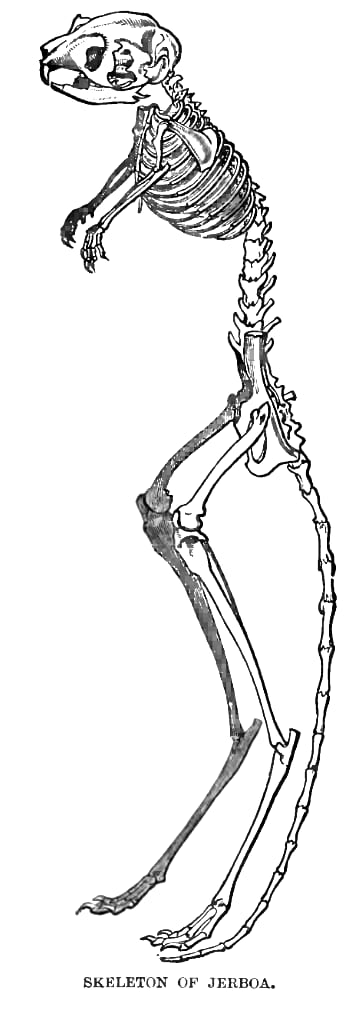
Jerboas look somewhat like miniature kangaroos, and have some external similarities. Both have long hind legs, short forelegs, and long tails. Jerboas move around in a similar manner to kangaroos, which is by hopping, or saltation. However, their anatomy is more attuned towards erratic hopping locomotion, making use of sharp turns and great vertical leaps to confuse and escape predators, rather than for sustained hopping over long periods of time. Researchers have found that, when jerboas execute their vertical leaps, the primary tendons in the hindlimbs only recovered and reused on average 4.4% of energy contributed to the jump; this is lower than many hopping animals. Unlike other hopping mammals which are facultative bipeds, jerboas do not use their forelimbs to walk at slower speeds; instead, unlike nearly any other mammal apart from humans, they almost exclusively move on two legs, making them obligate bipeds.
Jerboas have metatarsal bones that are fused into one long bone, called the cannon bone. Their cannon bone is more distinct and defined than in other rodents. This acts as leverage to allow them to reach higher heights while jumping, while also supporting the legs. Their back legs are often up to four times as long as the front legs. This further allows them to sling-shot themselves into the air. Jerboas that live in sandy desert environments develop hairs on the bottom of their feet that allow for better traction and grip so that they don't slip in the sand.
Diet
Most jerboas rely on plant material as the main component of their diet, but they cannot eat hard seeds. Some species opportunistically eat other jerboas and other animals they come across. Unlike gerbils, jerboas are not known to store their food.
Some species of Jerboa are known to have a diet that consists of insects, plants, and sometimes soft seeds. They use their two front legs to gather food.
Jerboas do not drink water but instead get their water intake from the food they eat. Jerboas like desert plants; they are best when they are wet but when dried out the jerboas will dig the plants up and eat the roots because that part of the plant holds the most water. Jerboas will also try to minimize water loss by feeding at night when it is cooler in the desert.
Behavior
The bipedal locomotion of jerboas involves hopping, skipping, and running gaits, associated with rapid and frequent, difficult-to-predict changes in speed and direction, facilitating predator evasion relative to quadrupedal locomotion. This may explain why evolution of bipedal locomotion is favored in desert-dwelling rodents that forage in open habitats.
Jerboas can hop 10–13 cm (4–5 in) normally but if threatened by a predator the jerboa can jump up to 3 m (10 ft).
Jerboas are most active at twilight (crepuscular). During the heat of the day, they shelter in burrows. At night, they leave the burrows due to the cooler temperature of their environment. They dig the entrances to their burrow near plant life, especially along field borders. During the rainy season, they make tunnels in mounds or hills to reduce the risk of flooding. In the summer, jerboas occupying holes plug the entrance to keep out hot air and, some researchers speculate, predators. In most cases, burrows are constructed with an emergency exit that ends just below the surface or opens at the surface but is not strongly obstructed. This allows the jerboa to quickly escape predators.
Reproduction
Mating systems of closely related species in the family Dipodidae suggest that they may be polygynous. For some closely related jerboa species, mating usually happens a short time after awaking from winter hibernation. A female breeds twice in the summer, and raises from two to six young. Gestation time is between 25 and 35 days. Little is known about parental investment in long-eared jerboas. Like most mammals, females nurse and care for their young at least until they are weaned.
Food conditions become abundant typically in the spring and summer. This is also when reproduction rates in the jerboas increase. Jerboas have cells that produce sex hormones known as the gonadotropin-releasing hormone (GnRH). These cells fire the most in the months of March through July. These cells quit producing GnRH in the autumn, and the jerboa's mating season ends.
Communication and perception
Many species within the family Dipodidae engage in dust bathing, often a way to use chemical communication. Their keen hearing suggests they may use sounds or vibrations to communicate.