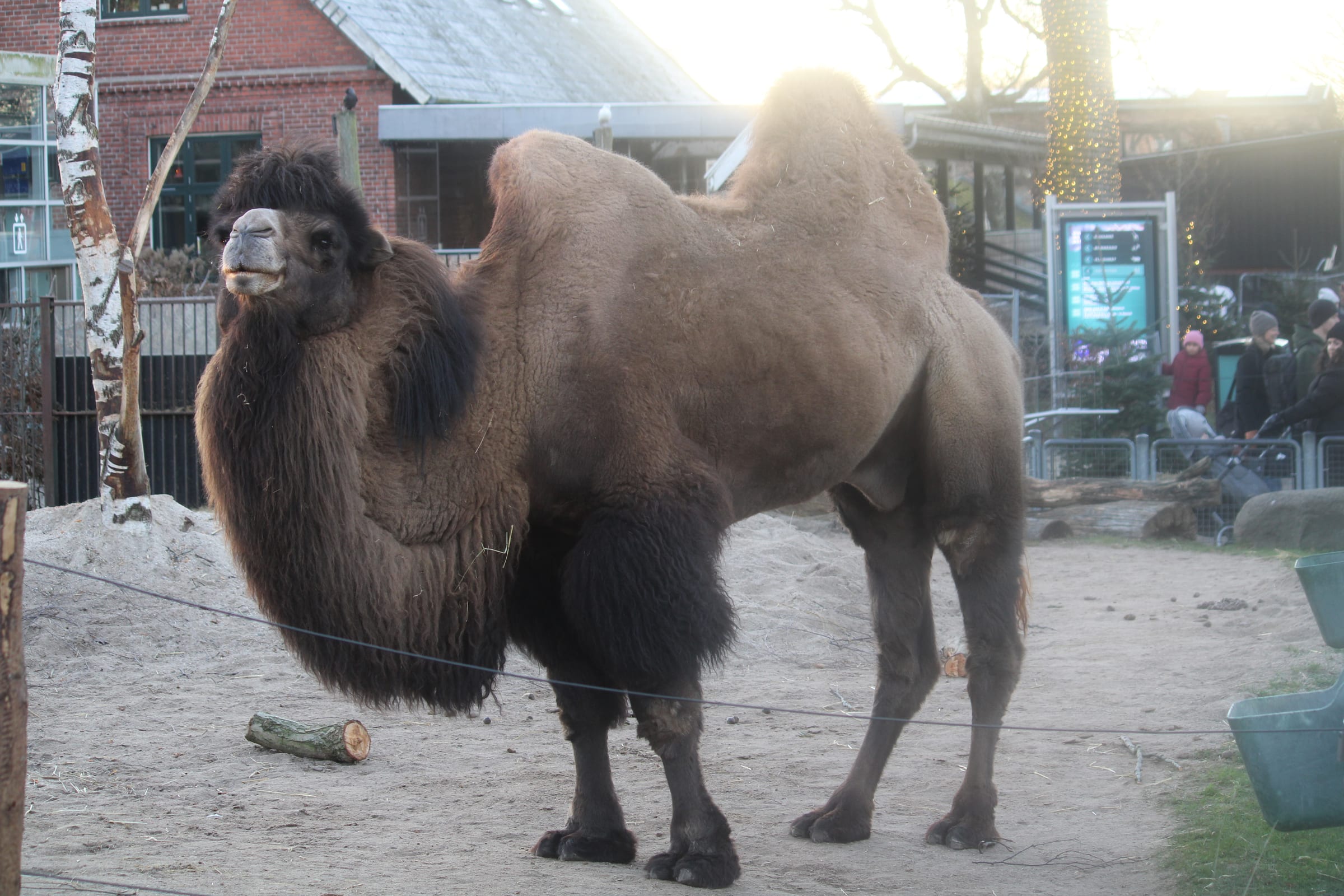
The Bactrian camel (Camelus bactrianus), also known as the Mongolian camel, domestic Bactrian camel, two-humped camel or double humped camel, is a camel native to the steppes of Central Asia. It has two humps on its back, in contrast to the single-humped dromedary. Its population of 2 million exists mainly in the domesticated form. Their name comes from the ancient historical region of Bactria.
Domesticated Bactrian camels have served as pack animals in inner Asia since ancient times. With its tolerance for cold, drought, and high altitudes, it enabled the travel of caravans on the Silk Road. Bactrian camels, whether domesticated or feral, are a separate species from the wild Bactrian camel (Camelus ferus), which is the only truly wild (as opposed to feral) species of camelid in the Old World. Domestic Bactrian camels do not descend from wild Bactrian camels, with the two species having split around 1 million years ago.
Two humps, four eyelids, and minus forty in its bones.
Description
The Bactrian camel is the largest mammal in its native range and is the largest living camel while being shorter at the shoulder than the dromedary. Shoulder height is from 160 to 180 cm (5.2 to 5.9 ft) with the overall height ranging from 230 to 250 cm (7.5 to 8.2 ft), head-and-body length is 225–350 cm (7.38–11.48 ft), and the tail length is 35–55 cm (14–22 in). At the top of the humps, the average height is 213 cm (6.99 ft).
Body mass can range from 300 to 1,000 kg (660 to 2,200 lb), with males weighing around 600 kg (1,300 lb), and females around 480 kg (1,060 lb). Its long, wooly coat varies in colour from dark brown to sandy beige. A mane and beard of long hair occurs on the neck and throat, with hairs measuring up to 25 cm (9.8 in) long.
The shaggy winter coat is shed extremely rapidly, with huge sections peeling off at once, appearing as if sloppily shorn. The two humps on the back are composed of fat (not water as is sometimes thought). The face is typical of a camelid, being long and somewhat triangular, with a split upper lip. The long eyelashes, along with the sealable nostrils, help to keep out dust in the frequent sandstorms which occur in their natural range. The two broad toes on each foot have undivided soles and are able to spread widely as an adaptation to walking on sand. The feet are very tough, as befits an animal of extreme environments.
Natural habitat
These camels are migratory, and their habitat ranges from rock-dominated mountain massifs to flat steppe, arid desert, (mostly the Gobi Desert), stony plains and sand dunes. Conditions are extremely harsh – vegetation is sparse, water sources are limited and temperatures are extreme. The coat of the Bactrian camel can withstand cold as low as −30 °C (−22 °F) in winter to 50 °C (122 °F) in summer. The camels' distribution is linked to the availability of water, with large groups congregating near rivers after rain or at the foot of the mountains, where water can be obtained from springs in the summer months, and in the form of snow during the winter.
Life history
Bactrian camels are exceptionally adept at withstanding wide variations in temperature, ranging from freezing cold to blistering heat. They can go without water for months at a time, but when water is available they may drink up to 57 L (13 imp gal; 15 US gal). A thirsty camel in a hot dry season can drink up to 200 L (44 imp gal; 53 US gal) of water in one day. When well fed, the humps are plump and erect, but as resources decline, they shrink and lean to the side. When moving faster than a walking speed, they pace, by stepping forwards with both legs on the same side (as opposed to trotting, using alternate diagonals as done by most other quadrupeds). Speeds of up to 65 kilometres per hour (40 mph) have been recorded, but they rarely move this fast. Usually doing sustained speeds of 40 km/h (25 mph) Domestic Bactrian camels have also been observed swimming. Their sense of sight is well developed and their sense of smell is extremely good. The lifespan of Bactrian camels is estimated at up to 50 years in the wild, but their average lifespan in the wild is around 30, domesticated ones haven't been recorded at living longer than 35 years.
Climate adaptations
The Bactrian camel has shaggy fur that keeps them warm. They live in areas with extreme temperatures, ranging from intense cold to severe heat. When it gets warm out, their shaggy coat will shed, helping the camel control its body temperature. The Bactrian camel has two humps to store the energy they get from fat. If energy sources become scarce, camels can rely on the energy stored in their humps. They can also drink up to 35 US gallons (130 L) of water at a time.
Relationship to humans
The Bactrian camel was domesticated circa 2500 BCE. The dromedary is believed to have been domesticated between 4000 BCE and 2000 BCE in Arabia. As pack animals, these ungulates are virtually unsurpassed, able to carry 170–250 kg (370–550 lb) at a rate of 47 kilometres (29 mi) per day, or 4 kilometres per hour (2.5 mph) over a period of four days. The species was a mainstay of transportation on the Silk Road. The Bactrian camel was an important aspect in human transportation, they were able to withstand harsh conditions, which made them ideal for long-distance travel. Furthermore, Bactrian camels are frequently ridden, especially in desertified areas. In ancient Sindh, for example, Bactrian camels of two humps were initially used by the rich for riding. The camel was later brought to other areas such as Balochistan and Iran for the same purpose.
Bactrian camels have been the focus of artwork throughout history. For example, westerners from the Tarim Basin and elsewhere were depicted in numerous ceramic figurines of the Chinese Tang dynasty (618–907).