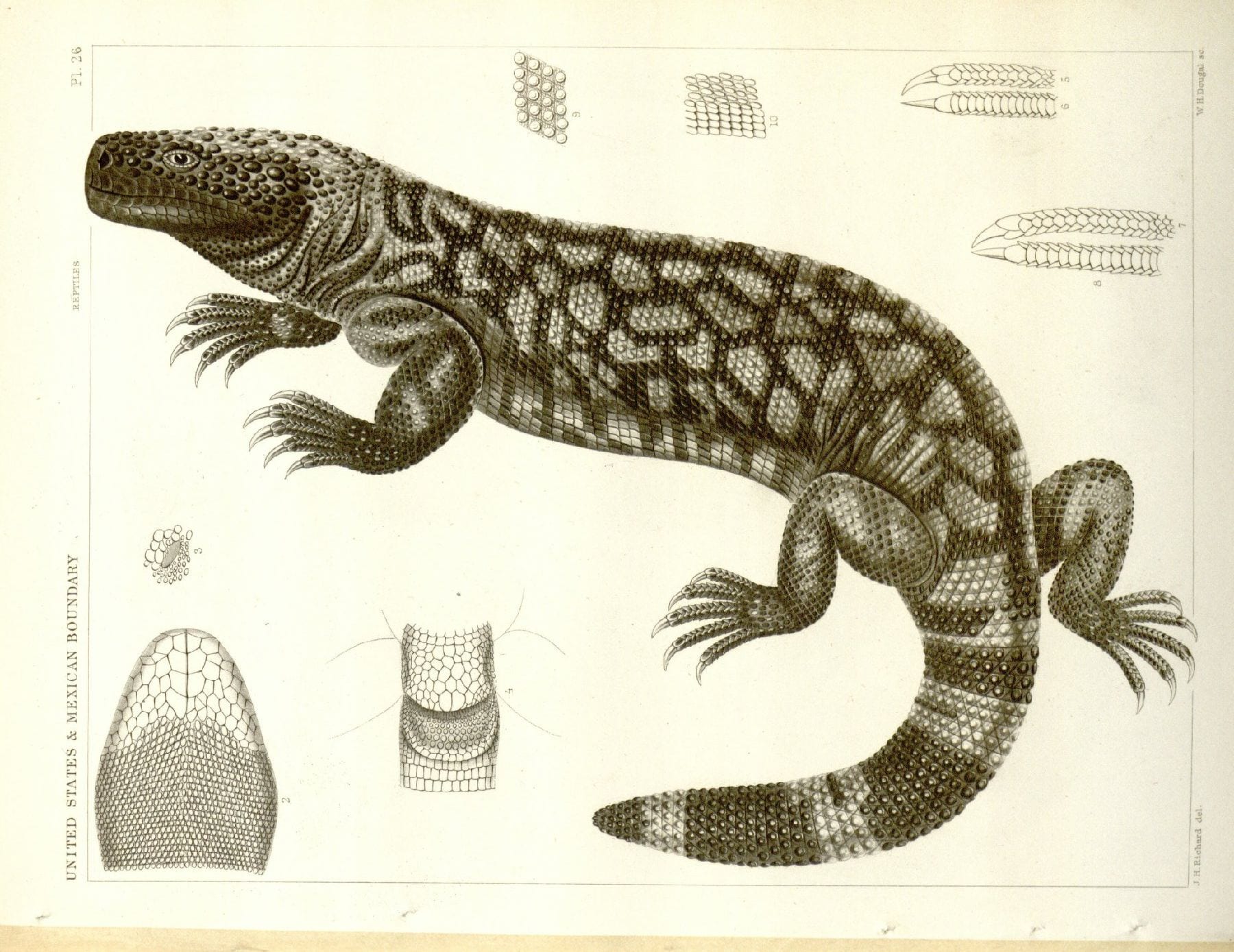
The Gila monster ( HEE-lə; Heloderma suspectum) is a species of venomous lizard native to the Southwestern United States and the northwestern Mexican state of Sonora. It is a heavy, slow-moving reptile, up to 22 in (56 cm) long, and it is the only venomous lizard native to the United States. Its venomous close relatives, the four beaded lizards (all former subspecies of Heloderma horridum) inhabit Mexico and Guatemala. The Gila monster is sluggish in nature, so it is not generally dangerous and very rarely poses a real threat to humans. Nonetheless, it has a fearsome reputation and is sometimes killed despite the species being protected by state law in Arizona.
One of two venomous lizards alive, beaded like a saddle.
Description
The Gila monster is the largest extant lizard species native to North America north of the Mexican border. Its snout-to-vent length ranges from 26 to 36 cm (10 to 14 in). The tail is about 20% of the body size, and the largest specimens may reach 51 to 56 cm (20 to 22 in) in total length. Body mass is typically in the range of 550 to 800 g (1.21 to 1.76 lb). They appear strong in their body structure with a stout snout, massive head, and "little"-appearing eyes, which can be protected by a nictitating membrane.
The Gila monster has four close living relatives, all of which are beaded lizards. There are three species in Mexico: Heloderma exasperatum, Heloderma horridum and Heloderma alvarezi, as well as another species in Guatemala: Heloderma charlesbogerti.
Distribution and habitat
The Gila monster is found in the Southwestern United States and Mexico, across a range including Sonora, Arizona, and parts of California, Nevada, Utah, and New Mexico. No records have been given from Baja California. They inhabit scrubland, succulent desert, and oak woodland, seeking shelter in burrows, thickets, and under rocks in locations with a favorable microclimate and adequate humidity. Gila monsters rely heavily on the use of shelters and spend much of their time dwelling there. Often times these shelters are in rocky areas in Navajo Sandstone and basaltic lava flows. Gila monsters depend on water resources and can be observed in puddles of water after a summer rain. They avoid living in open areas, such as flats and open grasslands.
Diet
The Gila monster's diet consists of a variety of food items – small mammals (such as young rabbits, hares, mice, ground squirrels, and other rodents), small birds, snakes, lizards, frogs, insects, other invertebrates, carrion, and the eggs of birds, lizards, snakes, and tortoises. Three to four extensive meals in spring are claimed to give Gila monsters enough energy for a whole season. They can store fat in their tails and therefore do not need to eat often. Nevertheless, they feed whenever they come across suitable prey. Young Gila monsters can swallow up to half of their body weight in a single meal. Adults may eat up to one third of their body weight in one meal.
The Gila monster uses its extremely acute sense of smell to locate prey. The strong, two-ended tipped tongue, which is pigmented in black-blue colors, picks up scent molecules to be transferred to the opening of the Jacobson organ around the middle of the upper mouth cavern.
Prey may be crushed to death if large, or eaten alive, most of the time head first, and helped down by muscular contractions and neck flexing. After food has been swallowed, the Gila monster may immediately resume tongue flicking and search behavior in order to identify further prey such as eggs or young in nests. Gila monsters are able to climb trees, cacti, and even fairly straight, rough-surfaced walls.
Ecology
Gila monsters spend 90% of their lifetime underground in burrows or rocky shelters. They are active in the morning during the dry season (spring and early summer). The lizards move to different shelters every 4–5 days up to the beginning of the summer season. By doing so, they optimize for a suitable microhabitat. Later in the summer, they may be active on warm nights or after a thunderstorm. They maintain a surface body temperature of about 30 °C (86 °F). Close to 37 °C (99 °F), they are able to decrease their body temperature by up to 2 °C (3.6 °F) by an activated, limited evaporation via the cloaca. One study investigating a population of Gila monsters in southwestern Utah noted that the lizard's activity peaked from late April to mid June. The average distance traveled during their bouts of activity was 210 metres (690 ft), but on occasion some lizards would travel distances greater than 1 kilometre (0.62 mi). During the Gila monster's active season of approximately 90 days, only ten days were spent active. Gila monsters are slow sprinters, but they have relatively high endurance and maximal aerobic capacity (VO2 max) compared to other lizards. They are preyed upon by coyotes, badgers, and raptors. Hatchlings are preyed on by snakes, such as kingsnakes (Lampropeltis sp.).
Life cycle
The Gila monster emerges from brumation in early March. Gila monsters sexually mature at 4–5 years old. It mates in April and May. The male initiates courtship by flicking his tongue to search for the female's scent. If the female rejects his advances, she will bite him and chase him away. When successful, copulation has been observed in captivity to last from 15 minutes to two and a half hours. There is only a single record of attempted mating outside of a shelter. The female lays eggs at the end of May into June. A clutch may consist of up to eight (rarely more than six) eggs. The incubation in captivity lasts about 5 months, depending on the incubation temperature. The hatchlings are about 16 cm (6.3 in) long and can bite and inject venom as soon as they are hatched.
The egg development and hatching time of young in the wild has been a subject of ongoing speculation for decades. The first model stated that youngsters hatch in fall and stay underground. The second theory postulated a nearly developed embryo remains inside the egg over winter and hatches in spring. Hatchlings (weight about 35 g (1.2 oz)) are observed at the end of April to early June.