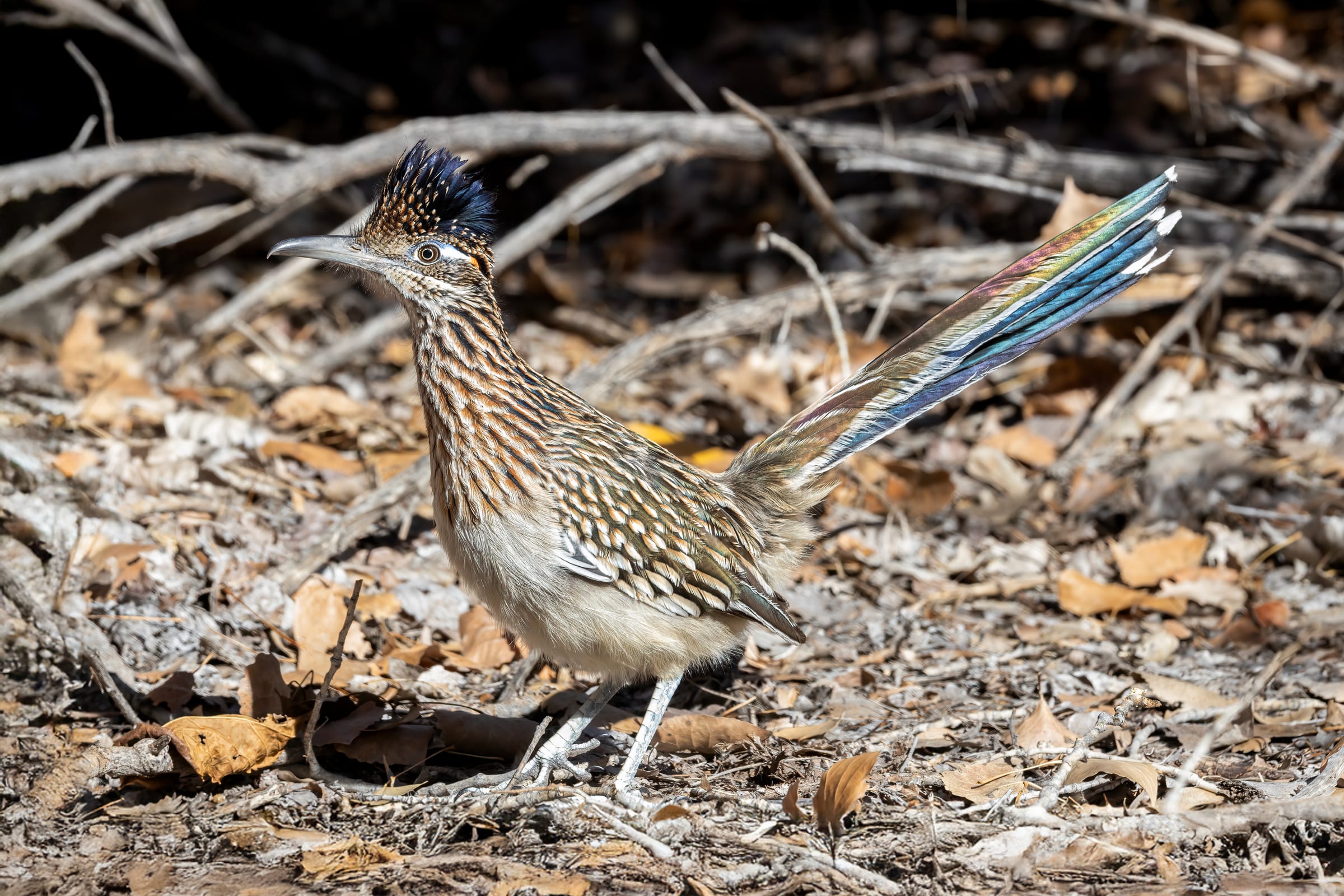
The greater roadrunner (Geococcyx californianus) is a long-legged bird in the cuckoo family, Cuculidae, from the Aridoamerica region in the Southwestern United States and Mexico. The scientific name means "Californian earth-cuckoo". Along with the lesser roadrunner, it is one of two species in the genus Geococcyx. This roadrunner is also known as the chaparral cock, ground cuckoo, and snake killer.
Outruns rattlesnakes at thirty kilometres an hour, no problem.
Description
The greater roadrunner is about 52–62 cm (20–24 in) long, has a 43–61 cm (17–24 in) wingspan, and weighs 221–538 g (7.8–19.0 oz). It stands around 25–30 cm (9+3⁄4–11+3⁄4 in) tall and is the largest cuckoo of the Americas. The upper body is mostly brown with black streaks and sometimes pink spots. The neck and upper breast are white or pale brown with dark brown streaks, and the belly is white. A crest of brown feathers sticks up on the head, and a bare patch of orange and blue skin lies behind each eye; the blue is replaced by white in adult males (except the blue adjacent to the eye), and the orange (to the rear) is often hidden by feathers. Males and females have identical plumage. Females are slightly smaller, on average 2 cm (3⁄4 in) shorter and 30 g (1.1 oz) lighter than males. The long, stout beak is grayish brown to gray and has a hooked tip. Roadrunners have four toes on each zygodactyl foot; two face forward, and two face backward. The toes are brown in color and have pale gold spots.
Although capable of limited flight, it spends most of its time on the ground, and can run at speeds up to 20 mph (32 km/h). Cases where roadrunners have run as fast as 26 mph (42 km/h) have been reported. This is the fastest running speed clocked for a flying bird, but not nearly as fast as the 40 mph (60 km/h) of the completely flightless and much larger ostrich.
Distribution and habitat
The greater roadrunner is found in the Aridoamerica ecoregion, within the Southwestern United States and northern Mexico. It can be seen regularly in the US states of California, Texas, New Mexico, Arizona, Nevada, Oklahoma, Utah, and a tiny bit of Colorado, and less frequently in Kansas, Louisiana, Arkansas, and Missouri, as well as the Mexican states of Baja California, Baja California Sur, Sonora, Sinaloa, Chihuahua, Durango, Jalisco, Coahuila, Zacatecas, Aguascalientes, Guanajuato, Michoacán, Querétaro, México, Puebla, Nuevo León, Tamaulipas, and San Luis Potosí. The species is not migratory.
The greater roadrunner can be found from 200 ft (61 m) below sea level to 7,500 ft (2,300 m), but rarely above 9,800 ft (3,000 m). It occupies arid and semiarid scrubland, with scattered vegetation (typically less than 50% cover) with a height less than 3.0 m (9 ft 10 in).
Behavior
Until a mate is found, greater roadrunners typically live a solitary life. They are monogamous, forming long-term pair bonds. Breeding season begins from mid-March to early September. Courtship behaviors between greater roadrunners are a lengthy process including a combination of chasing, tail wagging, play-fighting, and acoustic signals. Once the chasing stage has passed, the male presents nesting materials or food to the females.
Often, males offer food to females during the act of copulation. A unique feature of the greater roadrunner is that mated couples continue their copulation rituals long after the need for egg fertilization. This factor is believed to contribute to the couple's pair-bond maintenance. Greater roadrunner couples defend a territory of about 7,500 to 8,600 ft2 (700 to 800 m2) in size. The male is more territorial, calling out to warn competitors, and does not hesitate to physically push the intruders out of his territory. Some couples defend the same territory all year long.
Taxonomy and systematics
Greater roadrunner fossils dating from the Holocene and Pleistocene have been found in California,Arizona, New Mexico, and Texas, in the United States, and the Mexican state of Nuevo León. The oldest known fossil comes from a cave in New Mexico, estimated at an age of 33,500 years. In the La Brea Tar Pits, fragments from 25 greater roadrunner fossils have been found. Several other fossils are also known from Santa Barbara and Kern Counties, as well as Northern Mexico.
Prehistoric remains indicate that until 8,000 years ago, the greater roadrunner was found in sparse forests rather than scrubby deserts; only later did it adapt to arid environments. Due to this, along with human transformation of the landscape, it has recently started to move northeast of its normal distribution. Sparse forests can be found in these parts, in an environment similar to the prehistoric North American Southwest.
Relationship to humans
Some Pueblo Native American tribes, including the Hopi, believed the roadrunner provided protection against evil spirits. In Mexico, some said it brought babies, as the white stork was said to in Europe. Some Anglo frontier people believed roadrunners led lost people to trails.
Wile E. Coyote and the Road Runner are the two main characters and protagonists of a long-running (since 1949) Warner Bros. animated series.
The greater roadrunner is the state bird of New Mexico, and as such, appeared in a 1982 sheet of 20-cent United States stamps showing 50 state birds and flowers.