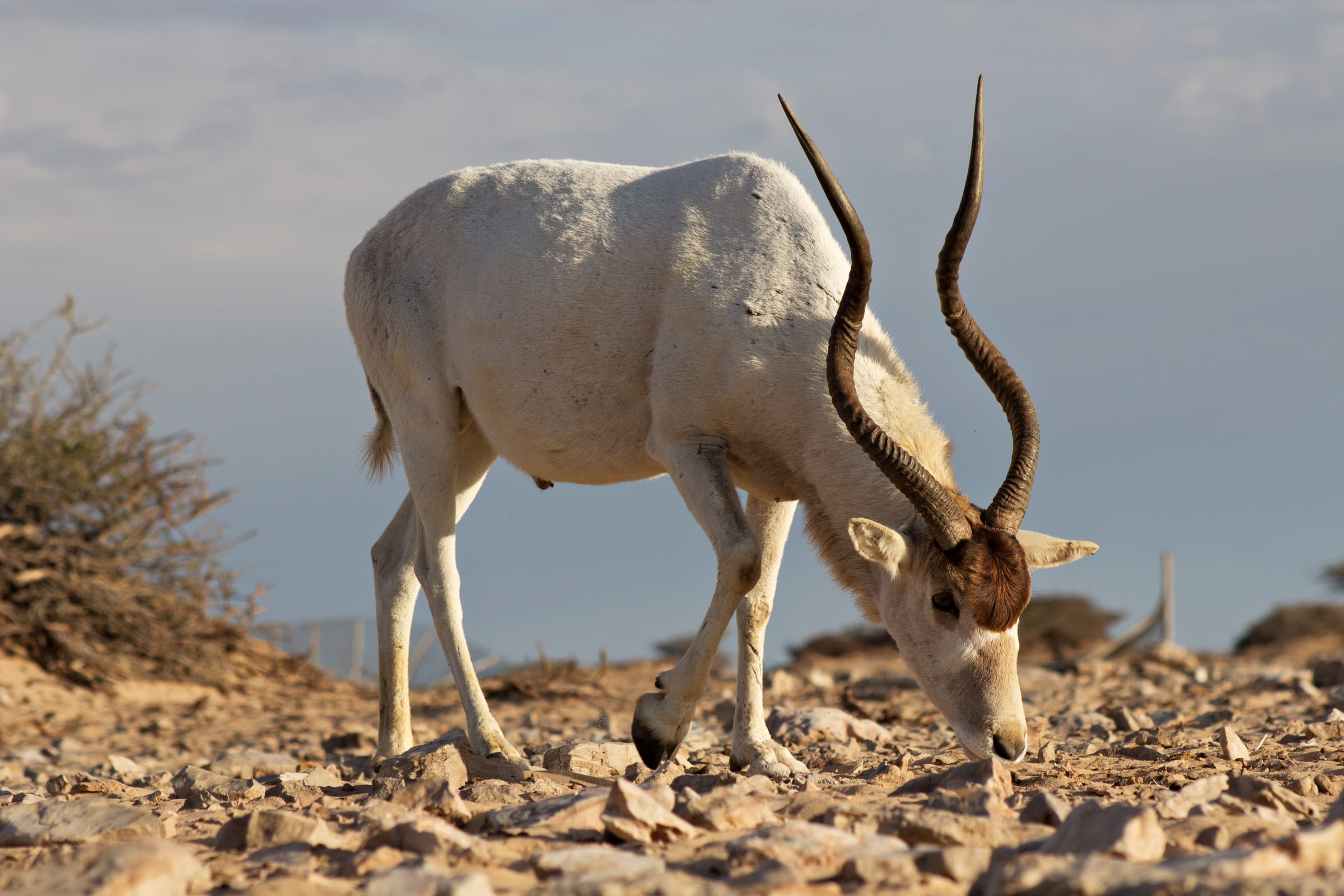
The addax (Addax nasomaculatus), also known as the white antelope and the screwhorn antelope, is an antelope native to the Sahara. The only member of the genus Addax, it was first described scientifically by Henri de Blainville in 1816. As suggested by its alternative name, the addax has spiral horns that are 55 to 80 cm (22 to 31 in) long in females and 70 to 85 cm (28 to 33 in) in males. In the winter, its coat is greyish-brown with white hindquarters and legs, and long, brown hair on the head, neck, and shoulders; in the summer, the coat turns almost completely white or sandy blonde. Males stand from 105 to 115 cm (41 to 45 in) at the shoulder, with females at 95 to 110 cm (37 to 43 in). They are sexually dimorphic, as the females are generally smaller than the males.
The addax lives in arid regions, semideserts, and sandy and stony deserts in North Africa. It mainly eats grasses and leaves of shrubs, leguminous herbs, and bushes. It can live without water for long periods of time. Addax form herds of five to 20 members, consisting of both males and females. The herd is usually led by one dominant male. Breeding season is at its peak during winter and early spring.
An antelope of the Sahara, drinking only from morning dew.
Description
The addax is greyish-brown in winter and almost completely white or sandy blonde in summer; it has white hindquarters and legs, and long, brown hair on the head, neck, and shoulders. Its head-to-body length is 120 to 130 cm (47 to 51 in), and its tail is 25 to 35 cm (9.8 to 13.8 in) long. It is sexually dimorphic in size, as males stand from 105 to 115 cm (41 to 45 in) at the shoulder with a weight of 100 to 125 kg (220 to 276 lb), whereas females are 95 to 110 cm (37 to 43 in) tall with a weight of 60 to 90 kg (130 to 200 lb).
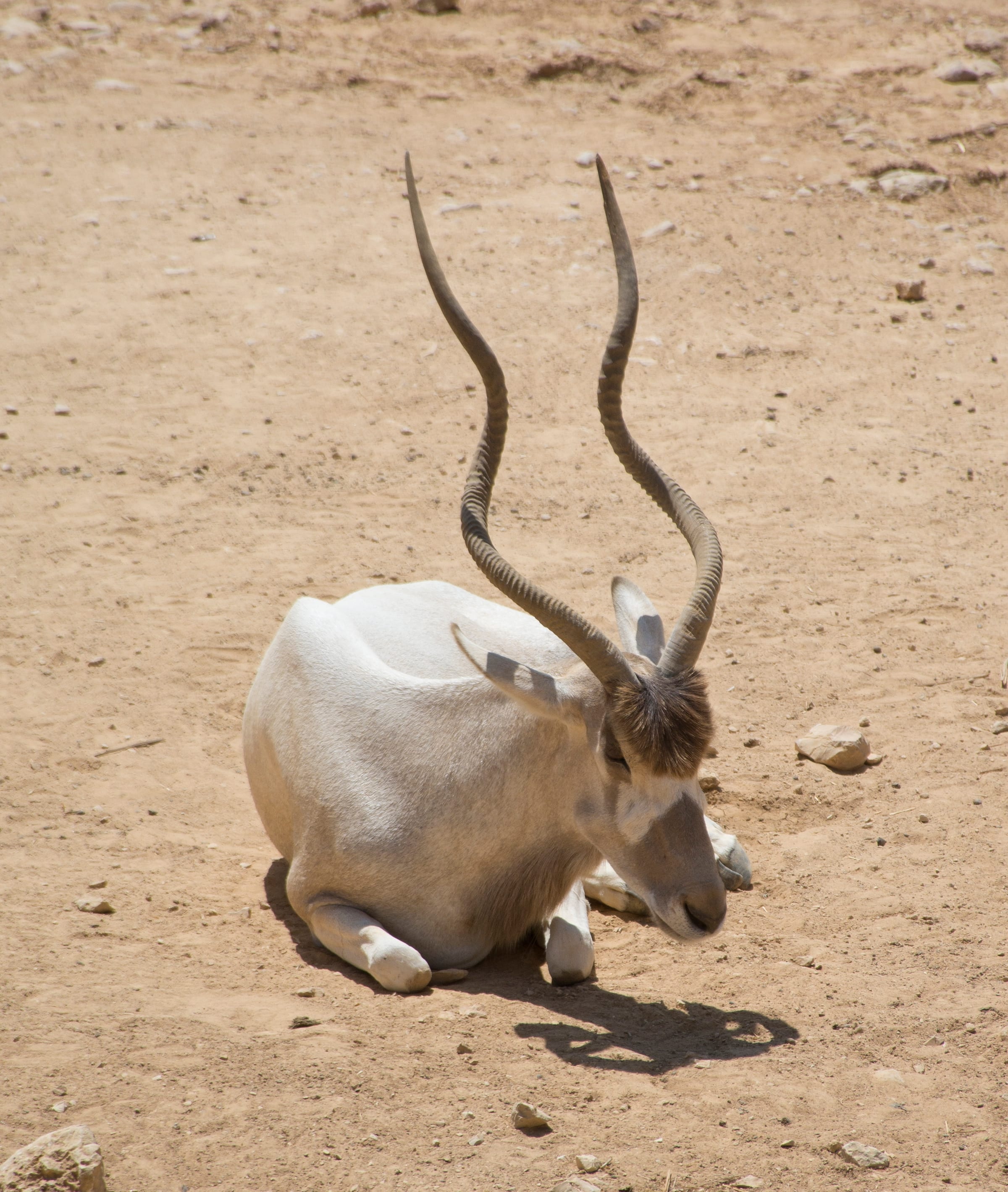
Their heads are marked with brown or black patches that form an X over their noses. They have scraggly beards and prominent red nostrils. Long, black hairs stick out between their curved and spiraling horns, ending in a short mane on the neck.
The horns have two to three twists and are typically 55 to 80 cm (22 to 31 in) in females and 70 to 85 cm (28 to 33 in) in males, although the maximum recorded length is 109.2 cm (43.0 in). The lower and middle portions of the horns are marked with a series of 30 to 35 ring-shaped ridges. The tail is short and slender, ending in a puff of black hair. The hooves are broad with flat soles and strong dewclaws to help them walk on soft sand. All four feet possess scent glands. The lifespan of the addax is up to 19 years in the wild, which can be extended to 25 years in captivity.
Distribution and habitat
The addax inhabits arid regions, semideserts, and sandy and stony deserts. It can live in extremely arid areas, with less than 100 mm (3.9 in) annual rainfall. It also inhabits deserts with tussock grasses (Stipagrostis species) and succulent thorn scrub Cornulaca. Formerly, the addax was widespread in the Sahelo-Saharan region of Africa, west of the Nile Valley, and all countries sharing the Sahara, but today the only known self-sustaining population is present in the Termit Massif Reserve in Niger. Reports of sightings have been made from the eastern Air Mountains in Niger and Bodélé in Chad. Rare nomads may be seen in northern Niger, southern Algeria, and Libya; it is rumoured to be present along the Mali/Mauritania border, though no sightings have been confirmed. The addax was once abundant in North Africa, native to Chad, Mauritania, and Niger. It is extinct in Algeria, Egypt, Libya, Sudan, and the Western Sahara. It has been reintroduced into Morocco and Tunisia.
Behavior and ecology
Addax herds contain both males and females, and have from five to 20 members. They generally stay in one place and only wander widely in search of food. The herd is usually formed around one dominant male. In captivity, males show signs of territoriality and mate guarding, while captive females establish dominance hierarchies, with the oldest females holding highest rank. Herds are more likely to be found along the northern edge of the tropical rain system during the summer and move north as winter falls. They are able to track rainfall and head for these areas where vegetation is more plentiful. Males are territorial and guard females, while the females establish their own dominance hierarchies.
Due to its slow movements, the addax is an easy target for predators, such as humans, lions, leopards, cheetahs, and African wild dogs. Caracals, servals, and hyenas attack calves. The addax is normally not aggressive, though individuals may charge if they are disturbed.
Threats and conservation
Declines in the population of the addax have been ongoing since the mid-1800s. More recently, addax were found from Algeria to Sudan, but due mainly to overhunting, they have become much more restricted and rare.
Addax are easy to hunt due to their slow movements. Roadkill, firearms for easy hunting, and nomadic settlements near waterholes (their dry-season feeding places) have also decreased their numbers. Moreover, their meat and leather are highly prized. Other threats include chronic droughts in the deserts, habitat destruction due to more human settlements, and agriculture. Fewer than 500 individuals are thought to exist in the wild today, most of the animals being found between the Termit area of Niger, the Bodélé region of western Chad, and the Aoukar in Mauritania.
History and fossil record
In ancient times, the addax occurred from northern Africa through Arabia and the Levant. Pictures in a tomb, dating back to 2500 BCE, show at least the partial domestication of the addax by the ancient Egyptians. These pictures show addax and some other antelopes tied with ropes to stakes. The number of addax captured by a person were considered an indicator of his high social and economic position in the society. The pygarg ("white-buttocked") beast mentioned in Deuteronomy 14:5 is believed by Henry Baker Tristram to have been an addax, but poaching has resulted in the extinction of this species in Egypt since the 1960s.
Addax fossils have been found in four sites of Egypt – a 7000 BCE fossil from the Great Sand Sea, a 5000–6000 BCE fossil from Djara, a 4000–7000 BCE fossil from Abu Ballas Stufenmland, and a 5000 BCE fossil from Gilf Kebir. Apart from these, fossils have also been excavated from Mittleres Wadi Howar (6300 BCE fossil), and Pleistocene fossils from Grotte Neandertaliens, Jebel Irhoud, and Parc d'Hydra.