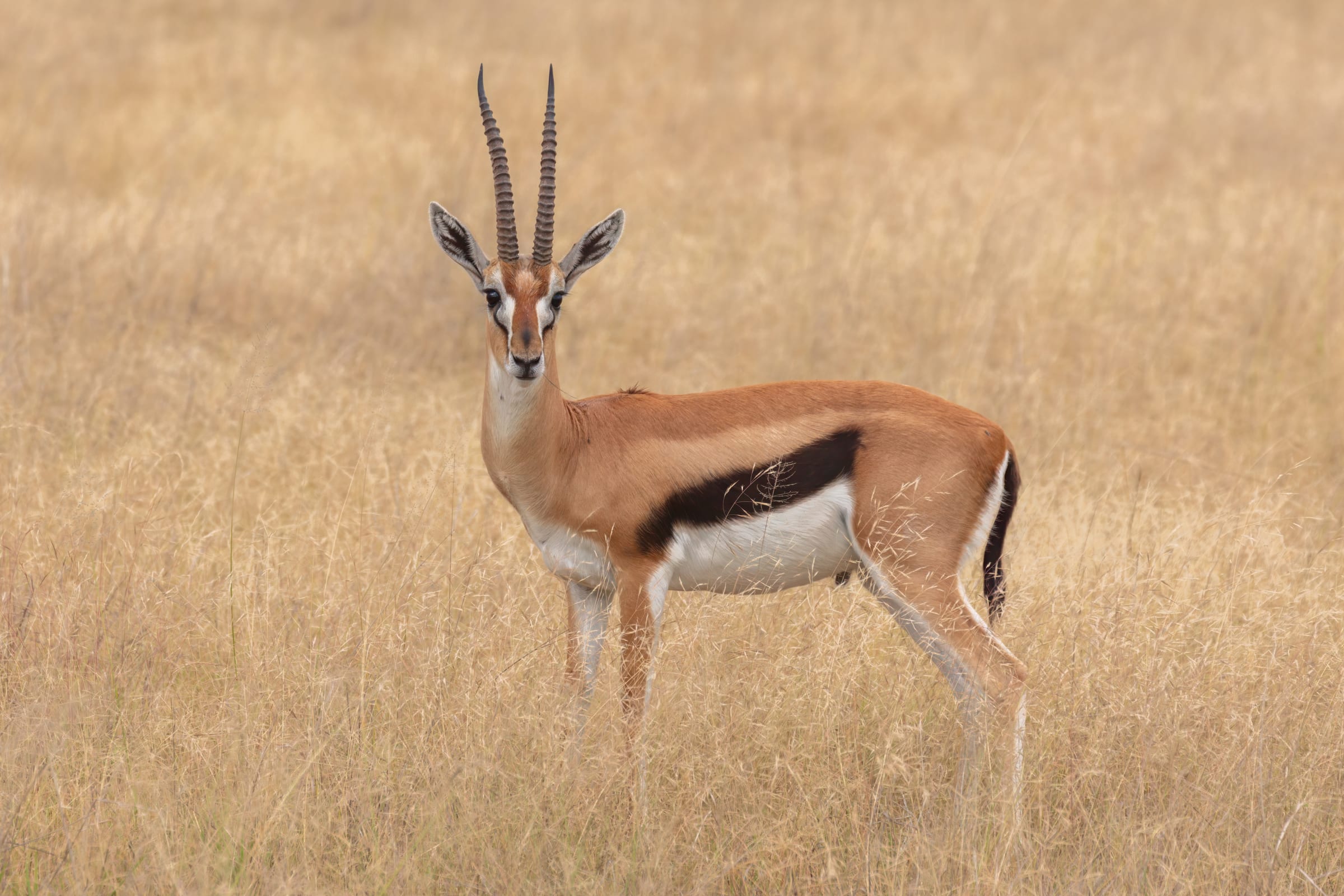
Thomson's gazelle (Eudorcas thomsonii) is one of the best known species of gazelles. It is named after explorer Joseph Thomson and is sometimes referred to as a "tommie". It is considered by some to be a subspecies of the red-fronted gazelle and was formerly considered a member of the genus Gazella within the subgenus Eudorcas, before Eudorcas was elevated to genus status.
Thomson's gazelles can be found in numbers exceeding 200,000 in Africa and are recognized as the most common type of gazelle in East Africa. A small fast antelope, the Thomson's gazelle is said to have top speeds up to 80–90 km/h (50–55 mph). It is the fourth-fastest land animal, after the cheetah (its main predator), pronghorn, and springbok.
Bounces stiff-legged to tell predators not to bother chasing.
Description
Thomson's gazelle is a relatively small gazelle; it stands 60–70 cm (24–28 in) at the shoulder. Males weigh 20–35 kg (44–77 lb), while the slightly lighter females weigh 15–25 kg (33–55 lb). Facial characteristics of the gazelle include white rings around the eyes, black stripes running from a corner of the eye to the nose, rufous stripes running from the horns to the nose, a dark patch on the nose, and a light forehead.
The coat is sandy brown to rufous; a black band runs across the flanks, from the upper foreleg to just above the upper hind leg. A buff band occurs above the black stripe. Short, black streaks mark the white rump. The black tail measures 15–27 cm (5.9–10.6 in). Males have well-developed preorbital glands near the eyes, which are used for scent-marking territories. Both sexes possess horns that curve slightly backward with the tips facing forward. The horns, highly ringed, measure 25–43 cm (9.8–16.9 in) in males and 7–15 cm (2.8–5.9 in) in females. However, females have more fragile horns; some are even hornless. Grant's gazelle is very similar to Thomson's gazelle, but can be differentiated by its larger size and the white patch on the rump extending top over the tail.
Ecology
Thomson's gazelle lives in East Africa's savannas and grassland habitats, particularly the Serengeti region of Kenya and Tanzania. It has narrow habitat preferences, preferring short grassland with dry, sturdy foundation. It does, however, migrate into tall grassland and dense woodland. Gazelles are mixed feeders. In the wet seasons, they eat mainly fresh grasses, but during the dry seasons, they eat more browse, particularly foliage from woody plants bushes and herbaceous forbs.
Thomson's gazelles are dependent on short grass. Their numbers can be highly concentrated at the beginning of the rains when the grass grows quickly. In the Serengeti, they follow the larger herbivores, such as plains zebras and blue wildebeests as they mow down the taller grasses. In the wild, Thomson's gazelles can live 10–15 years. Their major predators are cheetahs, which are able to attain higher speeds, but gazelles can outlast them in long chases and are able to make turns more quickly. This small antelope can run extremely fast, up to 80 km/h (50 mph), and zigzag, an adaptation which often saves it from predators. Sometimes, they are also taken by leopards, lions, African wild dogs, hyenas, Nile crocodiles and African rock pythons, and their fawns are sometimes the prey of eagles, jackals, and baboons. A noticeable behaviour of Thomson's gazelles is their bounding leap, known as stotting or pronking, used to startle predators and display strength.
Reproduction and parental care
A male gazelle follows a female and sniffs her urine to find out if she is in estrus, a process known as the Flehmen response. If so, he continues to court and mount her. Females leave the herd to give birth to single fawns after a five- to six-month gestation period. Breeding takes place year-round, with a peak in births around January/February, and in some populations a second peak around June/July. Newborn fawns weigh 2 to 3 kg (4.4 to 6.6 lb). They give birth twice yearly with one or two fawns. When giving birth, a female gazelle crouches as the newborn fawn drops to the ground, tearing the umbilical cord. The mother then licks the fawn clean of amniotic fluid and tissues. In addition, licking possibly also serves to stimulate the fawn's blood circulation, or to "label" it so its mother can recognize it by scent.
In the first six hours of the fawn's life, it moves and rests with its mother, but eventually spends more time away from its mother or hides in the grass. The mother stays in the vicinity of the fawn and returns to nurse it daily. Mother and fawn may spend an hour together before the fawn goes and lies back down to wait for the next nursing. Mother gazelles may associate with other gazelle mothers, but the fawns do not gather into "kindergartens". Mothers defend their young against jackals and baboons, but not against larger predators. Sometimes, a female can fend off a male baboon by headbutting him with her horns to defend her fawn.
Status
The population estimate is around 550,000. The population had declined 60% from 1978 to 2005. Threats to Thomson's gazelles are habitat modification, fire management, and road development. Surveys have reported steep declines (60–70%) over periods of about 20 years dating from the late 1970s in several places, including the main strongholds for the species: Serengeti, Masai Mara, and Ngorongoro.
Social behavior
During the wet season, a time when grass is abundant, adult male gazelles graze extensively. They spread out more and establish breeding territories. Younger males usually spend their time in bachelor groups, and are prevented from entering the territories. Females form migratory groups that enter the males' territories, mostly the ones with the highest-quality resources. As the female groups pass through and forage, the territorial males may try to herd them, and are usually successful in preventing single females from leaving, but not whole groups. Subadult males usually establish dominance through actual combat, while adults are more likely to do rituals. If a bachelor male should be passing through a territorial male's region, the male will chase the offender out of his territory.