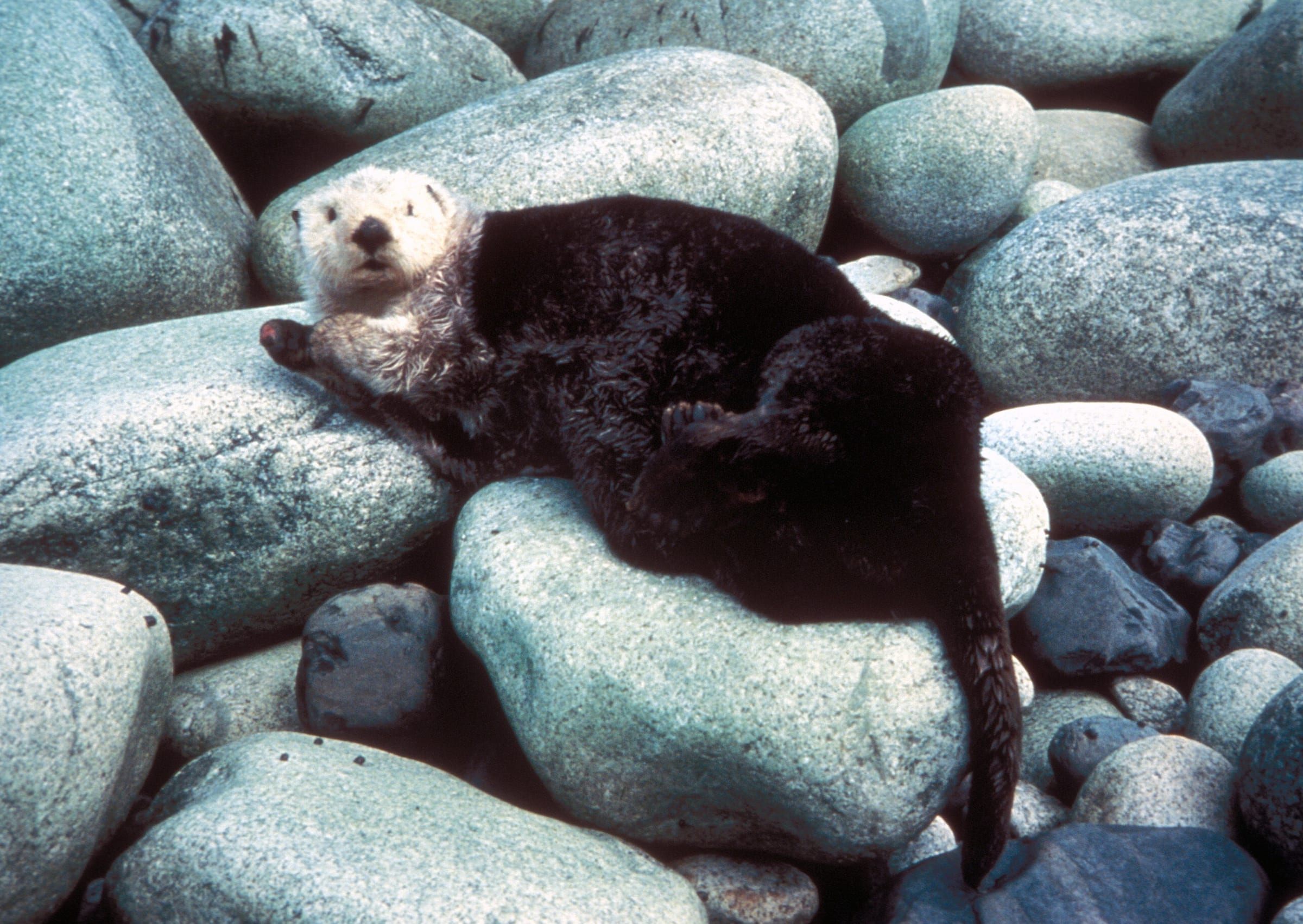
The sea otter (Enhydra lutris) is a marine mammal native to the coasts of the northern and eastern North Pacific Ocean. Adult sea otters typically weigh between 14 and 45 kg (30–100 lb), making them the heaviest members of the weasel family, but among the smallest marine mammals. Unlike most marine mammals, the sea otter's primary form of insulation is an exceptionally thick coat of fur, the densest in the animal kingdom. Although it can walk on land, the sea otter is capable of living exclusively in the ocean.
The sea otter inhabits nearshore environments, where it dives to the sea floor to forage. It preys mostly on marine invertebrates such as sea urchins, various mollusks and crustaceans, and some species of fish. Its foraging and eating habits are noteworthy in several respects. Its use of rocks to dislodge prey and to open shells makes it one of the few mammal species to use tools. In most of its range, it is a keystone species, controlling sea urchin populations which would otherwise inflict extensive damage to kelp forest ecosystems. Its diet includes prey species that are also valued by humans as food, leading to conflicts between sea otters and fisheries.
Floats on its back cracking shells with a favourite stone.
Description
The sea otter is one of the smallest marine mammal species, but it is the heaviest mustelid. Male sea otters usually weigh 22 to 45 kg (49–99 lb) and are 1.2 to 1.5 m (47–59 in) in length, though specimens up to 54 kg (119 lb) have been recorded. Females are smaller, weighing 14 to 33 kg (31–73 lb) and measuring 1.0 to 1.4 m (39–55 in) in length. The average weight for adult sea otters that are in more densely populated areas, at 28.3 kg (62 lb) in males and 21.1 kg (47 lb) in females, was considerably lighter than the average weight of otters in more sparse populations, at 39.3 kg (87 lb) in males and 25.2 kg (56 lb) in females Presumably less populous otters are more able to monopolize food sources, For its size, the male otter's baculum is very large, massive and bent upwards, measuring 150 mm (5+7⁄8 in) in length and 15 mm (9⁄16 in) at the base.
Population and distribution
Sea otters live in coastal waters 15 to 23 metres (49–75 ft) deep, and usually stay within a kilometre (2⁄3 mi) of the shore. They are found most often in areas with protection from the most severe ocean winds, such as rocky coastlines, thick kelp forests, and barrier reefs. Although they are most strongly associated with rocky substrates, sea otters can also live in areas where the sea floor consists primarily of mud, sand, or silt. Their northern range is limited by ice, as sea otters can survive amidst drift ice but not land-fast ice. Individuals generally occupy a home range a few kilometres long, and remain there year-round.
The sea otter population is thought to have once been 150,000 to 300,000, stretching in an arc across the North Pacific from northern Japan to the central Baja California Peninsula in Mexico. The fur trade that began in the 1740s reduced the sea otter's numbers to an estimated 1,000 to 2,000 members in 13 colonies. Hunting records researched by historian Adele Ogden place the westernmost limit of the hunting grounds off the northern Japanese island of Hokkaido and the easternmost limit off Punta Morro Hermosa about 34.6 kilometres (21+1⁄2 mi) south of Punta Eugenia, Baja California's westernmost headland in Mexico.
Behavior
The sea otter is diurnal. It has a period of foraging and eating in the morning, starting about an hour before sunrise, then rests or sleeps in mid-day. Foraging resumes for a few hours in the afternoon and subsides before sunset, and a third foraging period may occur around midnight. Females with pups appear to be more inclined to feed at night. Observations of the amount of time a sea otter must spend each day foraging range from 24% to 60%, apparently depending on the availability of food in the area.
Sea otters spend much of their time grooming, which consists of cleaning the fur, untangling knots, removing loose fur, rubbing the fur to squeeze out water and introduce air, and blowing air into the fur. To casual observers, it appears as if the animals are scratching, but they are not known to have lice or other parasites in the fur. When eating, sea otters roll in the water frequently, apparently to wash food scraps from their fur.
The sea otter hunts in short dives, often to the sea floor. Although it can hold its breath for up to five minutes, its dives typically last about one minute and not more than four minutes. It is the only marine animal capable of lifting and turning over rocks, which it often does with its front paws when searching for prey. The sea otter may also pluck snails and other organisms from kelp and dig deep into underwater mud for clams. It is the only marine mammal that catches fish with its forepaws rather than with its teeth.
Ecology
High energetic requirements of sea otter metabolism require them to consume at least 20% of their body weight a day. Surface swimming and foraging are major factors in their high energy expenditure due to drag on the surface of the water when swimming and the thermal heat loss from the body during deep dives when foraging. Sea otter muscles are specially adapted to generate heat without physical activity.
Sea otters are apex predators that consume over 100 prey species. In most of its range, the sea otter's diet consists almost exclusively of marine benthic invertebrates, including sea urchins (such as Strongylocentrotus franciscanus and S. purpuratus), sea stars (Pisaster ochraceus), sea cucumbers, fat innkeeper worms, crustaceans, a variety of mollusks such as chitons (such as Katharina tunicata), snails such as abalones and limpets (such as Diodora aspera), and bivalves such as clams, mussels (such as Mytilus edulis), and scallops (such as Crassadoma gigantea). Its prey ranges in size from tiny limpets and crabs to giant octopuses. Where prey such as sea urchins, clams, and abalone are present in a range of sizes, sea otters tend to select larger items over smaller ones of similar type. In California, they have been noted to ignore Pismo clams smaller than 8 centimetres (3 in) across.
Relationship with humans
Sea otters have the thickest fur of any mammal, which makes them a common target for many hunters. Archaeological evidence indicates that for thousands of years, indigenous peoples have hunted sea otters for food and fur. Large-scale hunting, part of the Maritime Fur Trade, which would eventually kill approximately one million sea otters, began in the 18th century when hunters and traders began to arrive from all over the world to meet foreign demand for otter pelts, which were one of the world's most valuable types of fur.