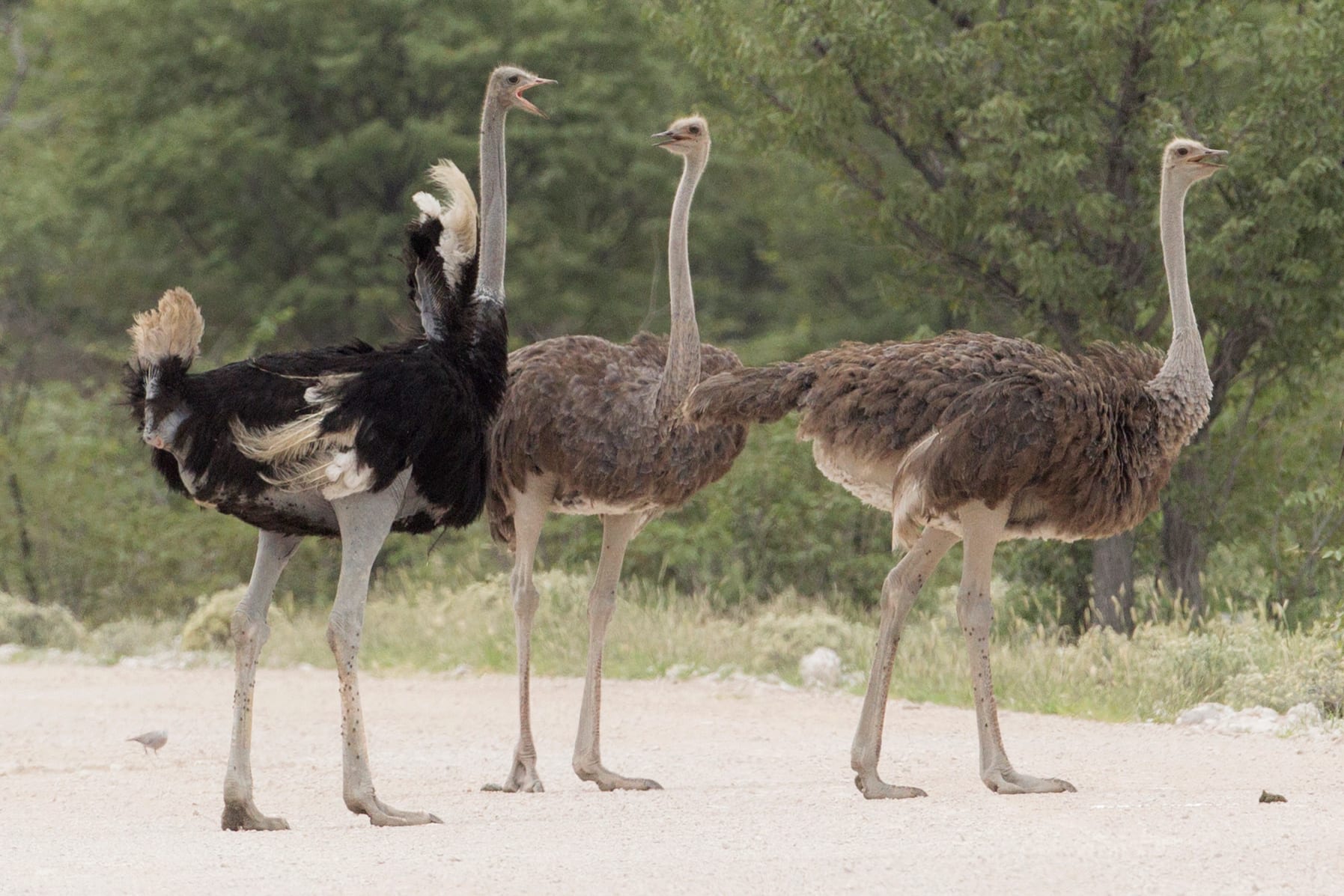
The common ostrich (Struthio camelus), or simply ostrich, is a species of flightless bird native to certain areas of Africa (and historically, Arabia) and is the largest living species of bird. The common ostrich is one of two extant species of ostriches, the only living members of the genus Struthio in the ratite group of birds. The other is the Somali ostrich (Struthio molybdophanes), which has been recognised as a distinct species by BirdLife International since 2014, having been previously considered a distinctive subspecies of ostrich.
The common ostrich belongs to the order Struthioniformes. Struthioniformes previously contained all the ratites, such as the kiwis, emus, rheas, and cassowaries. However, a recent genetic analysis has found that the group is not monophyletic, as it is paraphyletic with respect to the tinamous, so the ostriches are now classified as the only members of the order. Phylogenetic studies have shown that it is the sister group to all other members of Palaeognathae, and thus the flighted tinamous are the sister group to the extinct moa. It is distinctive in its appearance, with a long neck and legs, and can run for a long time at a speed of 55 km/h (34 mph) with short bursts up to about 70 km/h (43 mph), the fastest land speed of any bipedal animal. It lays the largest eggs of any living bird (the extinct giant elephant bird Aepyornis maximus of Madagascar and the South Island giant moa Dinornis robustus of New Zealand both laid larger eggs).
The biggest bird alive cannot fly but can outrun a horse.
Description
The common ostrich is the tallest and heaviest living bird. Males stand 2.1 to 2.75 m (6 ft 11 in to 9 ft 0 in) tall and weigh 100 to 130 kg (220 to 290 lb), whereas females are about 1.75 to 1.9 m (5 ft 9 in to 6 ft 3 in) tall and weigh 90 to 120 kg (200 to 260 lb). While exceptional male ostriches (in the nominate subspecies) can weigh up to 156.8 kg (346 lb), some specimens in South Africa can only weigh between 59.5 to 81.3 kg (131 to 179 lb). New chicks are fawn-coloured, with dark brown spots. After three months they start to gain their juvenile plumage, which is steadily replaced by adult-like plumage during their second year. At four or five months old, they are already about half the size of an adult bird, and after a year they reach adult height, but not till they are 18 months old will they be fully as heavy as their parents.
The feathers of adult males are mostly black, with white primaries and a white tail. However, the tail of one subspecies is buff. Females and young males are greyish-brown and white. The head and neck of both male and female ostriches are nearly bare, with a thin layer of down. The skin of the female's neck and thighs is pinkish-grey, while the male's is grey or pink dependent on subspecies.
Distribution and habitat
Common ostriches formerly occupied Africa north and south of the Sahara, East Africa, Africa south of the rainforest belt, and much of Asia Minor. Today common ostriches prefer open land and are native to the savannas and Sahel of Africa, both north and south of the equatorial forest zone. In southwest Africa they inhabit the semi-desert or true desert. Farmed common ostriches in Australia have established feral populations. The Arabian ostriches in the Near and Middle East were hunted to extinction by the middle of the 20th century. Attempts to reintroduce the common ostrich into Israel have failed. Common ostriches have occasionally been seen inhabiting islands on the Dahlak Archipelago, in the Red Sea near Eritrea.
Research conducted by the Birbal Sahni Institute of Palaeobotany in India found molecular evidence that ostriches lived in India 25,000 years ago. DNA tests on fossilised eggshells recovered from eight archaeological sites in the states of Rajasthan, Gujarat, and Madhya Pradesh found 92% genetic similarity between the eggshells and the North African ostrich, so these could have been fairly distant relatives.
Ostriches were introduced to Australia for farming, and a large feral population now exists in the Australian outback.
Behaviour and ecology
Common ostriches normally spend the winter months in pairs or alone. Only 16 percent of common ostrich sightings were of more than two birds. During breeding season and sometimes during extreme rainless periods ostriches live in nomadic groups of five to 100 birds (led by a top hen) that often travel together with other grazing animals, such as zebras or antelopes. Ostriches are diurnal, but may be active on moonlit nights. They are most active early and late in the day. The male common ostrich territory is between 2 and 20 km2 (0.77 and 7.72 sq mi).
With their acute eyesight and hearing, common ostriches can sense predators such as lions from far away. When being pursued by a predator, they have been known to reach speeds in excess of 70 km/h (43 mph), or possibly 80 km/h (50 mph) and can maintain a steady speed of 50 km/h (31 mph), which makes the common ostrich the fastest bipedal animal. When lying down and hiding from predators, the birds lay their heads and necks flat on the ground, making them appear like a mound of earth from a distance, aided by the heat haze in their hot, dry habitat.
When threatened, common ostriches run away, but they can cause serious injury and death with kicks from their powerful legs. Their legs can only kick forward. The kick from an ostrich can yield 225 kgf (2,210 N; 500 lbf).
Status and conservation
The wild common ostrich population has declined drastically in the last 200 years, with most surviving birds in reserves or on farms. However, its range remains very large (9,800,000 km2 or 3,800,000 sq mi), leading the IUCN and BirdLife International to treat it as a species of least concern. Of its five subspecies, the Arabian ostrich (S. c. syriacus) became extinct around 1966. North African ostrich populations are protected under Appendix I of the CITES (Convention on International Trade in Endangered Species of Wild Fauna and Flora) meaning commercial international trade is prohibited and non-commercial trade is strictly regulated.
Physiology
Morphology of the common ostrich lung indicates that the structure conforms to that of the other avian species, but still retains parts of its primitive ratite structure. The opening to the respiratory pathway begins with the laryngeal cavity lying posterior to the choanae within the buccal cavity. The tip of the tongue then lies anterior to the choanae, excluding the nasal respiratory pathway from the buccal cavity. The trachea lies ventrally to the cervical vertebrae extending from the larynx to the syrinx, where the trachea enters the thorax, dividing into two primary bronchi, one to each lung, in which they continue directly through to become mesobronchi. Ten different air sacs attach to the lungs to form areas for respiration. The most posterior air sacs (abdominal and post-thoracic) differ in that the right abdominal air sac is relatively small, lying to the right of the mesentery, and dorsally to the liver. While the left abdominal air sac is large and lies to the left of the mesentery. The connection from the main mesobronchi to the more anterior air sacs including the interclavicular, lateral clavicular, and pre-thoracic sacs known as the ventrobronchi region. While the caudal end of the mesobronchus branches into several dorsobronchi. Together, the ventrobronchi and dorsobronchi are connected by intra-pulmonary airways, the parabronchi, which form an arcade structure within the lung called the paleopulmo.