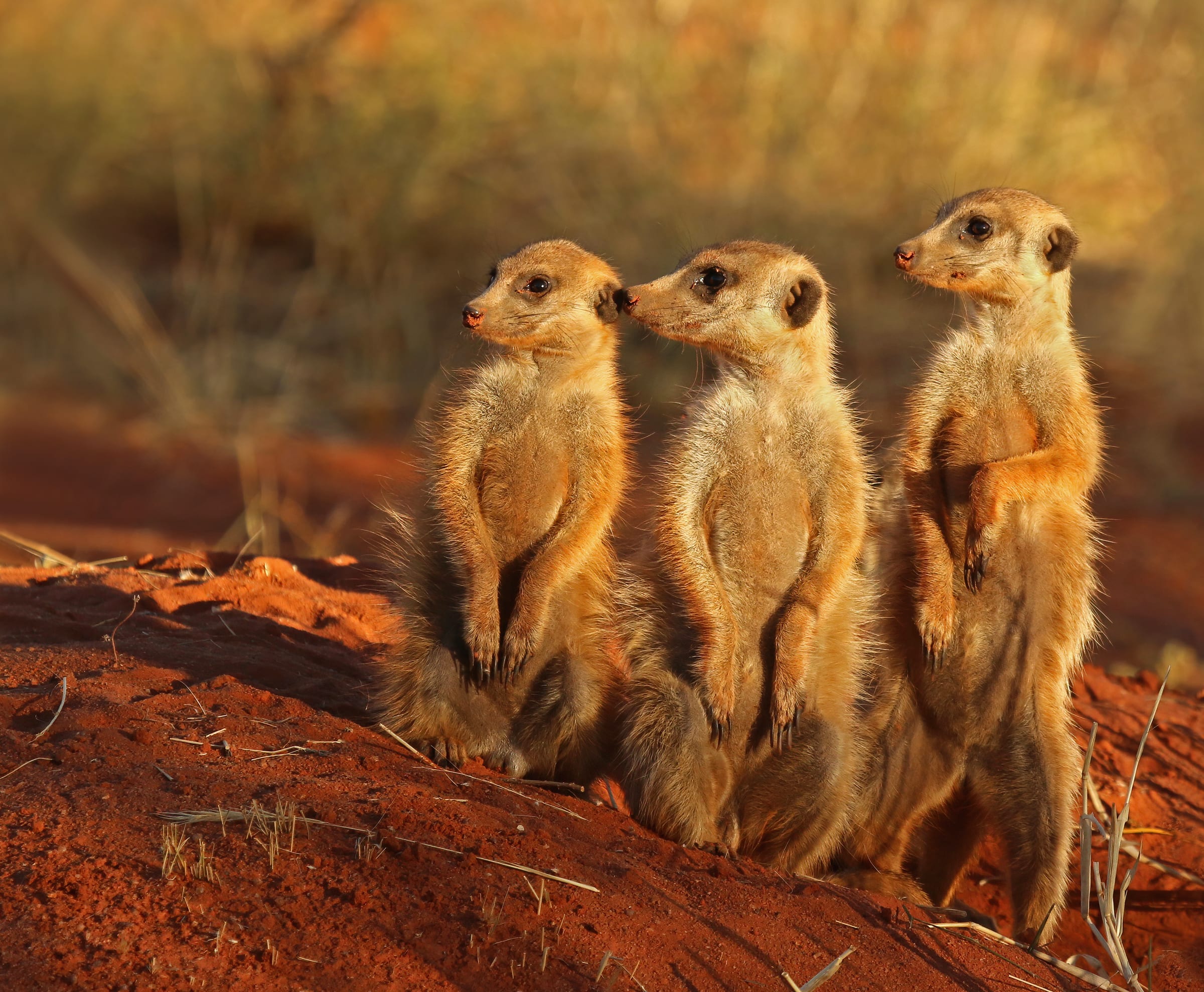
The meerkat (Suricata suricatta) or suricate is a small mongoose found in southern Africa. It is characterised by a broad head, large eyes, a pointed snout, long legs, a thin tapering tail, and a brindled coat pattern. The head-and-body length is around 24–35 cm (9.4–13.8 in), and the weight is typically between 0.62 and 0.97 kg (1.4 and 2.1 lb). The coat is light grey to yellowish-brown with alternate, poorly defined light and dark bands on the back. Meerkats have foreclaws adapted for digging and have the ability to thermoregulate to survive in their harsh, dry habitat. Three subspecies are recognised.
Meerkats are highly social, and form packs of two to 30 individuals each that occupy home ranges around 5 km2 (1.9 sq mi) in area. There is a social hierarchy—generally dominant individuals in a pack breed and produce offspring, and the nonbreeding, subordinate members provide altruistic care to the pups. Breeding occurs around the year, with peaks during heavy rainfall; after a gestation of 60 to 70 days, a litter of three to seven pups is born.
Stands sentry on hind legs against the whole Kalahari sky.
Distribution and habitat
The meerkat occurs in southwestern Botswana, western and southern Namibia, northern and western South Africa; the range barely extends into southwestern Angola. It lives in areas with stony, often calcareous ground in a variety of arid, open habitats with little woody vegetation. It is common in savannahs, open plains and rocky areas beside dry rivers in biomes such as the Fynbos and the Karoo, where the mean yearly rainfall is below 600 mm (24 in). The average precipitation reduces to 100 to 400 mm (3.9 to 15.7 in) towards the northwestern areas of the range. It prefers areas with short grasses and shrubs common in velds, such as camelthorn in Namibia and Acacia in the Kalahari. It is absent from true deserts, montane regions and forests. Population densities vary greatly between places, and are significantly influenced by predators and rainfall. For instance, a study in the Kgalagadi Transfrontier Park, where predation pressure is high, recorded a lower mean meerkat density relative to a ranch with lower occurrence of predators; in response to a 10% decrease in rainfall over a year, the density fell from 0.95 to 0.32/km2 (2.46 to 0.83/sq mi).
Ecology and behaviour
The meerkat is a social mammal, forming packs of two to 30 individuals each comprising nearly equal numbers of either sex and multiple family units of pairs and their offspring. Members of a pack take turns at jobs such as looking after pups and keeping a lookout for predators. Meerkats are a cooperatively breeding species—typically the dominant 'breeders' in a pack produce offspring, and the nonbreeding, subordinate 'helpers' provide altruistic care for the pups. This division of labour is not as strictly defined as it is in specialised eusocial species, such as the breeder-worker distinction in ants. Moreover, meerkats have a clear dominance hierarchy with older individuals having a higher social status. A study showed that dominant individuals can contribute more to offspring care when fewer helpers were available; subordinate members increased their contributions if they could forage better.
Threats and conservation
The meerkat is listed as Least Concern on the IUCN Red List; the population trend appears to be stable. There are no significant threats except low rainfall, which can lead to deaths of entire packs. Research has shown that temperature extremes have negative impacts on Kalahari Desert meerkats. Increased maximum air temperature is correlated with decreased survival and body mass in pups, perhaps as a result of dehydration from water loss during evaporative cooling or decreased water content in food, or from the heavier metabolic costs of thermoregulation on hot days. Higher temperatures are also associated with increased rates of endemic tuberculosis infection; this may be due to decreased immune function resulting from physiological stress, as well as increased male emigration rates observed during heat waves.
Meerkats occur in several protected areas such as the Kgalagadi Transfrontier Park and the Makgadikgadi Pan. The Kalahari Meerkat Project, founded by Tim Clutton-Brock, is a long-term research project run by four different research groups that focuses on understanding cooperative behaviour in meerkats. It began in the Gemsbok National Park but was shifted to the Kuruman River Reserve in 1993.
Phylogeny and evolution
Meerkat fossils dating back to 2.59 to 0.01 million years ago have been excavated in various locations in South Africa. A 2009 phylogenetic study of the family Herpestidae suggests it split into two lineages around the Early Miocene (25.4–18.2 mya)—eusocial and solitary mongooses. The meerkat belongs to the monophyletic eusocial mongoose clade along with several other African mongooses: Crossarchus (kusimanse), Helogale (dwarf mongoose), Liberiictis (Liberian mongoose) and Mungos (banded mongoose). The solitary mongoose lineage comprises two clades including species such as Meller's mongoose (Rhynchogale melleri) and the yellow mongoose (Cynictis penicillata). The meerkat genetically diverged from the rest of the clade 22.6–15.6 mya. The phylogenetic relationships of the meerkat are depicted as follows:
Characteristics
The meerkat is a small mongoose of slim build characterised by a broad head, large eyes, a pointed snout, long legs, a thin tapering tail and a brindled coat pattern. It is smaller than most other mongooses except the dwarf mongooses (genus Helogale) and possibly Galerella species. The head-and-body length is around 24–35 cm (9.4–13.8 in), and the weight has been recorded to be between 0.62–0.97 kg (1.4–2.1 lb) without much variation between the sexes (though some dominant females can be heavier than the rest). The soft coat is light grey to yellowish brown with alternate, poorly defined light and dark bands on the back. Individuals from the southern part of the range tend to be darker. The guard hairs, light at the base, have two dark rings and are tipped with black or silvery white; several such hairs aligned together give rise to the coat pattern. These hairs are typically between 1.5 and 2 cm (0.59 and 0.79 in), but measure 3–4 cm (1.2–1.6 in) on the flanks. Its head is mostly white and the underparts are covered sparsely with dark reddish-brown fur, with the dark skin underneath showing through. The eyes, in sockets covering over 20% of the skull length, are capable of binocular vision. The slim, yellowish tail, unlike the bushy tails of many other mongooses, measures 17 to 25 cm (6.7 to 9.8 in), and is tipped with black. Females have six nipples. The meerkat looks similar to two sympatric species—the banded and the yellow mongooses.