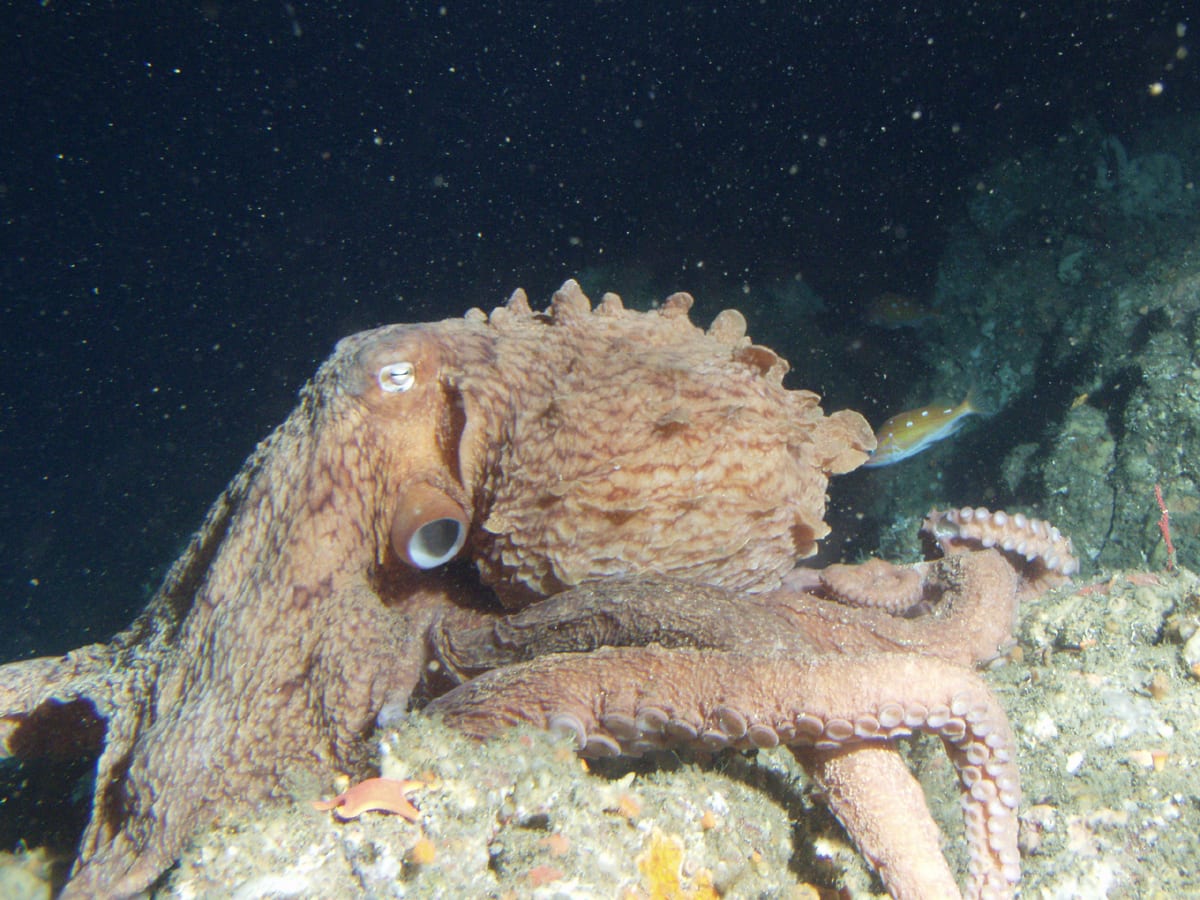
The giant Pacific octopus (Enteroctopus dofleini), also known as the North Pacific giant octopus, is a large marine cephalopod belonging to the genus Enteroctopus and Enteroctopodidae family.
Its spatial distribution encompasses much of the coastal North Pacific, from the Mexican state of Baja California, north along the United States' West Coast (California, Oregon, Washington and Alaska, including the Aleutian Islands), and British Columbia, Canada; across the northern Pacific to the Russian Far East (Kamchatka, Sea of Okhotsk), south to the East China Sea, the Yellow Sea, the Sea of Japan, Japan's Pacific east coast, and around the Korean Peninsula. It can be found from the intertidal zone down to 2,000 m (6,600 ft), and is best-adapted to colder, oxygen- and nutrient-rich waters. It is the largest octopus species on earth and can often be found in aquariums and research facilities in addition to the ocean. E. dofleini play an important role in maintaining the health and biodiversity of deep sea ecosystems, cognitive research, and the fishing industry.
Nine brains, three hearts, blue blood, and a vanishing act.
Description
E. dofleini is distinguished from other species by its large size. It is the largest octopus species. Adults usually weigh around 15 kg (33 lb), with an arm span up to 4.3 m (14 ft). The largest individual weighed in at 600 lb (270 kg), with a radial span of 32 ft (9.8 m).
American zoologist G. H. Parker found that the largest suckers on a giant Pacific octopus are about 6.4 cm (2.5 in) and can support 16 kg (35 lb) each.
Ecology
E. dofleini preys on shrimp, crabs, scallops, abalones, cockles, snails, clams, lobsters, fish, squid, and other octopuses. Food is procured with its suckers and then bitten using its tough beak of chitin. It has also been observed to catch spiny dogfish (Squalus acanthias) up to 1.2 m (4 ft) in length while in captivity. Additionally, consumed carcasses of this same shark species have been found in giant Pacific octopus middens in the wild, providing strong evidence of these octopuses preying on small sharks in their natural habitat. In May 2012, amateur photographer Ginger Morneau was widely reported to have photographed a wild giant Pacific octopus attacking and drowning a seagull, demonstrating that this species may eat any available source of food within its size range, even birds.
Lifespan and reproduction
Unlike most other octopus species, whose lifespans normally last only one year, the giant Pacific octopus has a lifespan of three to five years. They reach sexual maturity at one to two years of age. Gonadal maturation has been linked to the optic gland of octopuses which has been compared functionally to the vertebrate pituitary gland. These optic glands are the only endocrine glands identified in octopuses, and their secretions have been found to contribute to behaviors linked with reproduction and senescence. When removed, females no longer brood their eggs, resume feeding, increase in weight, and experience longer lifespans compared to sexually mature, brooding females who still retain their optic glands.
Conservation and climate change
Giant Pacific octopuses are not currently under the protection of Convention on International Trade in Endangered Species of Wild Fauna and Flora or evaluated in the IUCN Red List. DNA techniques have assisted in genetic and phylogenetic analysis of the species' evolutionary past. Following its DNA analysis, the giant Pacific octopus may actually prove to be three subspecies (one in Japan, another in Alaska, and a third in Puget Sound).
In Puget Sound, the Washington Fish and Wildlife Commission adopted rules for protecting the harvest of giant Pacific octopuses at seven sites, after a legal harvest caused a public outcry. Populations in Puget Sound are not considered threatened.
Intelligence
Octopuses are ranked as the most intelligent invertebrates. Giant Pacific octopuses are commonly kept on display at aquariums due to their size and interesting physiology, and have demonstrated the ability to recognize humans with whom they frequently come in contact. These responses include jetting water, changing body texture, and other behaviors that are consistently demonstrated to specific individuals. They have the ability to solve simple puzzles, open childproof bottles, and use tools. The octopus brain has folded lobes (a distinct characteristic of complexity) and visual and tactile memory centers. They have about 300 million neurons. They have been known to open tank valves, disassemble expensive equipment, and generally wreak havoc in labs and aquaria. Some researchers even claim that they are capable of motor play and having personalities.