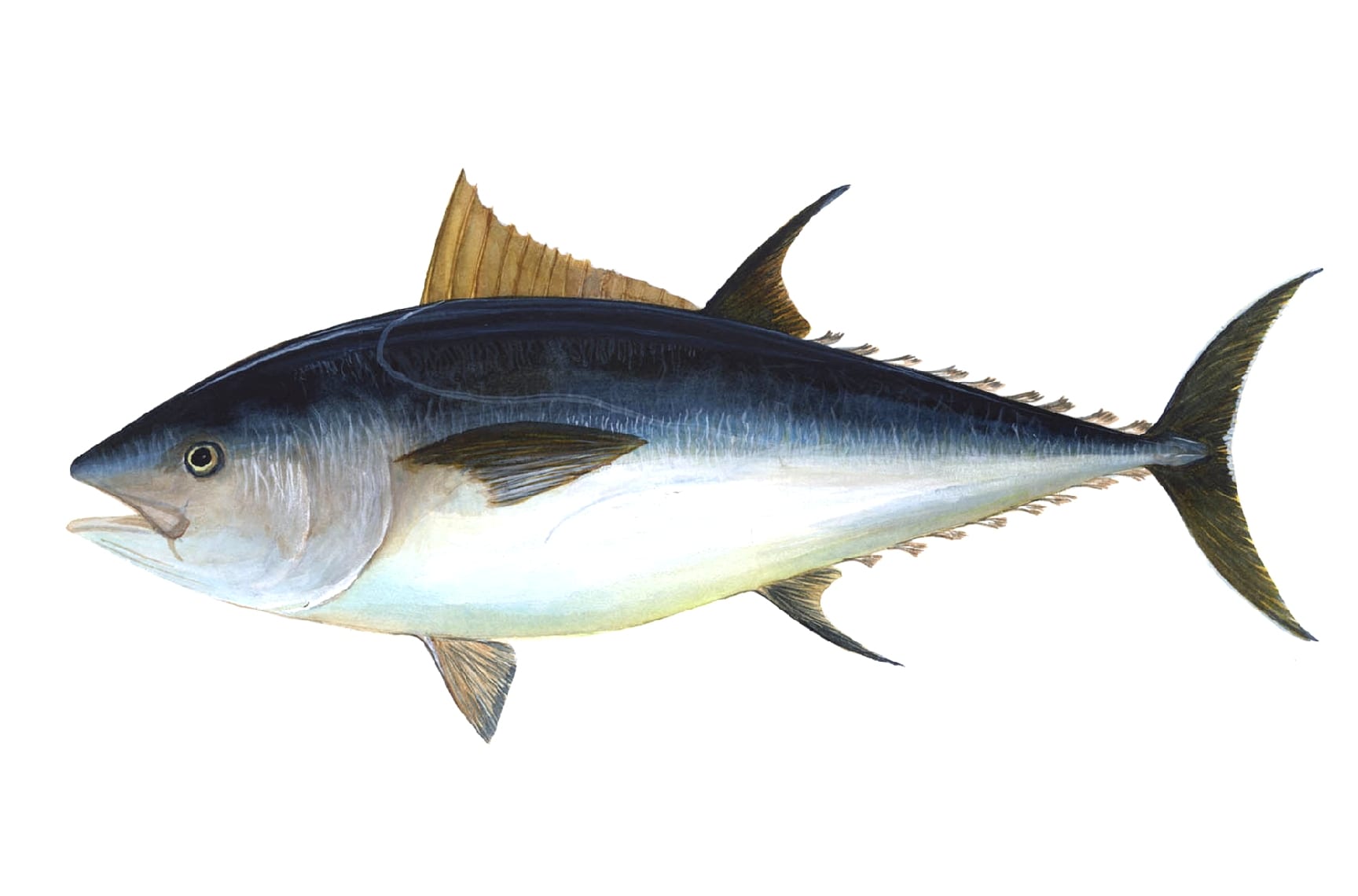
The Atlantic bluefin tuna (Thunnus thynnus) is a species of tuna in the family Scombridae. It is variously known as the northern bluefin tuna (mainly when including Pacific bluefin as a subspecies), giant bluefin tuna (for individuals exceeding 150 kg [330 lb]), and formerly as the tunny.
Atlantic bluefins are native to both the western and eastern Atlantic Ocean, as well as the Mediterranean Sea. They have become regionally extinct in the Black Sea. The Atlantic bluefin tuna is a close relative of one of the other two bluefin tuna species, the Pacific bluefin tuna. The southern bluefin tuna, on the other hand, is more closely related to other tuna species such as yellowfin tuna and bigeye tuna, and the similarities between the southern and northern species are due to convergent evolution.
A warm-blooded torpedo that crosses oceans like rumour.
Description
The body of the Atlantic bluefin tuna is rhomboidal in profile and robust. The head is conical and the mouth rather large. The head contains a "pineal window" that allows the fish to navigate over its multiple thousands-of-miles range. Their color is dark blue above and gray below, with a gold coruscation covering the body and bright yellow caudal finlets. Bluefin tuna can be distinguished from other family members by the relatively short length of their pectoral fins. Their livers have a unique characteristic in that they are covered with blood vessels (striated). In other tunas with short pectoral fins, such vessels are either not present or present in small numbers along the edges.
Biology and ecology
Bluefins dive to depths of 1,006 m (3,301 ft). The Atlantic bluefin tuna typically hunts small fish such as sardines, herring, mackerel, and eels, and invertebrates such as squid and crustaceans. They exhibit opportunistic hunting in schools of fish organized by size. Their white skeletal muscle allows for large contractions which aids burst swimming to ensure prey capture.
The species is host to over 70 parasites although none have been yet described as causing harm to the species. The tetraphyllidean tapeworm Pelichnibothrium speciosum is one parasite of the species. As the tapeworm's definite host is the blue shark, which does not generally seem to feed on tuna, the Atlantic bluefin tuna likely is a dead-end host for P. speciosum.
Atlantic bluefin tuna are eaten by a wide variety of predators. When they are newly hatched, they are eaten by other fishes that specialize in eating plankton, as well as by other plankton organisms like jellyfish. They may even be eaten by their own, with some populations of larvae demonstrating cannibalism. At that life stage, their numbers are reduced dramatically. Therefore, adult bluefin tuna spawn at specific locations and time of the moon cycle to minimize predation on their offspring. Those that survive face a steady increase in the size of their predators. Adult Atlantic Bluefin are not eaten by anything other than the very largest billfishes, toothed whales, and some open ocean shark species.
Human interaction
According to Longo, "by the turn of the first millennium CE, a sophisticated bluefin tuna trap fishery [had] emerged. ... This trap fishery, called tonnara in Italian, madrague in French, almadraba in Spanish, and armação in Portuguese, forms an elaborate maze of nets that capture and corral bluefin tuna during their spawning season. Active for more than a thousand years, the traditional/artisanal bluefin tuna trap fishery has experienced a collapse in the Mediterranean and has struggled where it is still practiced."
After World War II, Japanese fishermen wanted more tuna to eat and to export for European and U.S. canning industries. They expanded their fishing range and perfected industrial long-line fishing, a practice that employs thousands of baited hooks on lines several kilometers long. In the 1970s, Japanese manufacturers developed lightweight, high-strength polymers that were spun into drift net. Though they were banned on the high seas by the early 1990s, in the 1970s, hundreds of kilometers of them were often deployed in a single night. At-sea freezing technology then allowed them to bring frozen sushi-ready tuna from the farthest oceans to market after as long as a year.