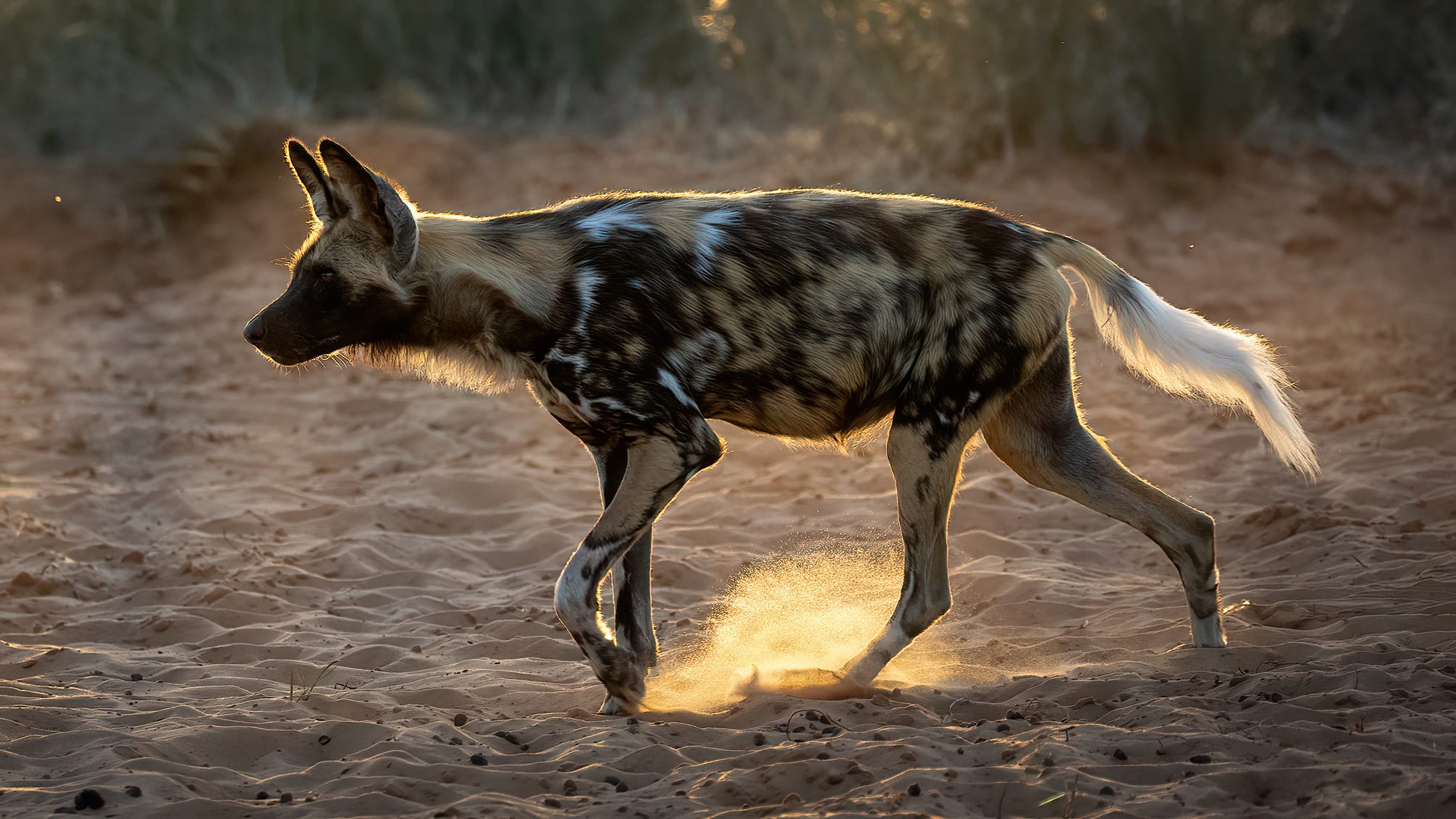
The African wild dog (Lycaon pictus), also called painted dog and Cape hunting dog, is a wild canine native to sub-Saharan Africa. It is the largest wild canine in Africa and the only extant member of the genus Lycaon, which is distinguished from Canis by dentition highly specialised for a hypercarnivorous diet and by a lack of dewclaws.
An estimated 6,600 adults (including 1,400 mature individuals) live in 39 subpopulations, all threatened by habitat fragmentation, human persecution, and outbreaks of disease. As the largest subpopulation probably consists of fewer than 250 individuals, the African wild dog has been listed as endangered on the IUCN Red List since 1990.
Paints the bush in patched coats, hunts with an eighty percent kill rate.
Description
The African wild dog is the bulkiest and most solidly built of African canids. The species stands 60 to 75 cm (24 to 30 in) at the shoulders, measures 71 to 112 cm (28 to 44 in) in head-and-body length, and has a tail length of 29 to 41 cm (11 to 16 in). Adults have a weight range of 18 to 36 kg (40 to 79 lb). Typically, dogs from East Africa weigh around 20–25 kg (44–55 lb). By body mass, they are only outsized amongst other extant canids by the wolf species complex. Females are usually 3–7% smaller than males. Compared to members of the genus Canis, the African wild dog is comparatively lean and tall, with outsized ears and lacking dewclaws. The middle two toepads are usually fused. Its dentition differs from that of Canis by the degeneration of the last lower molar, the narrowness of the canines, and proportionately large premolars, which are the largest relative to body size of any carnivore other than hyenas. The heel of the lower carnassial M1 is crested with a single, blade-like cusp, which enhances the shearing capacity of the teeth, thus the speed at which prey can be consumed. This feature, termed "trenchant heel", is shared with two other canids, the Asian dhole and the South American bush dog. The skull is relatively shorter and broader than those of other canids.
Distribution and habitat
The African wild dog occurs foremost in Southern and East Africa.
It is rare in North Africa and mostly absent in West Africa, with the only potentially viable population occurring in Senegal's Niokolo-Koba National Park. It is occasionally sighted in other parts of Senegal, Guinea, and Mali. Its distribution is patchy in East Africa.
It inhabits mostly savannas and arid zones, generally avoiding forested areas. This preference is likely linked to its hunting habits, which require open areas that do not obstruct vision or impede pursuit. It travels through scrubland, woodland, and montane areas in pursuit of prey. A forest-dwelling population has been identified in the Harenna Forest, a wet montane forest up to an elevation of 2,400 m (7,900 ft) in the Bale Mountains of Ethiopia. At least one record exists of a pack being sighted on the summit of Mount Kilimanjaro. In Zimbabwe, it has been recorded at the elevation of 1,800 m (5,900 ft). In Ethiopia, several packs were sighted at elevations of 1,900 to 2,800 m (6,200 to 9,200 ft), and a dead individual was found in June 1995 at 4,050 m (13,290 ft) on the Sanetti Plateau. A stable population comprising more than 370 individuals is present in Kruger National Park.
Behaviour and ecology
The African wild dog have strong social bonds, stronger than those of sympatric lions and spotted hyenas; thus, solitary living and hunting are extremely rare in the species. It lives in permanent packs consisting of two to 27 adults and yearling pups. The typical pack size in the Kruger National Park and the Maasai Mara is four or five adults, while packs in Moremi and Selous Game Reserves contain eight or nine. However, larger packs have been observed and temporary aggregations of hundreds of individuals may have gathered in response to the seasonal migration of vast springbok herds in Southern Africa. Males and females have separate dominance hierarchies, with the latter usually being led by the oldest female. Males may be led by the oldest male, but these can be supplanted by younger specimens; thus, some packs may contain elderly male former pack leaders. The dominant pair typically monopolises breeding. The species differs from most other social carnivorans in that males remain in the natal pack, while females disperse (a pattern also found in primates such as gorillas, chimpanzees, and red colobuses). Furthermore, males in any given pack tend to outnumber females 3:1. Dispersing females join other packs and evict some of the resident females related to the other pack members, thus preventing inbreeding and allowing the evicted individuals to find new packs of their own and breed.
Threats
The African wild dog is primarily threatened by habitat fragmentation, which results from human–wildlife conflict, transmission of infectious diseases and high mortality rates; it has been exterminated in large parts of North and West Africa, and its population has greatly reduced in Central Africa, Uganda and much of Kenya. Surveys in the Central African Republic's Chinko area revealed that the African wild dog population decreased from 160 individuals in 2012 to 26 individuals in 2017. At the same time, transhumant pastoralists from the border area with Sudan moved in the area with their livestock.
Conservation
The non-governmental organization African Wild Dog Conservancy began working in 2003 to conserve the African wild dog in northeastern and coastal Kenya, a convergence zone of two biodiversity hotspots. This area largely consists of community lands inhabited by pastoralists. With the help of local people, a pilot study was launched confirming the presence of a population of wild dogs largely unknown to conservationists. Over the next 16 years, local ecological knowledge revealed this area to be a significant refuge for African wild dogs and an important wildlife corridor connecting Kenya's Tsavo National Parks with the Horn of Africa in an increasingly human-dominated landscape. This project has been identified as a wild dog conservation priority by the IUCN/SSC Canid Specialist Group.