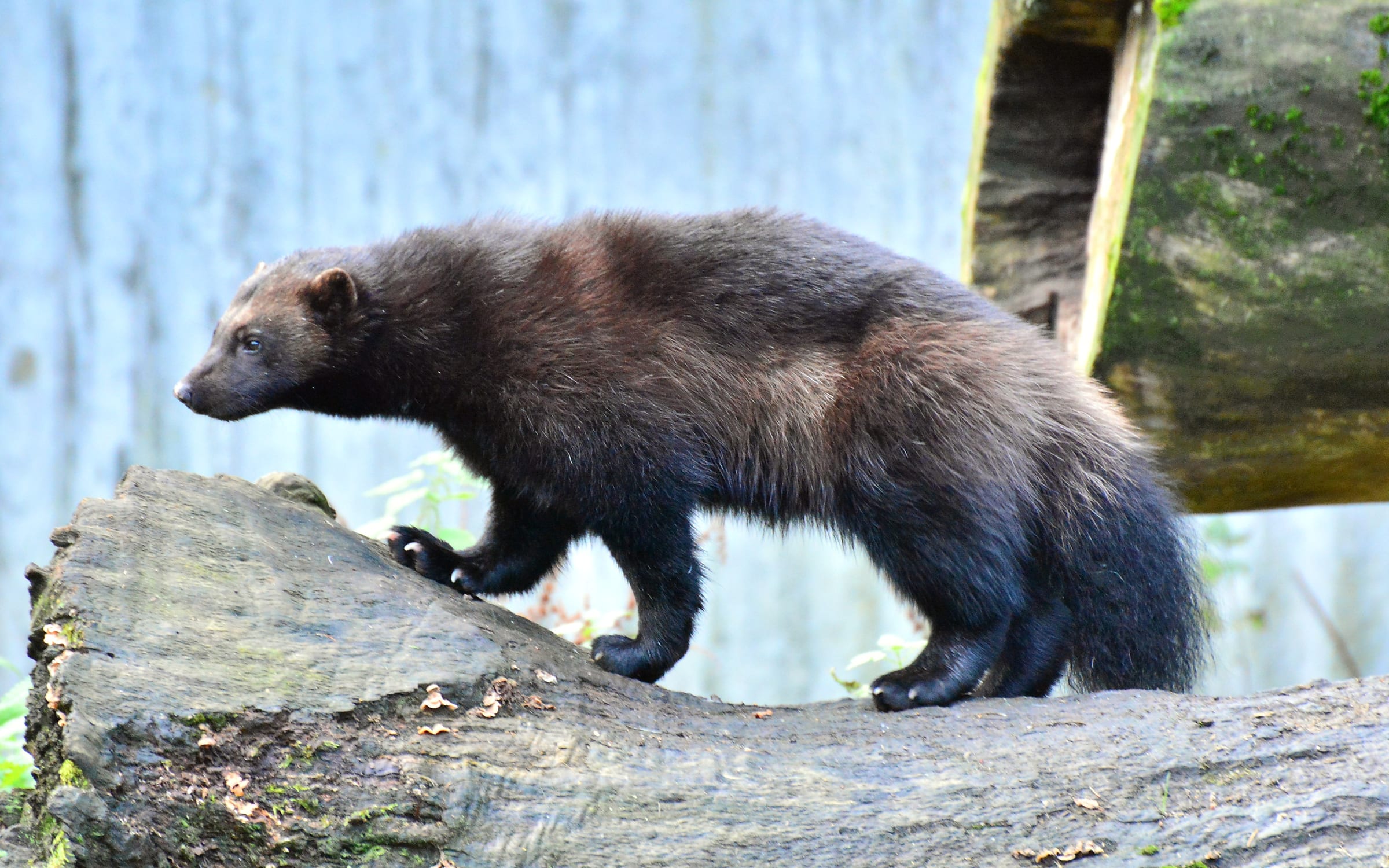
The wolverine ( WUUL-və-reen, US also WUUL-və-REEN; Gulo gulo), also called the carcajou or quickhatch (from East Cree, kwiihkwahaacheew), is the largest land-dwelling member of the family Mustelidae. It is a muscular carnivore and a solitary animal. The wolverine has a reputation for ferocity and strength out of proportion to its size, with the documented ability to kill prey many times larger than itself.
The wolverine is found primarily in remote reaches of the northern boreal forests and subarctic and alpine tundra of the Northern Hemisphere, with the greatest numbers in Northern Canada, the U.S. state of Alaska, the mainland Nordic countries of Europe, and throughout western Russia and Siberia. Its population has steadily declined since the 19th century owing to trapping, range reduction and habitat fragmentation. The wolverine has become essentially absent from the southern end of its range in both Europe and North America.
Fearless beyond all reason, the small bear of the boreal north.
Physical characteristics
Anatomically, the wolverine is an elongated animal that is low to the ground. With strong limbs, broad and rounded head, small eyes and short rounded ears, it most closely resembles a large fisher. Though its legs are short, its large, five-toed paws with crampon-like claws and plantigrade posture enable it to climb up and over steep cliffs, trees and snow-covered peaks with relative ease.
Distribution
Wolverines live primarily in isolated arctic, boreal, and alpine regions of northern Canada, Alaska, Siberia, and Fennoscandia; they are also native to European Russia, the Baltic countries, the Russian Far East, northeast China and Mongolia.
Wolverine remains have been found in Ukraine, but they were extirpated and it is unclear whether the wolverines would have formed sustainable populations.
Unique records of encounters with wolverines have been noted in Latvia, the most recent one being in late July 2022 (although it can be disputed because of the unclear footage); the population was widespread in the 16th and 17th centuries, but it is no longer native to the area.
Behavior and ecology
Wolverines are primarily scavengers. Most of their food is carrion, especially in winter and early spring. They may find carrion themselves, feed on it after the predator (often, a wolf pack) has finished, or simply take it from another predator. Wolverines are known to follow wolf and lynx trails to scavenge the remains of their kills. Whether eating live prey or carrion, the wolverine's feeding style appears voracious, leading to the nickname of "glutton" (also the basis of the scientific name). However, this feeding style is believed to be an adaptation to food scarcity, especially in winter.
Threats and conservation
The world's total wolverine population is not known. The animal exhibits a low population density and requires a very large home range. The wolverine is listed by the IUCN as Least Concern because of its "wide distribution, remaining large populations, and the unlikelihood that it is in decline at a rate fast enough to trigger even Near Threatened".
The range of a male wolverine can be more than 620 km2 (240 sq mi), encompassing the ranges of several females which have smaller home ranges of roughly 130–260 km2 (50–100 mi2). Adult wolverines try for the most part to keep nonoverlapping ranges with adults of the same sex. Radio tracking suggests an animal can range hundreds of miles in a few months.
Female wolverines burrow into snow in February to create a den, which is used until weaning in mid-May. Areas inhabited nonseasonally by wolverines are thus restricted to zones with late-spring snowmelts. This fact has led to concern that global warming will shrink the ranges of wolverine populations.
Taxonomy and evolutionary history
Genetic evidence suggests that the wolverine is most closely related to the tayra and martens, all of which shared a Eurasian ancestor.
There are two subspecies: the Old World form, Gulo gulo gulo, and the New World form, G. g. luscus. Some authors had described as many as four additional North American subspecies, including ones limited to Vancouver Island (G. g. vancouverensis) and the Kenai Peninsula in Alaska (G. g. katschemakensis). However, the most accepted taxonomy recognizes either the two continental subspecies or G. gulo as a single Holarctic taxon.
Recently compiled genetic evidence suggests most of North America's wolverines are descended from a single source, likely originating from Beringia during the last glaciation and rapidly expanding thereafter, though considerable uncertainty to this conclusion is due to the difficulty of collecting samples in the extremely depleted southern extent of the range.