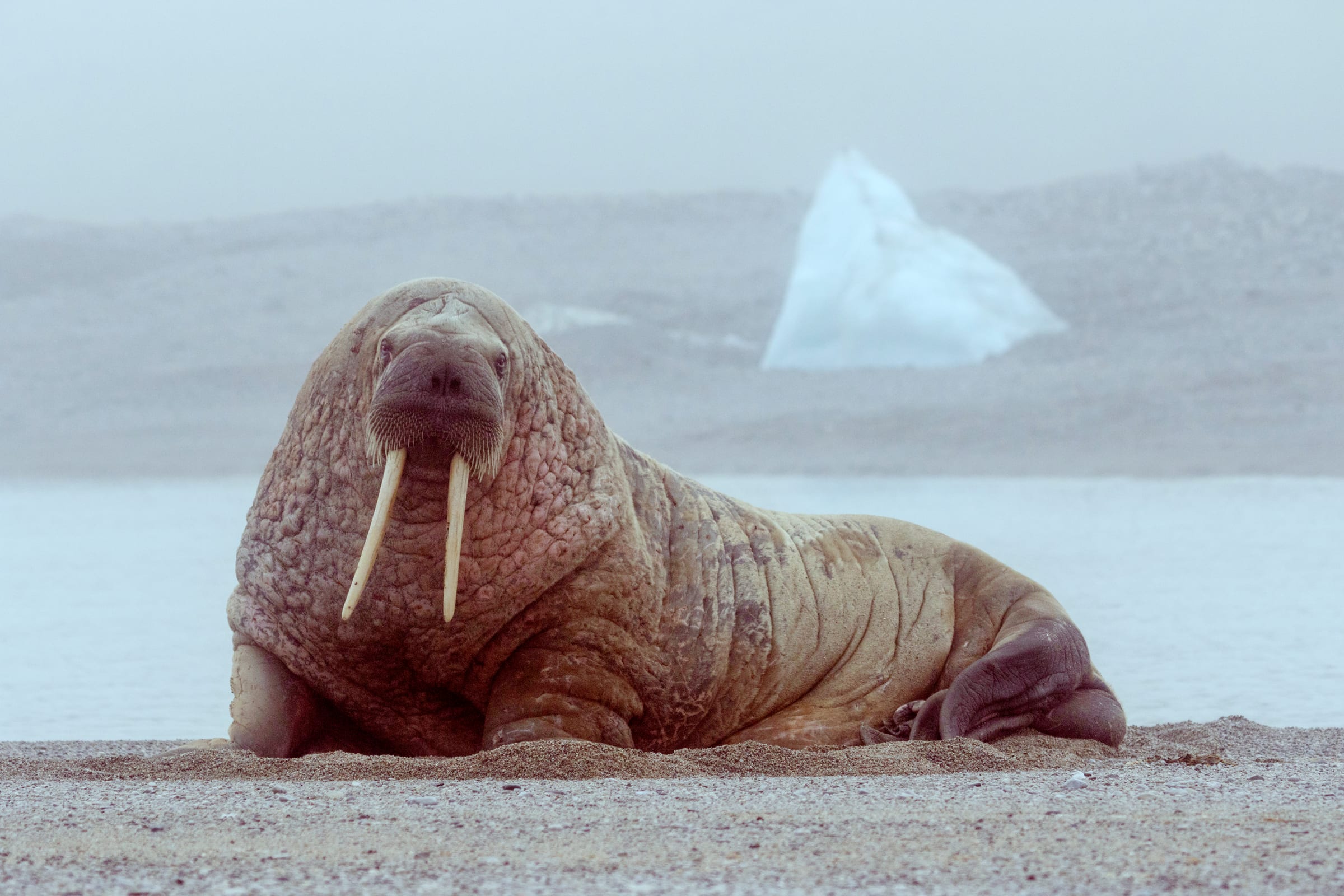
The walrus (Odobenus rosmarus; plural walrus or walruses) is a large pinniped marine mammal with discontinuous distribution about the North Pole in the Arctic Ocean and subarctic seas of the Northern Hemisphere. It is the only extant species in the family Odobenidae and genus Odobenus. This species is subdivided into two subspecies: the Atlantic walrus (O. r. rosmarus), which lives in the Atlantic Ocean, and the Pacific walrus (O. r. divergens), which lives in the Pacific Ocean.
Adult walrus are characterised by prominent tusks and whiskers, and considerable bulk; adult males in the Pacific can weigh more than 2,000 kilograms (4,400 pounds) and, among pinnipeds, are exceeded in size only by the two species of elephant seals. Walrus live mostly in shallow waters above the continental shelves, spending significant amounts of their lives on the sea ice looking for benthic bivalve molluscs. Walruses are relatively long-lived, social and intelligent animals, and are considered a keystone species of the Arctic marine region.
A ton of blubber, ivory tusks, and impossibly delicate whiskers.
Anatomy
While some outsized Pacific males can weigh as much as 2,000 kg (4,400 lb), most weigh between 800 and 1,700 kg (1,800 and 3,700 lb). An occasional male of the Pacific subspecies far exceeds normal dimensions. In 1909, a walrus hide weighing 500 kg (1,100 lb) was collected from an enormous bull in Franz Josef Land, while in August 1910, Jack Woodson shot a 4.9-metre-long (16 ft) walrus, harvesting its 450 kg (1,000 lb) hide. Since a walrus's hide usually accounts for about 20% of its body weight, the total body mass of these two giants is estimated to have been at least 2,300 kg (5,000 lb). However, in a 2015 study examining the sizes of large marine animals, McClain and colleagues found that both of the former records were difficult to verify, and that the maximum weight recorded was a male measuring 3.8 m (12 ft 6 in) in length and 1,883 kg (4,151 lb), and a maximum length of 3.95 m (13.0 ft) were considered the most reliable and accurately measured individuals. The Atlantic subspecies weighs about 10–20% less than the Pacific subspecies. Male Atlantic walrus weigh an average of 900 kg (2,000 lb). The Atlantic walrus also tends to have relatively shorter tusks and somewhat more of a flattened snout. Females weigh about two-thirds as much as males, with the Atlantic females averaging 560 kg (1,230 lb), sometimes weighing as little as 400 kg (880 lb), and the Pacific female averaging 800 kg (1,800 lb). Length typically ranges from 2.2 to 3.5 m (7 ft 3 in to 11 ft 6 in).
Ecology
The majority of the population of the Pacific walrus spends its summers north of the Bering Strait in the Chukchi Sea of the Arctic Ocean along the northern coast of eastern Siberia, around Wrangel Island, in the Beaufort Sea along the northern shore of Alaska south to Unimak Island, and in the waters between those locations. Smaller numbers of males summer in the Gulf of Anadyr on the southern coast of the Siberian Chukchi Peninsula, and in Bristol Bay off the southern coast of Alaska, west of the Alaska Peninsula. In the spring and fall, walruses congregate throughout the Bering Strait, reaching from the western coast of Alaska to the Gulf of Anadyr. They winter over in the Bering Sea along the eastern coast of Siberia south to the northern part of the Kamchatka Peninsula, and along the southern coast of Alaska. A 28,000-year-old fossil walrus was dredged up from the bottom of San Francisco Bay, indicating that Pacific walruses ranged that far south during the last Ice Age.
Life history
Walruses live to about 20–30 years old in the wild. The oldest-living walrus on record was Slowpoke, a captive walrus at SeaWorld Orlando, who lived to be 49 years old when he died. The males reach sexual maturity as early as 7 years, but do not typically mate until fully developed at around 15 years of age. They rut from January through April, decreasing their food intake dramatically. The females begin ovulating as soon as 4-6 years old. Females reach physical maturity at 10–12 years of age, and males at 15–16 years of age. The females are diestrous, coming into heat in late summer and around February, yet the males are fertile only around February; the potential fertility of this second period is unknown. Breeding occurs from January to March, peaking in February. Males aggregate in the water around ice-bound groups of estrous females and engage in competitive vocal displays. The females join them and copulate in the water.
Relationship with humans
Traditional hunters used all parts of the walrus. The meat, often preserved, is an important winter nutrition source; the flippers are fermented and stored as a delicacy until spring; tusks and bone were historically used for tools, as well as material for handicrafts; the oil was rendered for warmth and light; the tough hide made rope and house and boat coverings; and the intestines and gut linings made waterproof parkas. While some of these uses have faded with access to alternative technologies, walrus meat remains an important part of local diets, and tusk carving and engraving remain a vital art form.
In the 18th and 19th centuries, the walrus was heavily exploited by American and European sealers and whalers, leading to the near-extinction of the Atlantic subspecies. As early as 1871 traditional hunters were expressing concern about the numbers of walrus being hunted by whaling fleets. Commercial walrus harvesting is now outlawed throughout its range, although Chukchi, Yupik and Inuit peoples are permitted to kill small numbers towards the end of each summer.
According to Adolf Erik Nordenskiöld, European hunters and Arctic explorers found walrus meat not particularly tasty, and only ate it in case of necessity; however walrus tongue was a delicacy.