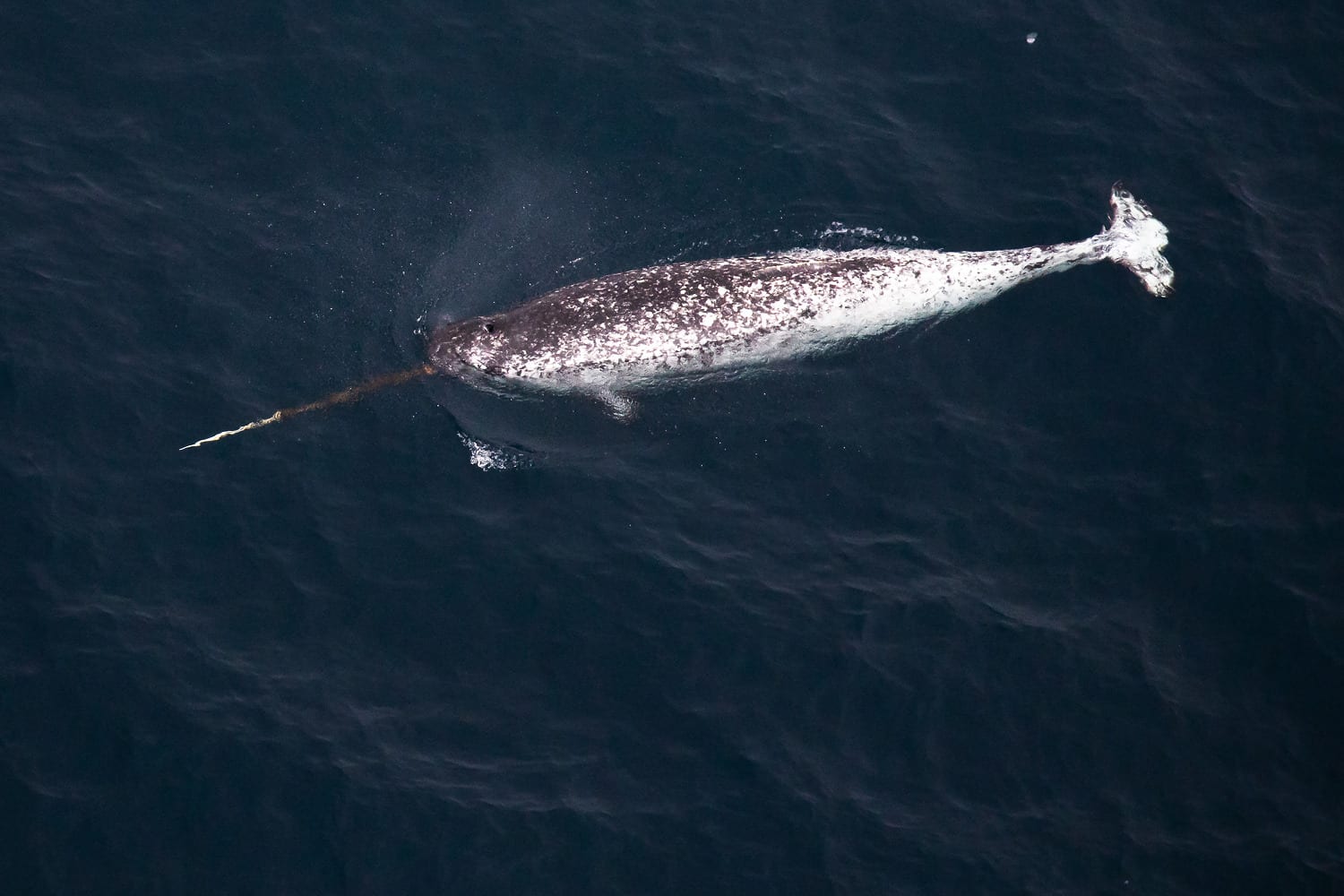
The narwhal (Monodon monoceros) is a species of toothed whale native to the Arctic. It is the only member of the genus Monodon and one of two living representatives of the family Monodontidae. The narwhal is a stocky cetacean with a relatively blunt snout, a large melon, and a shallow ridge in place of a dorsal fin. Males of this species have a spiralled tusk that is 1.5–3.0 m (4.9–9.8 ft) long, which is a protruding left canine thought to function as a weapon, a tool for feeding, in attracting mates or sensing water salinity. Specially adapted slow-twitch muscles, along with the jointed neck vertebrae and shallow dorsal ridge allow for easy movement through the Arctic environment, where the narwhal spends extended periods at great depths. The narwhal's geographic range overlaps with that of the similarly built and closely related beluga whale, and the animals are known to interbreed.
Narwhals inhabit the Arctic waters of Canada, Greenland and Russia. Every year, they migrate to ice-free summering grounds, usually in shallow waters, and often return to the same sites in subsequent years. Their diet mainly consists of polar and Arctic cod, Greenland halibut, cuttlefish, shrimp, and armhook squid. Diving to depths of up to 2,370 m (7,780 ft), the narwhal is among the deepest-diving cetaceans. The animals typically travel in groups of three to eight, with aggregations of up to 1,000 occurring in the summer months. Narwhals mate among the offshore pack ice from March to May, and the young are born between July and August of the following year. When communicating amongst themselves, narwhals use a variety of clicks, whistles and knocks.
The unicorn of the sea, sounding the deep with a spiral tooth.
Description
The narwhal has a robust body with a short, blunt snout, small upcurved flippers, and convex to concave tail flukes. Adults measure 3.0 to 5.5 m (9.8 to 18.0 ft) in length and weigh 800 to 1,600 kg (1,800 to 3,500 lb). Male narwhals attain sexual maturity at 12 to 20 years of age, reaching a length of 3.5 to 4.0 m (11.5 to 13.1 ft). Females reach sexual maturity at a younger age, between 8 and 9 years old, when they are about 3.4 m (11 ft) long. On average, males are about 70 cm (28 in) longer and more than 75% heavier than females.
The colouration of the narwhal consists of a mottled pattern, with blackish-brown markings over a white background. At birth, the skin is light grey, and when sexually mature, white patches grow on the navel and genital slit; such whitening occurs throughout life, resulting in aged narwhals being almost purely white. Unlike most whales, the narwhal has a shallow dorsal ridge, rather than a dorsal fin, possibly an evolutionary adaptation to make swimming under ice easier or to facilitate rolling. The neck vertebrae are also jointed, instead of being fused as in most whales, which allows for a greater range of neck flexibility. These characteristics are shared by the beluga whale. Furthermore, male and female narwhals have differently shaped tail flukes; the former are bent inward, while the latter are swept back on the front margins. This is thought to be an adaptation for reducing drag caused by the tusk.
Distribution
The narwhal is found in the Atlantic and Russian areas of the Arctic Ocean. Individuals are commonly recorded in the Canadian Arctic Archipelago, such as in the northern part of Hudson Bay, in Hudson Strait, in Baffin Bay, off the east coast of Greenland and in a strip running east from the northern end of Greenland to eastern Russia (170° east). Land in this strip includes Svalbard, Franz Joseph Land and Severnaya Zemlya. The northernmost sightings of narwhals occurred north of Franz Joseph Land, at about 85° north. There are an estimated 12,500 narwhals in the northern Hudson Bay, whereas around 140,000 reside in Baffin Bay.
Behaviour and ecology
Narwhals normally congregate in groups of three to eight individuals. Groups may be "nurseries" with only females and young, or can contain only juveniles or adult males ("bulls"); mixed groups can occur at any time of year. In the summer, several groups come together, forming larger aggregations which can contain 500 to over 1,000 individuals. Male narwhals have been observed rubbing each other's tusks, a behaviour known as "tusking".
When in their wintering waters, narwhals make some of the deepest dives recorded for cetaceans, diving to at least 800 m (2,620 ft) over 15 times per day, with many dives reaching 1,500 m (4,920 ft). The greatest dive depth recorded is 2,370 m (7,780 ft). Dives last up to 25 minutes, and vary in depth depending on the season and local variation between environments. For example, in the Baffin Bay wintering grounds, narwhals tend to dive deep within the steep coasts, typically south of Baffin Bay. This suggests differences in habitat structure, prey availability, or genetic adaptations between subpopulations. In the northern wintering grounds, narwhals do not dive as deep as the southern population, in spite of greater water depths in these areas. This is mainly attributed to prey being concentrated nearer to the surface, which causes narwhals to alter their foraging strategies.
Conservation
The narwhal is listed as a species of least concern by the IUCN Red List. As of 2017, the global population is estimated to be 123,000 mature individuals out of a total of 170,000. There were about 12,000 narwhals in Northern Hudson Bay in 2011, and around 49,000 near Somerset Island in 2013. There are approximately 35,000 in Admiralty Inlet, 10,000 in Eclipse Sound, 17,000 in Eastern Baffin Bay, and 12,000 in Jones Sound. Population numbers in Smith Sound, Inglefield Bredning and Melville Bay are 16,000, 8,000 and 3,000, respectively. There are roughly 800 narwhals in the waters off Svalbard.
In the 1972 Marine Mammal Protection Act, the United States banned imports of products made from narwhal parts. They are listed on Appendix II of the Convention on International Trade in Endangered Species of Wild Fauna and Flora (CITES) and Convention on the Conservation of Migratory Species of Wild Animals (CMS). These committees restrict international trading of live animals and their body parts, as well as implementing sustainable action plans. The species is classified as special concern under the Committee on the Status of Endangered Wildlife in Canada (COSEWIC), which aims to classify the risk levels of species in the country.
In 2025 the United Kingdom protected narwhals under the Ivory Act, which forbids trade in teeth and tusks except for "artistic and cultural artifacts."
Relationship with humans
Narwhals have coexisted alongside circumpolar peoples for millennia. Their long, distinctive tusks were often held with fascination throughout human history. These tusks were prized for their supposed healing powers, and were worn on staffs and thrones. Depictions of narwhal tusks in works of art such as The Lady and the Unicorn have found a prevalent place in human arts.
Narwhals have been hunted by Inuit to the same extent as other sea mammals, such as seals and whales. Almost all parts of the narwhal—the meat, skin, blubber and organs—are consumed. Muktuk, the raw skin and attached blubber, is considered a delicacy. As a custom, one or two vertebrae per animal are used for tools and art. The skin is an important source of vitamin C, which is otherwise difficult to obtain in the Arctic Circle. In some places in Greenland, such as Qaanaaq, traditional hunting methods are used and whales are harpooned from handmade kayaks. In other parts of Greenland and Northern Canada, high-speed boats and hunting rifles are used.
In Inuit legend, the narwhal's tusk was created when a woman with harpoon rope tied around her waist was dragged into the ocean after the harpoon had stuck into a large narwhal. She was then transformed into a narwhal; her hair, which she was wearing in a twisted knot, became the spiralling narwhal tusk.