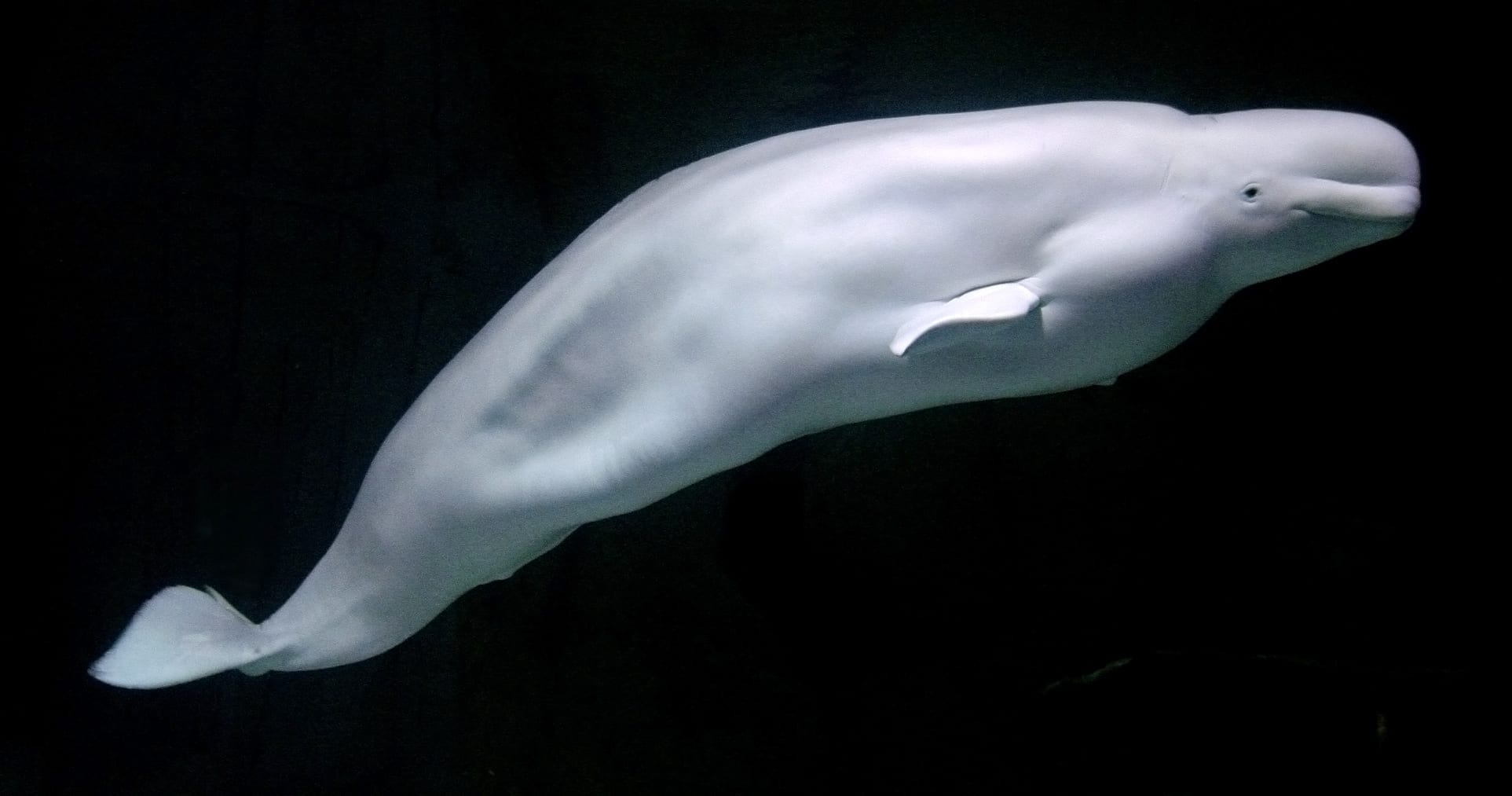
The beluga whale (; Delphinapterus leucas), is an Arctic and sub-Arctic cetacean. It is one of two living members of the family Monodontidae, along with the narwhal, and the only member of the genus Delphinapterus. It is also known as the white whale, as it is the only cetacean to regularly occur with this colour; the sea canary, due to its high-pitched calls; and the melonhead, though that more commonly refers to the melon-headed whale, which is an oceanic dolphin.
The beluga is adapted to life in the Arctic, with anatomical and physiological characteristics that differentiate it from other cetaceans. Amongst these are its all-white colour and the absence of a dorsal fin, which allows it to swim under ice with ease. It possesses a distinctive protuberance at the front of its head which houses an echolocation organ called the melon, which in this species is large and deformable. The beluga's body size is between that of a dolphin and a True's beaked whale, with males growing up to 5.5 m (18 ft) long and weighing up to 1,600 kg (3,530 lb). This whale has a stocky body. Like many cetaceans, a large percentage of its weight is blubber (subcutaneous fat). Its sense of hearing is highly developed and its echolocation allows it to move about and find breathing holes under sheet ice.
The canary of the sea, singing under the polar ice.
Description
Belugas have a round and muscular body that is tapered at both ends. The tapering begins at the base of its neck, which gives the beluga the appearance of shoulders. This trait is unique compared to other cetaceans. Beluga whales do not have fused neck vertebrae. The neck of a beluga is narrower when compared to other extant whales. The unusual vertebrae traits in a beluga allow it to move its head and nod.
Habitat and distribution
The beluga inhabits a discontinuous circumpolar distribution in Arctic and sub-Arctic waters. During the summer, they can mainly be found in deep waters ranging from 76°N to 80°N, particularly along the coasts of Alaska, northern Canada, western Greenland and northern Russia. The southernmost extent of their range includes isolated populations in the St. Lawrence River in the Atlantic, and the Amur River delta, the Shantar Islands and the waters surrounding Sakhalin Island in the Sea of Okhotsk.
Behaviour
Belugas are highly sociable and they regularly form small groups, or pods, that may contain between two and 25 individuals, with an average of 10 members. Pods tend to be unstable, meaning individuals tend to move from pod to pod. Radio tracking has even shown belugas can start out in one pod and within a few days be hundreds of miles away from that pod. Beluga whale pods can be grouped into three categories, nurseries (which consist of mother and calves), bachelors (which consist of all males) and mixed groups which contain both sexes. Most beluga whale pods were not organized primarily around close maternal relatives; the pods included both relatives and non-relatives, many members were paternal rather than maternal relatives, and there were also many cases where unrelated adult males traveled together. Many hundreds and even thousands of individuals can be present when the pods join in river estuaries during the summer. This can represent a significant proportion of the total population and is when they are most vulnerable to being hunted.
They are cooperative and frequently hunt in coordinated groups. Belugas in a pod are very sociable and often chase each other as if they are playing or fighting, and they often rub against each other. Often individuals will surface and dive together in a synchronized manner, in a behavior known as milling.
Threats
The native populations of the Arctic in Alaska, Canada, Greenland and Russia hunt belugas, for both consumption and profit. Belugas have been easy prey for hunters due to their predictable migration patterns and the high population density in estuaries and surrounding coastal areas during the summer.
The number of animals killed is about 1,000 per year, (see table below. and its sources). Beluga whale hunting quotas in Canada and the United States are established using the Potential Biological Removal equation PBR = Nmin * 0.5 * Rmax * FR, to determine what constitutes a sustainable hunt. Nmin represents a conservative estimation of the population size, Rmax, represents the maximum rate of population increase and FR represents the recovery factor.
Conservation status
Prior to 2008, the beluga was listed as vulnerable by the International Union for Conservation of Nature (IUCN), a higher level of concern. The IUCN cited the stability of the largest sub-populations and improved census methods that indicate a larger population than previously estimated. In 2008, the beluga was reclassified as near threatened by the IUCN due to uncertainty about threats to their numbers and the number of belugas over parts of its range (especially the Russian Arctic), and the expectation that if current conservation efforts cease, especially hunting management, the beluga population is likely to qualify for threatened status within five years. In June 2017, its status was reassessed to least concern.