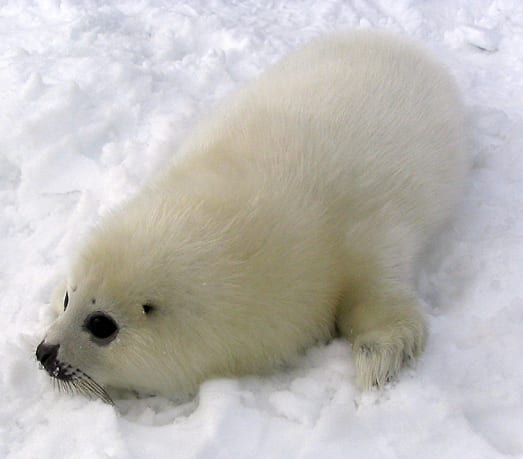
The harp seal (Pagophilus groenlandicus), also known as the saddleback seal or Greenland seal, is a species of earless seal, or true seal, native to the northernmost Atlantic Ocean and Arctic Ocean. Originally in the genus Phoca with a number of other species, it was reclassified into the monotypic genus Pagophilus in 1844. In Greek, its scientific name translates to "Greenlandic ice-lover", and its taxonomic synonym, Phoca groenlandica translates to "Greenlandic seal".
Born on drifting ice in a coat the color of clouds.
Description
The mature harp seal has pure black eyes. It has a silver-grey fur covering its body, with black harp- or wishbone-shaped markings dorsally, accounting for its common name. Adult harp seals grow to be 1.7 to 2.0 m (5 ft 7 in to 6 ft 7 in) long and weigh from 115 to 140 kg (254 to 309 lb). The harp seal pup has a white coat for the first 2–3 weeks until the first moult, when it is replaced by a black-dotted silver to grey coat. Pups acquire their characteristic pattern once they near sexual maturity. In males, the transition to the harp-pattern tends to be abrupt, while in females it may be gradual and span years. Some females may never lose all their spots or not fully develop the harp-pattern. Harp seals show little sexual dimorphism in size, with males being slightly larger.
The harp seal is a modest diver. Dive depth varies with season, time of day and location. In the Greenland Sea sub-population, the average dive rate is around 8.3 dives per hour and dives range from a depth of less than 20 m (66 ft) to over 500 m (1,600 ft). Dive duration ranges from less than two minutes to just over 20 minutes. During the spring and summer when seals forage along the pack ice in the Greenland Sea, most dives are less than 50 m (160 ft). In the late fall and winter, dive depth has been found to increase, particularly in the Denmark Strait, where the mean dive depth was found to be 141 m (463 ft).
Population and distribution
Global harp seal population estimates total around 4.5 million individuals. Due to their dependence on pack ice for breeding, the harp seal range is restricted to areas where pack ice forms seasonally. The western North Atlantic stock or population, which is the largest, is located off eastern Canada. This population is further divided into two separate "herds" based on the breeding location. The Front herd breeds off the coast of Labrador and Newfoundland, and the Gulf herd breeds near the Magdalen Islands in the middle of the Gulf of St. Lawrence. A second stock breeds on the "West Ice" off eastern Greenland. A third stock breeds on the "East Ice" in the White Sea, which is off the north coast of Russia below the Barents Sea. Breeding occurs between mid-February and April, and varies somewhat for each stock. The three stocks are allopatric and do not interbreed. Some individuals from the Greenland Sea sub-population have been observed to forage in the Barents Sea alongside the White Sea sub-population during late summer and fall.
Life history
Harp seals spend relatively little time on land compared with time at sea. They are social animals and can be quite vocal in groups. Within their large colonies, smaller groups with their own hierarchies form. Groups of several thousand form during pupping and mating season. Harp seals can live over 30 years in the wild. On the ice, pups call their mothers by "yelling", and "mumble" while playing with other pups. Adults "growl" and "warble" to warn off conspecifics and predators. Underwater, adults have been recorded using more than 19 types of vocalization during courting and mating.
The harp seal is a fast ice breeder and is believed to have a promiscuous mating system. Breeding occurs between mid-February and April. While courtship starts on the ice, mating usually takes place in the water. Courtship peaks during mid-March and involves males performing underwater displays, using bubbles, vocalizations, and paw movements to court females. Females, who remain on the ice, will resist copulation unless underwater.
Sealing
All three populations are hunted commercially, mainly by Canada, Norway, Russia and Greenland.
In Canada, commercial hunting season is from 15 November to 15 May. Most sealing occurs in late March in the Gulf of St. Lawrence, and during the first or second week of April off Newfoundland, in an area known as "the Front". This peak spring period is generally what is referred to as the "Canadian seal hunt". Hunting Canadian whitecoats has been banned since 1987. Since 2000, harp seals that are targeted during the hunt are often found to be "beaters" less than a year old. In 2006, the St. Lawrence hunt officially started on 25 March due to thin ice caused by the year's milder temperatures. Inuit living in the region hunt mainly for food and, to a lesser extent, commerce.
In 2019, the Department of Fisheries and Oceans estimated sustainable harvest levels for the next five years. The identified annual Canadian Total Allowable Catch (TAC) levels were 425,000 assuming harvest age structures of 95% young of the year (YOY). In 2016, 66,800 harp seals and 1,612 grey seals were harvested in Atlantic Canada.