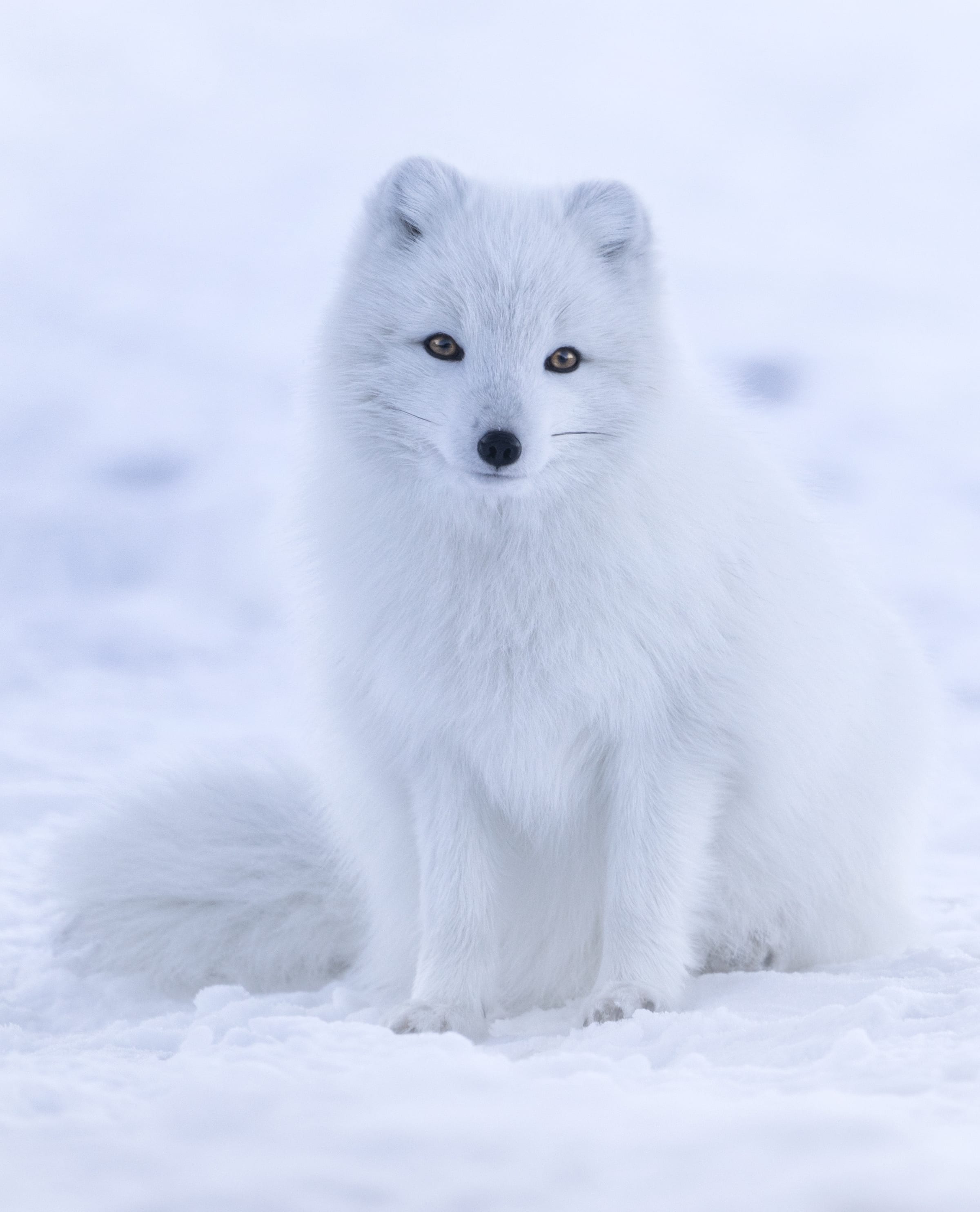
The Arctic fox (Vulpes lagopus), also known as the white fox, polar fox, or snow fox, is a small species of fox native to the Arctic regions of the Northern Hemisphere and common throughout the Arctic tundra. It is well adapted to living in cold environments, and is known for its thick, warm fur that can be used as camouflage against snow in the winter. It has a large and fluffy tail. In the wild, most individuals do not live past their first year but some exceptional ones survive up to 11 years. Its body length ranges from 46 to 68 cm (18 to 27 in), with a generally rounded body shape to minimize the escape of body heat.
The Arctic fox preys on many small creatures such as lemmings, voles, ringed seal pups, fish, waterfowl, and seabirds. It also eats carrion, berries, seaweed, and insects and other small invertebrates. Arctic foxes form monogamous pairs during the breeding season and they stay together to raise their young in complex underground dens. Occasionally, other family members may assist in raising their young. Natural predators of the Arctic fox include golden eagles, Arctic wolves, polar bears, wolverines, red foxes, and brown bears.
Survives minus seventy by turning white and curling into itself.
Description
The Arctic fox is smaller than the red fox, standing 25–30 cm (9.8–11.8 in) tall at the shoulder. Males weigh 3.5 kg (7.7 lb) on average, with a range of 3.2–9.4 kg (7.1–20.7 lb), while females average 2.9 kg (6.4 lb), with a range of 1.4–3.2 kg (3.1–7.1 lb). The average head-to-rear length of males is 55 cm (22 in), ranging from 46–68 cm (18–27 in), while females average 52 cm (20 in) with a range of 41–55 cm (16–22 in). Foxes that live further north are smaller than more southern foxes. The tail is about one third the length of the body.
Arctic foxes shed twice a year, switching between their summer coat, which is darker, and their winter coat, which is lighter. The summer coat is short, and the winter coat is long and thick in order to retain heat. The winter coat is twice the length of the summer coat.
Distribution and habitat
The Arctic fox has a circumpolar distribution and occurs in Arctic tundra habitats in northern Europe, northern Asia, and North America. Its range includes Iceland, Fennoscandia, Svalbard, and other islands in the Barents Sea, northern Russia, islands in the Bering Sea, Greenland, Alaska, and Canada as far south as Hudson Bay. In the late 19th century, it was introduced into the Aleutian Islands southwest of Alaska. However, the population on the Aleutian Islands is currently being eradicated in conservation efforts to preserve the local bird population. It mostly inhabits tundra and pack ice, but is also present in Canadian boreal forests (northeastern Alberta, northern Saskatchewan, northern Manitoba, Northern Ontario, Northern Quebec, and Newfoundland and Labrador) and the Kenai Peninsula in Alaska. They are found at elevations up to 3,000 m (9,800 ft) above sea level and have been seen on sea ice close to the North Pole.
The Arctic fox is the only land mammal native to Iceland. It came to the isolated North Atlantic island at the end of the last ice age, walking over the frozen sea. The Arctic Fox Center in Súðavík contains an exhibition on the Arctic fox and conducts studies on the influence of tourism on the population. Its range during the last ice age was much more extensive than it is now, and fossil remains of the Arctic fox have been found over much of northern Europe and Siberia.
Behavior and ecology
Arctic foxes must endure a temperature difference of up to 90–100 °C (160–180 °F) between the external environment and their internal core temperature. To prevent heat loss, the Arctic fox curls up tightly tucking its legs and head under its body and behind its furry tail. This position gives the fox the smallest surface area to volume ratio and protects the least insulated areas. Arctic foxes also stay warm by getting out of the wind and residing in their dens. Although the Arctic foxes are active year-round and do not hibernate, they attempt to preserve fat by reducing their locomotor activity. They build up their fat reserves in the autumn, sometimes increasing their body weight by more than 50%. This provides greater insulation during the winter and a source of energy when food is scarce.
In the spring, the Arctic fox's attention switches to reproduction and a home for their potential offspring. They live in large dens in frost-free, slightly raised ground. These are complex systems of tunnels covering as much as 1,000 m2 (11,000 sq ft) and are often in eskers, long ridges of sedimentary material deposited in formerly glaciated regions. These dens may be in existence for many decades and are used by many generations of foxes.
Conservation status
The Arctic fox has been assessed as least concern on the IUCN Red List since 2004. However, the Scandinavian mainland population is acutely endangered, despite being legally protected from hunting and persecution for several decades. The estimate of the adult population in all of Norway, Sweden, and Finland is fewer than 200 individuals. Of these, especially in Finland, the Arctic fox is even classified as critically endangered, because even though the animal was declared a protected species in Finland in 1940, the population has not recovered despite that. As a result, the populations of Arctic fox have been carefully studied and inventoried in places such as the Vindelfjällens Nature Reserve (Sweden), which has the Arctic fox as its symbol.
The abundance of the Arctic fox tends to fluctuate in a cycle along with the population of lemmings and voles (a 3- to 4-year cycle). The populations are especially vulnerable during the years when the prey population crashes, and uncontrolled trapping has almost eradicated two subpopulations.
The pelts of Arctic foxes with a slate-blue coloration were especially valuable. They were transported to various previously fox-free Aleutian Islands during the 1920s. The program was successful in terms of increasing the population of blue foxes, but their predation of Aleutian Canada geese conflicted with the goal of preserving that species.