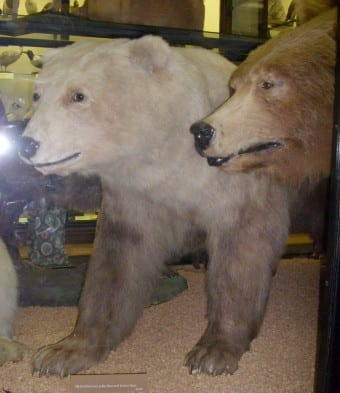
The polar bear (Ursus maritimus) is a large bear native to the Arctic and nearby areas. It is closely related to the brown bear, and the two species can interbreed. The polar bear is the largest extant species of bear and land carnivore by body mass, with adult males weighing 300–800 kg (660–1,760 lb). The species is sexually dimorphic, as adult females are much smaller. The polar bear is white or yellowish-furred with black skin and a thick layer of fat. It is more slender than the brown bear, with a narrower skull, longer neck and lower shoulder hump. Its teeth are sharper and more adapted to cutting meat. The paws are large and allow the bear to walk on ice and paddle in the water.
Polar bears are both terrestrial and pagophilic (ice-living) and are considered marine mammals because of their dependence on marine ecosystems. They prefer the annual sea ice but live on land when the ice melts in the summer. They are mostly carnivorous and specialized for preying on seals, particularly ringed seals. Such prey is typically taken by ambush; the bear may stalk its prey on the ice or in the water, but also will stay at a breathing hole or ice edge to wait for prey to swim by. The bear primarily feeds on the seal's energy-rich blubber. Other prey include walruses, beluga whales and some terrestrial animals. Polar bears are usually solitary but can be found in groups when on land. During the breeding season, male bears guard females and defend them from rivals. Mothers give birth to cubs in maternity dens during the winter. Young stay with their mother for up to two and a half years.
Largest land carnivore on earth, hunting only on shifting sea ice.
Description
The polar bear is the largest living species of bear and land carnivore, though some brown bear subspecies like the Kodiak bear can rival it in size. Males are generally 200–250 cm (6.6–8.2 ft) long with a weight of 300–800 kg (660–1,760 lb). Females are smaller at 180–200 cm (5.9–6.6 ft) with a weight of 150–300 kg (330–660 lb). Sexual dimorphism in the species is particularly high compared with most other mammals. Male polar bears also have proportionally larger heads than females. The weight of polar bears fluctuates during the year, as they can bulk up on fat and increase their mass by 50 percent. A fattened, pregnant female can weigh as much as 500 kg (1,100 lb). Adults may stand 130–160 cm (4.3–5.2 ft) tall at the shoulder. The tail is 76–126 mm (3.0–5.0 in) long. The largest polar bear on record, reportedly weighing 1,002 kg (2,209 lb), was a male shot at Kotzebue Sound in northwestern Alaska in 1960.
Distribution and habitat
Polar bears inhabit the Arctic and adjacent areas. Their range includes Greenland, Canada, Alaska, Russia and the Svalbard Archipelago of Norway. Polar bears have been recorded as close as 25 km (16 mi) from the North Pole. The southern limits of their range include James Bay and Newfoundland and Labrador in Canada and St. Matthew Island and the Pribilof Islands of Alaska. They are not permanent residents of Iceland but have been recorded visiting there if they can reach it via sea ice. As there has been minimal human encroachment on the bears' remote habitat, they can still be found in much of their original range, more of it than any other large land carnivore.
Behaviour and ecology
Polar bears may travel areas as small as 3,500 km2 (1,400 sq mi) to as large as 38,000 km2 (15,000 sq mi) in a year, while drifting ice allows them to move further. Depending on ice conditions, a bear can travel an average of 12 km (7.5 mi) per day. These movements are powered by their energy-rich diet. Polar bears move by walking and galloping and do not trot. Walking bears tilt their front paws towards each other. They can run at estimated speeds of up to 40 km/h (25 mph) but typically move at around 5.5 km/h (3.4 mph). Polar bears are also capable swimmers and can swim at up to 6 km/h (3.7 mph). One study found they can swim for an average of 3.4 days at a time and travel an average of 154.2 km (95.8 mi). They can dive for as long as three minutes. When swimming, the broad front paws do the paddling, while the hind legs play a role in steering and diving.
Conservation status
In 2015, the IUCN Red List categorized the polar bear as vulnerable because of a "decline in area of occupancy, extent of occurrence and/or quality of habitat". It estimated the total population to be between 22,000 and 31,000, and the current population trend is unknown. Threats to polar bear populations include climate change, pollution and energy development. In 2021, the IUCN/SSC Polar Bear Specialist Group labelled four subpopulations (Barents and Chukchi Sea, Foxe Basin and Gulf of Boothia) as "likely stable", two (Kane Basin and M'Clintock Channel) as "likely increased" and three (Southern Beaufort Sea, Southern and Western Hudson Bay) as "likely decreased" over specific periods between the 1980s and 2010s. The remaining ten did not have enough data.
Relationship with humans
Polar bears have coexisted and interacted with circumpolar peoples for millennia. "White bears" are mentioned as commercial items in the Japanese book Nihon Shoki in the seventh century. It is not clear if these were polar bears or white-coloured brown bears. During the Middle Ages, Europeans considered white bears to be a novelty and were more familiar with brown- and black-coloured bears. The first known written account of the polar bear in its natural environment is found in the 13th-century anonymous Norwegian text Konungs skuggsjá, which mentions that "the white bear of Greenland wanders most of the time on the ice of the sea, hunting seals and whales and feeding on them" and says the bear is "as skillful a swimmer as any seal or whale".