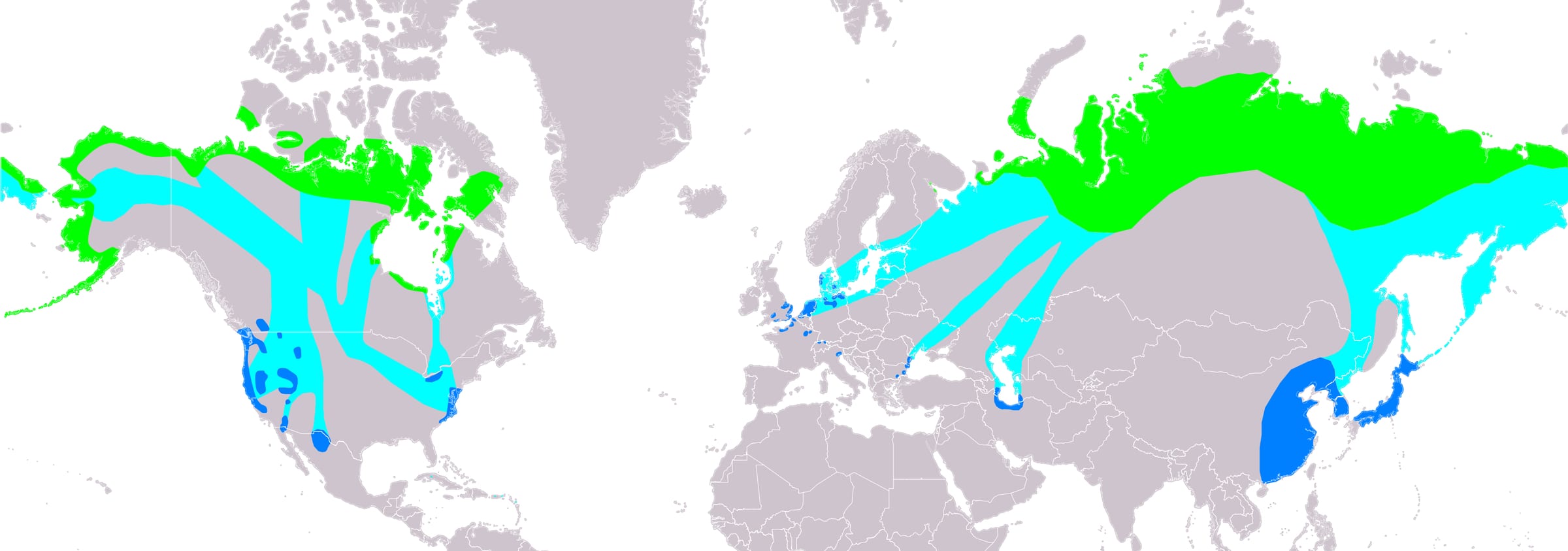
The tundra swan (Cygnus columbianus) is a Holarctic species of swan and the smallest of the Holarctic swans. It comprises two subspecies, which are sometimes treated as separate species: Bewick's swan (C. c. bewickii) of the Palaearctic and the whistling swan (C. c. columbianus) of the Nearctic.
Adult birds of both subspecies have entirely white plumage, black feet, and a mostly black bill with a salmon-pink streak along the mouthline and varying amounts of yellow at the base. Bewick's swan is the smaller subspecies and resembles the whooper swan, while the whistling swan is distinguished by its larger size and nearly all-black bill. The species is notably vocal, producing high-pitched honking calls, particularly when foraging in flocks.
Crosses continents on whistling wings to nest at the top of the world.
Description
C. columbianus is the smallest of the Holarctic swans, at 115–150 cm (45–59 in) in length, 168–211 cm (66–83 in) in wingspan and a weight range of 3.4–9.6 kg (7.5–21.2 lb). In adult birds, the plumage of both subspecies is entirely white, with black feet, and a bill that is mostly black, with a thin salmon-pink streak running along the mouthline and – depending on the subspecies – more or less yellow in the proximal part. The iris is dark brown. In birds living in waters that contains large amounts of iron ions (e.g. bog lakes), the head and neck plumage acquires a golden or rusty hue. Pens (females) are slightly smaller than cobs (males), but do not differ in appearance otherwise.
Immatures of both subspecies are white mixed with some dull grey feathering, mainly on the head and upper neck, which are often entirely light grey; their first-summer plumage is quite white already, and in their second winter they moult into the adult plumage. Their bills are black with a large dirty-pink patch taking up most of the proximal half and often black nostrils, and their feet are dark grey with a pinkish hue. Downy young are silvery grey above and white below.
Distribution
As their common name implies, the tundra swan breeds in the tundra of the Arctic and subarctic, where they inhabit shallow pools, lakes and rivers. These birds, unlike mute swans (C. olor) but like the other Arctic swans, are migratory birds. The winter habitat of both subspecies is grassland and marshland, often near the coast; they like to visit fields after harvest to feed on discarded grains and while on migration may stop over on mountain lakes. According to National Geographic, when migrating these birds can fly at altitudes of 8 km (5.0 mi) in a V formation.
Ecology and biology
About 15% of the adults die each year from various causes, and thus the average lifespan in the wild is about 10 years. The oldest recorded tundra swan was over 24 years old.
In summer, their diet consists mainly of aquatic vegetation, e.g. mannagrass (Glyceria), Potamogeton pondweeds and marine eelgrass (Zostera), acquired by sticking the head underwater or upending while swimming; they also eat some grass growing on dry land. At other times of year, leftover grains and other crops such as potatoes, picked up in open fields after harvest, make up much of their diet. Tundra swans forage mainly by day. In the breeding season, they tend to be territorial and are aggressive to many animals who pass by; outside the breeding season they are rather gregarious birds.
Conservation status
The whistling swan is the most common swan species of North America, estimated to number almost 170,000 individuals around 1990. Its numbers seem to be slowly declining in the west of its range since the late 19th century, coincident with the expansion of human settlement and habitat conversion in the birds' wintering areas; the eastern whistling swan populations on the other hand seem to be increasing somewhat, and altogether its numbers seem to have slightly risen in the late 20th century (the population was estimated at 146,000 in 1972). Bewick's swan remains far less known; although its population is in decline in northwestern Europe, for currently unexplained reasons. The European winter population was estimated at 16,000–17,000 about 1990, with about 20,000 birds wintering in east Asia. The Iranian wintering population is small—1,000 birds or so at most—but they usually disperse to several sites, some of which are still unknown to scientists.