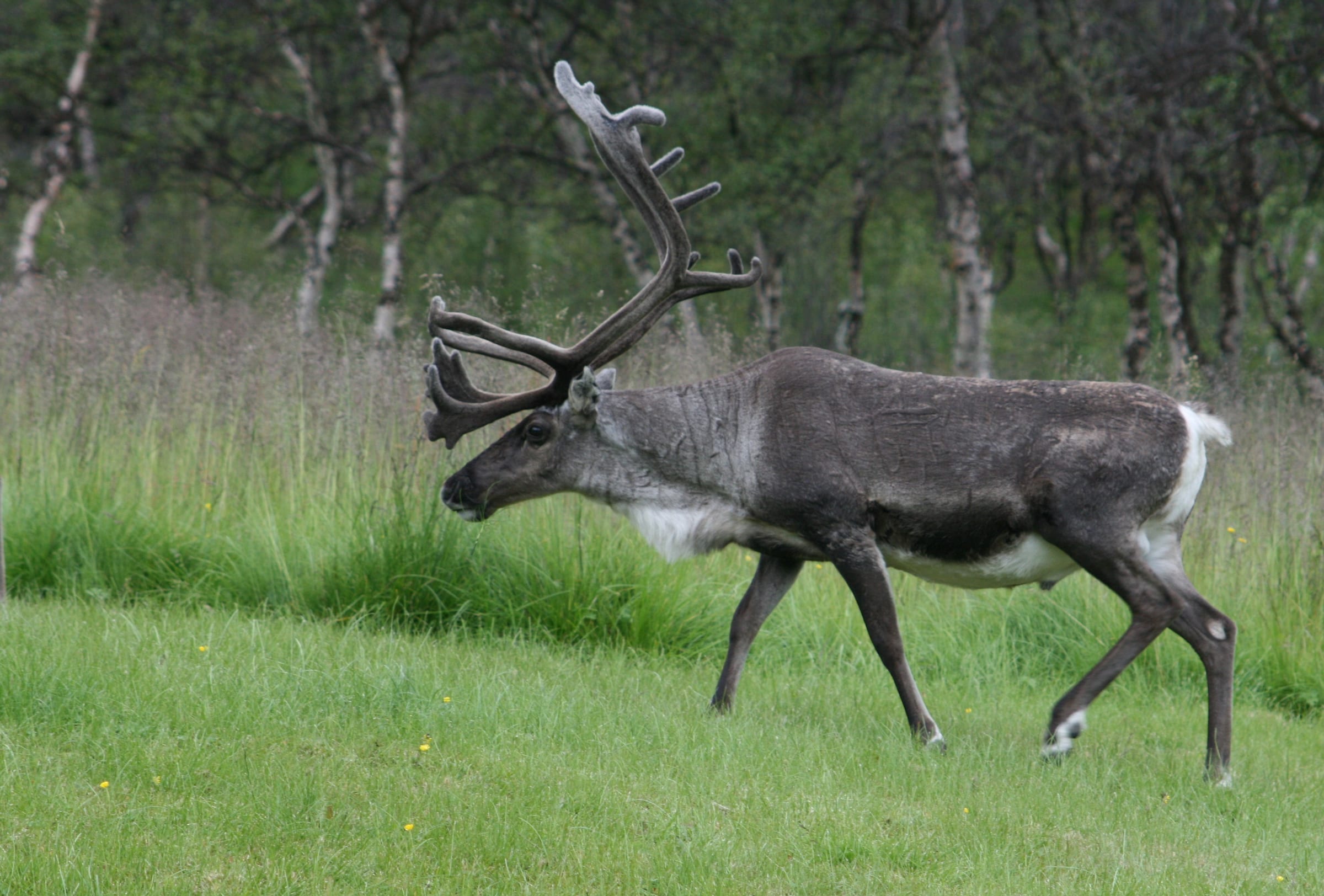
The reindeer or caribou (Rangifer tarandus) is a species of deer with circumpolar distribution, native to Arctic, subarctic, tundra, boreal, and mountainous regions of Northern Europe, Siberia, and North America. It is the only representative of the genus Rangifer. More recent studies suggest the splitting of reindeer and caribou (North American terminology). "All caribou and reindeer throughout the world are considered to be the same species, but there are 7 subspecies."
Reindeer occur in both migratory and sedentary populations, and their herd sizes vary greatly in different regions. The tundra subspecies are adapted for extreme cold, and some are adapted for long-distance migration.
The only deer where both sexes wear antlers like crowns.
Description
Names follow international convention before the recent revision (see Reindeer § Taxonomy below). Reindeer / caribou (Rangifer) vary in size from the smallest, the Svalbard reindeer (R. (t.) platyrhynchus), to the largest, Osborn's caribou (R. t. osborni). They also vary in coat color and antler architecture.
The North American range of caribou extends from Alaska through the Yukon, the Northwest Territories and Nunavut throughout the tundra, taiga (boreal forest) and south through the Canadian Rocky Mountains. Of the eight subspecies classified by Harding (2022) into the Arctic caribou (R. arcticus), the migratory mainland barren-ground caribou of Arctic Alaska and Northern Canada (R. t. arcticus), summer in tundra and winter in taiga, a transitional forest zone between boreal forest and tundra; the nomadic Peary caribou (R. t. pearyi) lives in the polar desert of the high Arctic Archipelago and Grant's caribou (R. t. granti also called the Porcupine caribou) lives in the western end of the Alaska Peninsula and the adjacent islands; the other four subspecies, Osborn's caribou (R. t. osborni), Stone's caribou (R. t. stonei), the Rocky Mountain caribou (R. t. fortidens) and the Selkirk Mountains caribou (R. t. montanus) are all montane. The extinct insular Queen Charlotte Islands caribou (R. t. dawsoni), lived on Graham Island in Haida Gwaii (formerly known as the Queen Charlotte Islands).
Physical characteristics
Naming in this and following sections follows the taxonomy in the authoritative 2011 reference work Handbook of the Mammals of the World Vol. 2: Hoofed Mammals.
In most cervid species, only males grow antlers; the reindeer is the only cervid species in which females also grow them normally. Androgens play an essential role in the antler formation of cervids. The antlerogenic genes in reindeer have more sensitivity to androgens in comparison with other cervids.
Biology and behaviors
Reindeer have developed adaptations for optimal metabolic efficiency during warm months as well as for during cold months. The body composition of reindeer varies highly with the seasons. Of particular interest is the body composition and diet of breeding and non-breeding females between the seasons. Breeding females have more body mass than non-breeding females between the months of March and September with a difference of around 10 kg (22 lb) more than non-breeding females. From November to December, non-breeding females have more body mass than breeding females, as non-breeding females are able to focus their energies towards storage during colder months rather than lactation and reproduction. Body masses of both breeding and non-breeding females peaks in September. During the months of March through April, breeding females have more fat mass than the non-breeding females with a difference of almost 3 kg (6.6 lb). After this, however, non-breeding females on average have a higher body fat mass than do breeding females.
Ecology
Originally, the reindeer was found in Scandinavia, Eastern Europe, Greenland, Russia, Mongolia and northern China north of the 50th latitude. In North America, it was found in Canada, Alaska, and the northern contiguous United States from Maine to Washington. In the 19th century, it was still present in southern Idaho. Even in historical times, it probably occurred naturally in Ireland, and it is believed to have lived in Scotland until the 12th century, when the last reindeer were hunted in Orkney. During the Late Pleistocene Epoch, reindeer occurred further south in North America, such as in Nevada, Tennessee, and Alabama, and as far south as Spain in Europe. Though their range retreated northwards during the terminal Pleistocene, reindeer returned to Northern Europe during the Younger Dryas. Today, wild reindeer have disappeared from these areas, especially from the southern parts, where it vanished almost everywhere. Large populations of wild reindeer are still found in Norway, Finland, Siberia, Greenland, Alaska and Canada.
Status
About 20,000 mountain reindeer (R. t. tarandus) still live in the mountains of Norway, notably in Hardangervidda. In Sweden there are approximately 250,000 reindeer in herds managed by Sámi villages. Russia manages 19 herds of Siberian tundra reindeer (R. t. sibiricus) that total about 940,000. The Taimyr herd of Siberian tundra reindeer is the largest wild reindeer herd in the world, varying between 400,000 and 1,000,000; it is a metapopulation consisting of several subpopulations — some of which are phenotypically different — with different migration routes and calving areas. The Kamchatkan reindeer (R. t. phylarchus), a forest subspecies, formerly included reindeer west of the Sea of Okhotsk which, however, are indistinguishable genetically from the Jano-Indigirka, East Siberian taiga and Chukotka populations of R. t. sibiricus. Siberian tundra reindeer herds have been in decline but are stable or increasing since 2000.
Insular (island) reindeer, classified as the Novaya Zemlya reindeer (R. t. pearsoni) occupy several island groups: the Novaya Zemlya Archipelago (about 5,000 animals at last count, but most of these are either domestic reindeer or domestic-wild hybrids), the New Siberia Archipelago (about 10,000 to 15,000), and Wrangel Island (200 to 300 feral domestic reindeer).