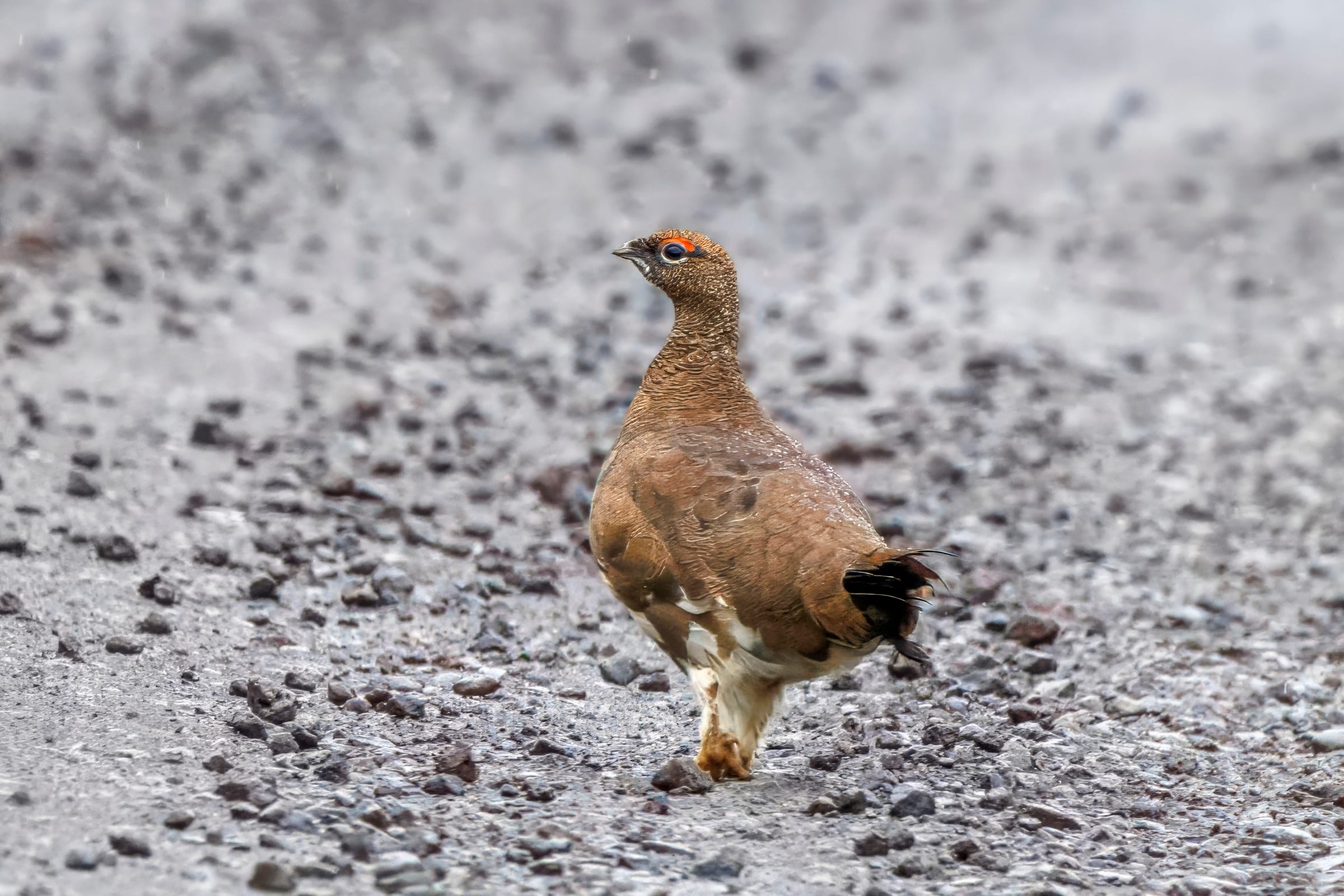
The rock ptarmigan (Lagopus muta) is a medium-sized game bird in the grouse tribe. It is known simply as the ptarmigan in Europe. It is the official bird for the Canadian territory of Nunavut, where it is known as the aqiggiq (ᐊᕿᒡᒋᖅ), and the official game bird for the province of Newfoundland and Labrador. In Japan, it is known as the raichō (雷鳥), which means "thunder bird"; it is the official bird of Gifu, Nagano, and Toyama Prefectures and is a protected species nationwide.
Changes wardrobe three times a year to match the tundra.
Description
The rock ptarmigan is 34–36 cm (13–14 in) long with an 8 cm (3.1 in) tail and with a wingspan of 54–60 cm (21–24 in) and a weight of 440–640 g (15.5–22.6 oz). It is about ten percent smaller than the willow ptarmigan.
The rock ptarmigan is camouflaged to match the seasons; its feathers moult from white in winter to grey and brown in spring or summer. The breeding male has greyish upper parts with white wings and underparts. In winter, its plumage becomes completely white except for the black outer tail feathers and eye line. It can be distinguished from the winter willow ptarmigan by habitat; the rock ptarmigan prefers higher elevations and more barren habitats. It also differs in its slender bill; males additionally have black lores, absent in the willow ptarmigan, though they are also absent in female rock ptarmigan.
Distribution and habitat
The rock ptarmigan is a sedentary species which breeds across Arctic and Subarctic Eurasia and North America (including Greenland) on rocky mountainsides and tundra. It is widespread in the Arctic Cordillera and across the Eurasian Arctic from Norway, Sweden east to the Siberian Far East. It is also found in isolated populations in the mountains of Scotland, the Pyrenees, the Alps, Bulgaria, the Urals, the Pamir Mountains, the Altay Mountains, and Japan, where it occurs only in the Japanese Alps and on Mount Haku. Because of the remote habitat in which it lives, it has only a few predators, notably gyrfalcon, golden eagle, and arctic fox, and it can be surprisingly approachable.
The small population living on Franz Josef Land in the Russian High Arctic overwinters during the polar night and survives by feeding on rich vegetation on and underneath high cliffs where seabird colonies are located in summer.
In Great Britain, it occurred in England in the Lake District fells until the early 1800s, and slightly later in the Southern Uplands of Scotland, but is now absent from these regions, occurring now only in the Scottish Highlands. During the last ice age, the species was far more widespread in continental Europe.
Ecology
Food sources can vary tremendously depending on the region of their distribution. In Alaska, rock ptarmigans consume aspen buds, dwarf birch and willow buds and catkins as a staple winter diet. They transition their diets over to Empetrum nigrum (crowberries) and Vaccinium vitis-idaea (cowberry or lingonberry) shrubs during the spring. The greatest variety in its diet occurs during early summer, when it feeds on willow leaves, as well as the leaves and flowers of Dryas and locoweed. It also feeds on berries, bistort seeds, and birch buds from late summer to autumn. Insects, larvae and snails are eaten by chicks.
Apart from the red eye combs, male rock ptarmigans have no 'distinct' plumage (other than the black eye stripe) that are more typical for other grouse in temperate regions. Studies on other grouses have shown that much variation in comb size and colour exists between the species, and that the comb is used in courtship display and aggressive interactions between males. Many studies have shown that there is a strong correlation between the comb size and the level of testosterone in males; one report from 1981 showed that the amount of testosterone is correlated to aggressiveness against other males.
Sounds and displays
Male rock ptarmigans emit a repertoire of guttural snores and rattles, most often directed to other males during breeding season. On open leks, single or multiple males also carry out displays on the ground and in the air to assert their territory, including chasing other males while flying.
Aerial courtship rituals involve fast forward flight with rapidly-beating wings followed by an upward glide, tail fanned out. The male, at the peak of the display, belts out a rasping "ah-AAH-ah-AAAAH-a-a-a-a-a-a!", with the sung latter part coinciding with a gliding descent afterwards. The sound is often described as that of a stick being pulled rapidly across the slats of a picket fence.
On the ground, male ptarmigans defend their space by calling and giving chase to other males. Physical conflicts between territorial males rarely occur, while confrontations between the former toward subordinate males are intensified. Other signals via fanning their tails, extended necks, lowered wings and circling a receptive female are also utilized.
Ecophysiology
Rock ptarmigan have a limited capacity for fat storage, which requires overwintering birds to forage frequently. Most of the minuscule mass gained over winter is to the ovary, oviduct and hypertrophy, in preparation for the spring breeding season. Rock ptarmigan maximize assimilation of nutrient poor foods with their elongated ceca. Metabolic requirements can be partially supplemented by fermentation, the energy gain from fermentation alone, however, is not independently significant.
The Svalbard Norwegian subspecies of rock ptarmigan, is the only subspecies that exhibits a significant seasonal mass gain. Larger fat deposits can help them survive during periods of low food availability. However, this alone is not an adequate source of energy to survive during winter. Additional stored fat does not appear to increase the energetic cost in these birds' locomotion. This adaptation is key for a species that must move frequently to forage. Fat assimilation in these birds is correlated to changes in liver weight. Most rock ptarmigan have no more than 20 grams of adipose tissue year round. Without food, these reserves can supplement energy for 2 days. The Svalbard rock ptarmigan, however, gains about 100 grams of adipose tissue. This can serve as an energy source for up to 10 days of starvation.