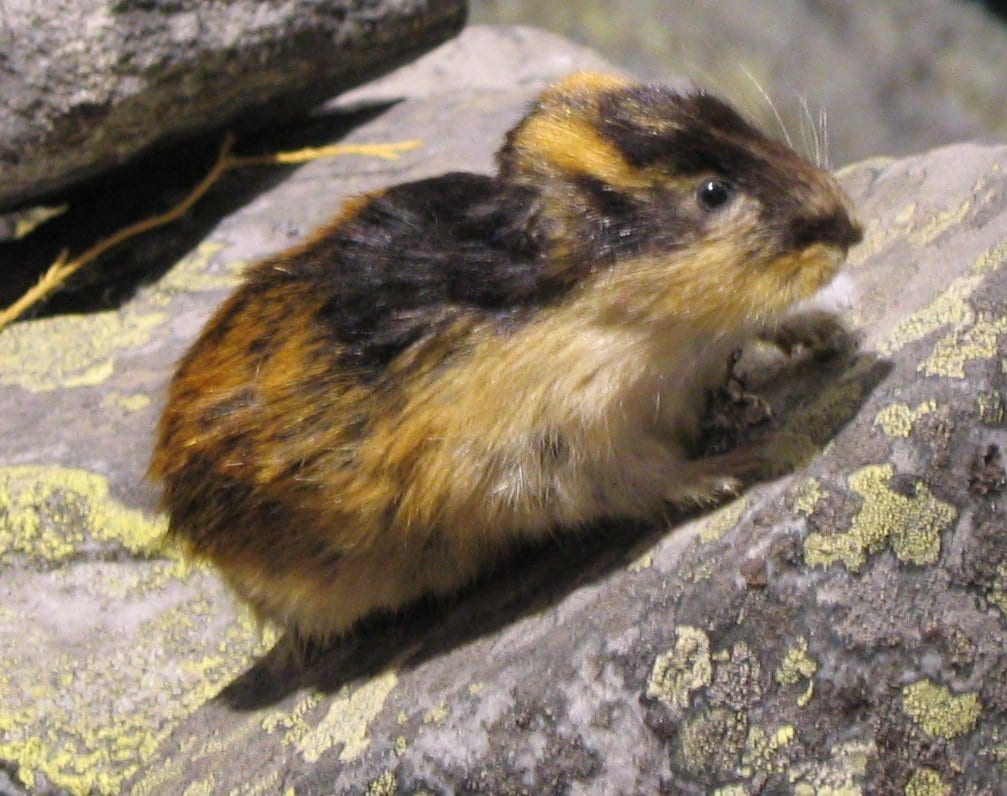
The Norway lemming, also known as the Norwegian lemming (Lemmus lemmus) is a common species of lemming found in northern Fennoscandia, where it is the only vertebrate species endemic to the region. The Norway lemming dwells in tundra and fells, and prefers to live near water. Adults feed primarily on sedges, grasses and moss. They are active at both day and night, alternating naps with periods of activity.
Tiny, ferocious, and prone to legendary population booms.
Description
The mainland Norway lemming has a bold pattern of black and yellow-brown, which is variable between individuals. In contrast, the Novaya Zemlya lemming has a cryptic gray coloration (hence why it was previously thought to be a population of the Siberian brown lemming). The species grows to a size of 155 mm (6.1 in). The tail is very short 10–19 mm (3⁄8–3⁄4 in). It weighs up to 130 g (4.6 oz). The dental formula is 1/1, 0/0, 3/3.
Distribution
It has a wide distribution from western Norway east to the Kola Peninsula. A 2021 study suggests that the lemmings of Novaya Zemlya may also belong to this species; this would extend its range east to Novaya Zemlya island, but these results have not been fully accepted.
Behaviour
The Norway lemming has a dramatic three- to four-year population cycle, in which the species' population periodically rises to unsustainable levels, leading to high mortality, which causes the population to crash again.
The Norway lemming spends the winter in nests under the snow. When the spring thaws begin and the snow starts to collapse, they must migrate to higher ground, where the snow is still firm enough for safety, or, more commonly, to lower ground, where they spend the summer months. In autumn, they must time their movement back to sheltered higher ground carefully, leaving after alpine snow cover is available for their burrows and nests, and before the lowlands are made uninhabitable by frost and ice.
The "Novaya Zemlya lemming"
In 2021, a taxonomic study analyzing a distinct population of lemmings on Novaya Zemlya, previously thought to be Siberian brown lemmings (Lemmus sibiricus), found them to be more closely related to L. lemmus, and reclassified them as a new subspecies, L. l. chernovi, or the Novaya Zemlya lemming, named after zoologist and academician of the Russian Academy of Sciences, Yury I. Chernov. It is currently only known from the southern island of the archipelago. It is thought that prior to the Eemian Interglacial, L. lemmus was distributed widely throughout the Arctic Shelf from Western Europe east to Novaya Zemlya, and sea level rise during the Eemian left the species in its present-day disjunct distribution, with populations only on Fennoscandia and Novaya Zemlya. Novaya Zemlya may have served as a refugium for cold-adapted terrestrial fauna such as L. lemmus during the Pleistocene interglacial periods. The Novaya Zemlya lemming lacks the aposematic coloration of the Norway lemming, being dull in color and lacking antipredator adaptations. It is thought that the aposematic traits may be specific to the mainland population and evolved during its isolation in the Fennoscandian refugium.