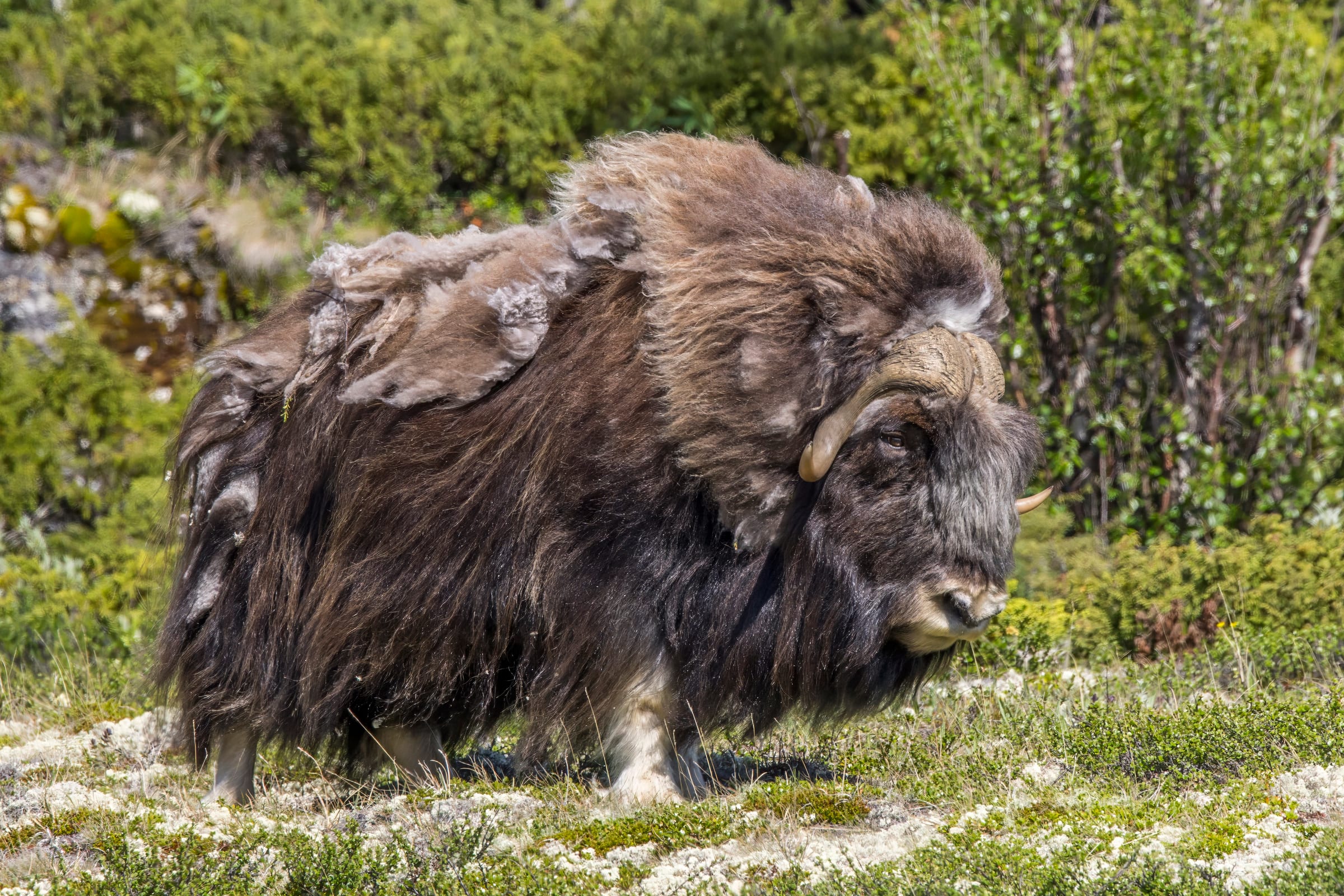
The muskox (Ovibos moschatus) is a hoofed mammal of the family Bovidae. Native to the Arctic, it is noted for its thick coat and for the strong odor emitted by males during the seasonal rut, from which its name derives. This musky odor has the effect of attracting females during mating season. Its Inuktitut name umingmak translates to "the bearded one".
Its Woods Cree names mâthi-môs and mâthi-mostos translate to "ugly moose" and "ugly bison", respectively. In historic times, muskoxen primarily lived in Greenland and the Canadian Arctic of the Northwest Territories and Nunavut. They were formerly present in Eurasia, with their youngest natural records in the region dating to around 2,700 years ago, with reintroduced populations in the U.S. state of Alaska, the Canadian territory of Yukon, and Siberia, and an introduced population in Norway, part of which emigrated to Sweden, where a small population now lives.
A shaggy ice-age relic forming circles against wolves and wind.
Physical characteristics
Both male and female muskoxen have long, curved horns. Muskoxen stand 1.1 to 1.5 m (3 ft 7 in to 4 ft 11 in) high at the withers, with females measuring 135 to 200 cm (4 ft 5 in to 6 ft 7 in) in length, and the larger males 200 to 250 cm (6 ft 7 in to 8 ft 2 in). The small tail, often concealed under a layer of fur, measures only 10 cm (3.9 in) long. Adults, on average, weigh 285 kg (628 lb), but can range from 180 to 410 kg (400 to 900 lb). The thick coat and large head suggest a larger animal than the muskox truly is; the bison, to which the muskox is often compared, can weigh up to twice as much. However, heavy zoo-kept specimens have weighed up to 650 kg (1,430 lb). Their coat, a mix of black, gray and brown, includes long guard hairs that almost reach the ground. Rare "white muskoxen" have been spotted in the Queen Maud Gulf Bird Sanctuary.
Muskoxen are occasionally semi-domesticated for wool, and rarely for meat and milk. The U.S. state of Alaska has several muskoxen farms specifically aimed at wool harvesting. The wool, called qiviut, is highly prized for its softness, length, and insulation value.
A muskox can reach speeds of up to 60 km/h (37 mph). Their life expectancy is between 12 and 20 years.
Range
During the Pleistocene period, muskoxen were much more widespread. Fossil evidence shows that they were widespread across the Siberian and North American Arctic, from the Urals to Greenland. The ancestors of today's muskoxen came across the Bering Land Bridge to North America between 200,000 and 90,000 years ago.
During the Wisconsinan, modern muskox thrived in the tundra south of the Laurentide Ice Sheet, in what is now the Midwest, the Appalachians and Virginia, while distant relatives Bootherium and Euceratherium lived in the forests of the Southern United States and the western shrubland, respectively. Though they were always less common than other Ice Age megafauna, muskox abundance peaked during the Würm II glaciation 20,000 years ago and declined afterwards, especially during the Pleistocene/Holocene extinction event, where its range was greatly reduced and only the populations in North America survived. The last known muskox population in Europe died out in Sweden 9,000 years ago. In Asia, muskox persisted until just 615–555 BC in Tumat, Sakha Republic.
Ecology
During the summer, muskoxen live in wet areas, such as river valleys, moving to higher elevations in the winter to avoid deep snow. Muskoxen will eat grasses, arctic willows, woody plants, lichens and mosses. When food is abundant, they prefer succulent and nutritious grasses in an area. Willows are the most commonly eaten plants in the winter. Muskoxen require a high threshold of fat reserves in order to conceive, which reflects their conservative breeding strategy. Winter ranges typically have shallow snow to reduce the energy costs of digging through snow to reach forage. The primary predators of muskoxen are arctic wolves, which may account for up to half of all mortality for the species. Other occasional predators, likely mainly predators of calves or infirm adults, can include grizzly bears and polar bears and wolverines.
Conservation status
Historically, this species declined because of overhunting, but populations have recovered following the enforcement of hunting regulations. Management in the late 1900s was mostly conservative hunting quotas to foster recovery and recolonization from the historic declines. The current world population of muskoxen is estimated at between 80,000 and 125,000, with an estimated 47,000 living on Banks Island, Canada.
In Greenland, there are no major threats. However, populations are often small in size and scattered; this makes them vulnerable to local fluctuations in climate. Most populations are within national parks, where they are protected from hunting. Muskoxen occur in four of Greenland's protected areas, with indigenous populations in Northeast Greenland National Park and introduced populations in Arnangarnup Qoorua Nature Reserve and Kangerlussuaq and Maniitsoq Caribou Reserves. In these areas, muskoxen receive full protection.
Muskoxen are being domesticated for the production of qiviut.
Social behavior and reproduction
Muskoxen live in herds of 12–24 in the winter and 8–20 in the summer when dominant bulls expel other males from the herd. They do not hold territories, but they do mark their trails with preorbital glands. Male and female muskoxen have separate age-based hierarchies, with mature oxen being dominant over juveniles. Dominant oxen tend to get access to the best resources and will displace subordinates from patches of grass during the winter.
Muskox bulls assert their dominance in many different ways. One is a "rush and butt", in which a dominant bull rushes a subordinate from the side with its horns, and warns the subordinate so it can have a chance to get away. Bulls will also roar, swing their heads, and paw the ground. Dominant bulls sometimes treat subordinate bulls like cows. A dominant bull will tap a subordinate with its foreleg, something they do to cows during mating. Dominant bulls will also mock copulate subordinates and sniff their genitals. A subordinate bull can challenge his status by charging a dominant bull.