The common swift (Apus apus) is a medium-sized bird, superficially similar to the barn swallow or house martin but somewhat larger, though not stemming from those passerine species, being in the order Apodiformes. The resemblances between the groups are due to convergent evolution, reflecting similar contextual development. The swifts' nearest relatives are the New World hummingbirds and the Southeast Asian treeswifts.
Its scientific name Apus is Latin for a swift, thought by the ancients to be a type of swallow with no feet (from Ancient Greek α, a, "without", and πούς, pous, "foot").
Eats, sleeps, and mates on the wing for ten months straight.
Description
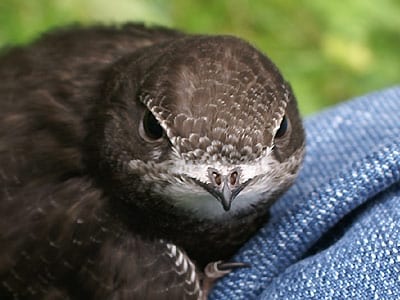
Common swifts are 16–17 cm (6.3–6.7 in) long with a wingspan of 38–40 cm (15–16 in) and entirely blackish-brown except for a small white or pale grey patch on their chins which is not visible from a distance. They have a short forked tail and very long swept-back wings that resemble a crescent or a boomerang.
Their call is a loud scream in two different tone pitches, the higher of which issues from the female. They often form "screaming parties" during summer evenings, when 10–20 swifts will gather in flight around their nesting area, calling out and being answered by nesting swifts. Larger "screaming parties" are formed at higher altitudes, especially late in the breeding season. Radar tracking of swifts at their breeding colonies has revealed that they often move together in flocks during their evening ascent and their dawn descent, but fly separately during the subsequent evening descent and the prior dawn ascent, suggesting that this flocking benefits the swifts via cue acquisition and information exchange between individuals or through extending social behaviour.
Behaviour
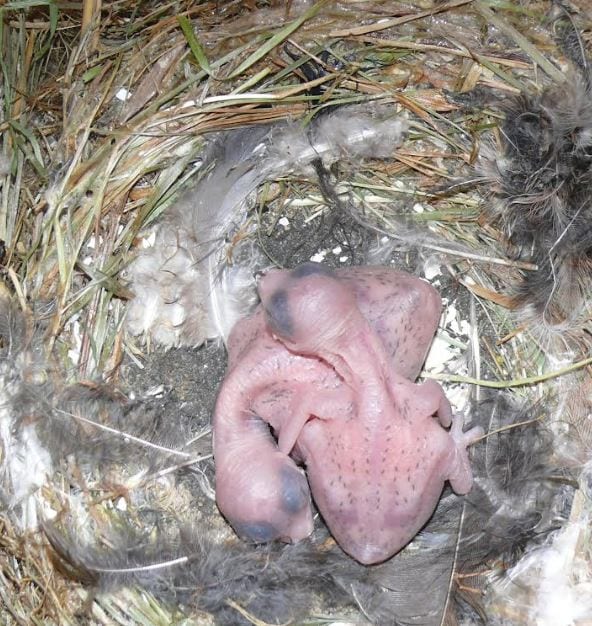
Swifts may nest in former woodpecker tree burrows found in ancient forests, such as some 600 reported nesting in the Białowieża Forest of North Eastern Poland, or the small colony found in a combination of woodpecker holes and tree nestboxes on the RSPB's reserve at the Caledonian Forest in Abernethy, Scotland. While tree holes and cliffs may have comprised their historical nesting resource, the almost complete removal of ancient forest from their nesting range has resulted in adaptation to man-made sites. Swifts build their nests of air-borne material caught in flight, bonded with their saliva, in suitable buildings hollows, such as under tiles, in gaps beneath window sills, and most typically under eaves and within gables.
Swifts form pairs that may couple for years, and often return to the same nesting site and partner year after year, repairing degradation suffered in their 40-week migratory absence. Insects such as clothes moths, carpet and larder beetles may consume all but the most indigestible nest elements, typically feather shafts.
Young nesting swifts are able to survive for a few days without food by dropping their body temperature and metabolic rate, entering a torpid state.
Differences between swifts and swallows
The barn swallow and house martin hunt for airborne insects in a manner similar to that of the slightly larger swift, and occasionally mixed groups of the species form. The most noticeable differences between the three types are:
The shrill screaming call of the swift distinguishes itself from the more inconspicuous babbling of the swallow.
The narrow sickle-shaped wings of the swift are longer than its body, and its silhouette in the air resembles an anchor.
Parasites
Swift nests commonly support populations of the chewing louse Dennyus hirundinis and the lousefly Crataerina pallida.