The monarch butterfly or simply monarch (Danaus plexippus) is a milkweed butterfly (subfamily Danainae) in the family Nymphalidae. Other common names, depending on region, include milkweed, common tiger, wanderer, and black-veined brown. It is among the most familiar of North American butterflies and an iconic pollinator, although it is not an especially effective pollinator of milkweeds. Its wings feature an easily recognizable black, orange, and white pattern, with a wingspan of 8.9–10.2 cm (3.5–4.0 in). A Müllerian mimic, the viceroy butterfly, is similar in color and pattern, but is markedly smaller and has an extra black stripe across each hindwing.
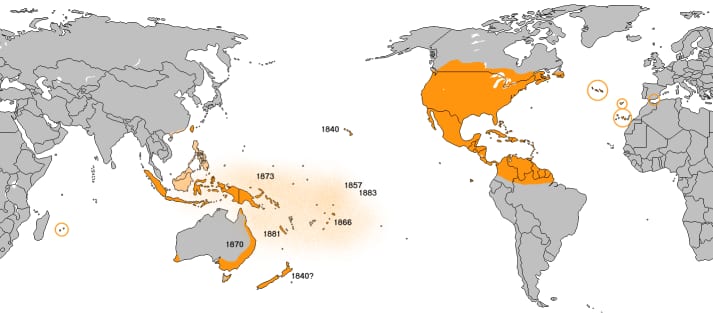
The eastern North American monarch population is notable for its annual southward late-summer/autumn instinctive migration from the northern and central United States and southern Canada to Florida and Mexico. During the fall migration, monarchs cover thousands of miles, with a corresponding multigenerational return north in spring. The western North American population of monarchs west of the Rocky Mountains often migrates to sites in southern California, but have been found in overwintering Mexican sites, as well. Populations are found further south in the Americas, and in parts of Europe, Oceania, and Southeast Asia.
Crosses a continent on stained-glass wings, then dies in Mexico.
Distribution and habitat
The range of the western and eastern populations of D. p. plexippus expands and contracts depending upon the season. The range differs between breeding areas, migration routes, and winter roosts. However, no genetic differences between the western and eastern monarch populations exist; reproductive isolation has not led to subspeciation of these populations, as it has elsewhere within the species' range.
In the Americas, the monarch ranges from southern Canada through northern South America. It is also found in Bermuda, the Cook Islands, Hawaii, Cuba, and other Caribbean islands, the Solomons, New Caledonia, New Zealand, Papua New Guinea, Australia, the Azores, the Canary Islands, Madeira, continental Portugal, Gibraltar, the Philippines, and Morocco. It appears in the UK in some years as an accidental migrant.
Overwintering populations of D. p. plexippus are found in Mexico, California, along the Gulf Coast of the United States, year-round in Florida, and in Arizona where the habitat has the specific conditions necessary for survival. On the East Coast of the United States, they have overwintered as far north as Virginia Beach, Virginia. Their wintering habitat typically provides access to streams, plenty of sunlight (enabling body temperatures that allow flight), and appropriate roosting vegetation, and is relatively free of predators.
Adult food sources
Although monarch larvae eat only milkweed, adult monarchs and other pollinators feed on the nectar of many plants, including:
Adult monarchs prefer to feed on sturdy plants that have relatively flat surfaces (sunflowers, asters) or long multi-flowering inflorescences (gayfeather), where the nectar is easily accessed, as in many species in the Asteraceae (sunflower) family. Common characteristics of this family include clusters of flowers with shallow, easily accessed nectar. Milkweeds, which also have easily accessible nectar, are excellent nectar sources.
Publications have reported that Mexican sunflower (Tithonia rotundifolia) is especially attractive to adult monarchs. Like that species, coneflowers (Echinacea spp.), gayfeathers (Liatris spp.), goldenrods (Solidago spp.), blue mistflower (Conoclinium coelestinum), frostweed (Verbesina virginica), Joe-Pye weeds (Eutrochium spp.), ironweeds (Vernonia spp.), asters (Symphyotrichum spp. and Eurybia spp.) and other late-flowering genera of the Asteraceae family, are major nectar sources for monarchs during their fall migration. During the spring migration, important nectar sources include early-blooming Asclepias spp., Coreopsis spp., Viburnum spp., and Phlox spp.
Life cycle
Like all Lepidoptera, monarchs undergo complete metamorphosis; their life cycle has four phases: egg, larva, pupa, and adult. Monarchs transition from eggs to adults during warm summer temperatures in as little as 25 days, extending to as many as seven weeks during cool spring conditions. During their development, both larvae and their milkweed hosts are vulnerable to weather extremes, predators, parasites, and diseases; commonly fewer than 10% of monarch eggs and caterpillars survive.
The egg is derived from materials ingested as a larva and from the spermatophores received from males during mating. Female monarchs lay eggs singly, most often on the underside of a young leaf of a milkweed plant during the spring and summer. Females secrete a small amount of glue to attach their eggs directly to the plant. They typically lay 300 to 500 eggs over a two- to five-week period.
Eggs are cream colored or light green, ovate to conical in shape, and about 1.2 mm × 0.9 mm (0.047 in × 0.035 in) in size. The eggs weigh less than 0.5 mg (0.0077 gr) each and have raised ridges that form longitudinally from the point to apex to the base. Although each egg is 1⁄1000 the mass of the female, she may lay up to her own mass in eggs. Females lay smaller eggs as they age. Larger females lay larger eggs.The number of eggs laid by a female, which may mate several times, can reach 1,180.
Courtship and mating
Monarch courtship occurs in two phases. During the aerial phase, a male pursues and often forces a female to the ground. During a ground phase and a post-nuptial flight, the butterflies copulate and remain attached for up to 16 hours. Only 30% of mating attempts end in copulation, suggesting that females can avoid mating, though some have more success than others. During copulation, a male transfers his spermatophore to a female. Along with sperm, the spermatophore provides a female with nutrition, which aids her in laying eggs. An increase in spermatophore size increases the fecundity of female monarchs. Males that produce larger spermatophores also fertilize more females' eggs.
Females and males typically mate more than once. Females that mate several times lay more eggs. Mating for the overwintering populations occurs in the spring, before dispersion. Mating is less dependent on pheromones than in other species in its genus. Male search and capture strategies may influence copulatory success, and human-induced changes to the habitat can influence monarch mating activity at overwintering sites.
Threats
In February 2015, the United States Fish and Wildlife Service (USFWS) reported a study that showed that nearly a billion monarchs had vanished from the butterfly's overwintering sites since 1990. The agency attributed the monarch's decline partly to a loss of milkweed caused by herbicides that farmers and homeowners had used.
A 2017 report included mention of the new ethanol-in-gasoline standards as reducing the amount of acreage left fallow in the U.S. midwest: "Federal policies such as the Ethanol Fuel Standards (Renewable Fuel Standard), crop insurance, and waning Farm Bill support for the Conservation Reserve Program (CRP) reduce support for integrated agro-ecological landscapes capable of sustaining both food production and monarch habitat, principally because these policies promote row crops over mixed, herbaceous perennial vegetation."
In 2018, a study correlated monarch butterfly decline to the fact that 95% of corn and soybean crops grown in the United States used genetically modified seeds resistant to the herbicide glyphosate. This meant that instead of spreading the herbicide only before seed planting, farmers could spread the herbicide a second time by air when weeds had begun to challenge the crops. Air application of the herbicide meant that the unplowed margins between the field and road that previously supported milkweed and a range of nectar flowers were now greatly diminished.