The peregrine falcon (Falco peregrinus), also referred to simply as the peregrine, is a bird of prey (raptor) in the family Falconidae known for its speed. A large, crow-sized falcon, it has a blue-grey back, barred white underparts and a black head. As is typical for bird-eating (avivore) raptors, peregrine falcons are sexually dimorphic, with females being considerably larger than males. Historically, the bird has also been known as the "black-cheeked falcon" in Australia and the "duck hawk" in North America.
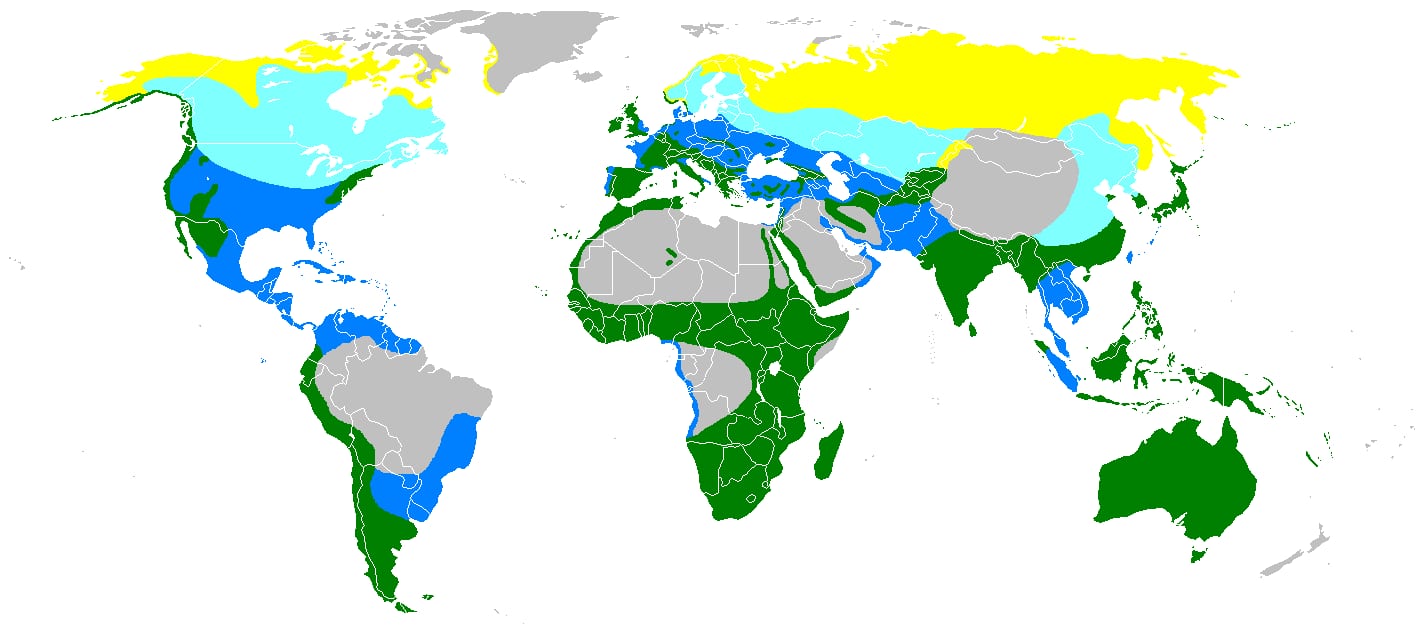
The breeding range includes land regions from the Arctic tundra to the tropics. It can be found nearly everywhere on Earth, except extreme polar regions, very high mountains, and most tropical rainforests. The only major ice-free landmasses from which it is entirely absent are the islands of New Zealand, making it the world's most widespread raptor and one of the most widely found wild bird species. In fact, the only land-based bird species found over a larger geographic area, domestic and feral pigeons, owe their success to human-led introduction. Both are domesticated forms of the rock dove, and are a major prey species for peregrine populations. Due to their greater abundance in cities than most other birds, feral pigeons support many peregrine populations as a staple food source, especially in urban settings.
The fastest animal on earth, falling at three hundred kilometres an hour.
Description
The peregrine falcon has a body length of 34 to 58 cm (13–23 in) and a wingspan from 74 to 120 cm (29–47 in). The male and female have similar markings and plumage but, as with many birds of prey, the peregrine falcon displays marked sexual dimorphism in size, with the female measuring up to 30% larger than the male. Males weigh 330 to 1,000 g (12–35 oz) and the noticeably larger females weigh 700 to 1,500 g (25–53 oz). In most subspecies, males weigh less than 700 g (25 oz) and females weigh more than 800 g (28 oz), and cases of females weighing about 50% more than their male breeding mates are not uncommon. The standard linear measurements of peregrines are: the wing chord measures 26.5 to 39 cm (10.4–15.4 in), the tail measures 13 to 19 cm (5.1–7.5 in) and the tarsus measures 4.5 to 5.6 cm (1.8–2.2 in).
Ecology and behaviour
The peregrine falcon lives mostly along mountain ranges, river valleys, coastlines, and increasingly in cities. In mild-winter regions, it is usually a permanent resident, and some individuals, especially adult males, will remain on the breeding territory. Only populations that breed in Arctic climates typically migrate great distances during the northern winter.
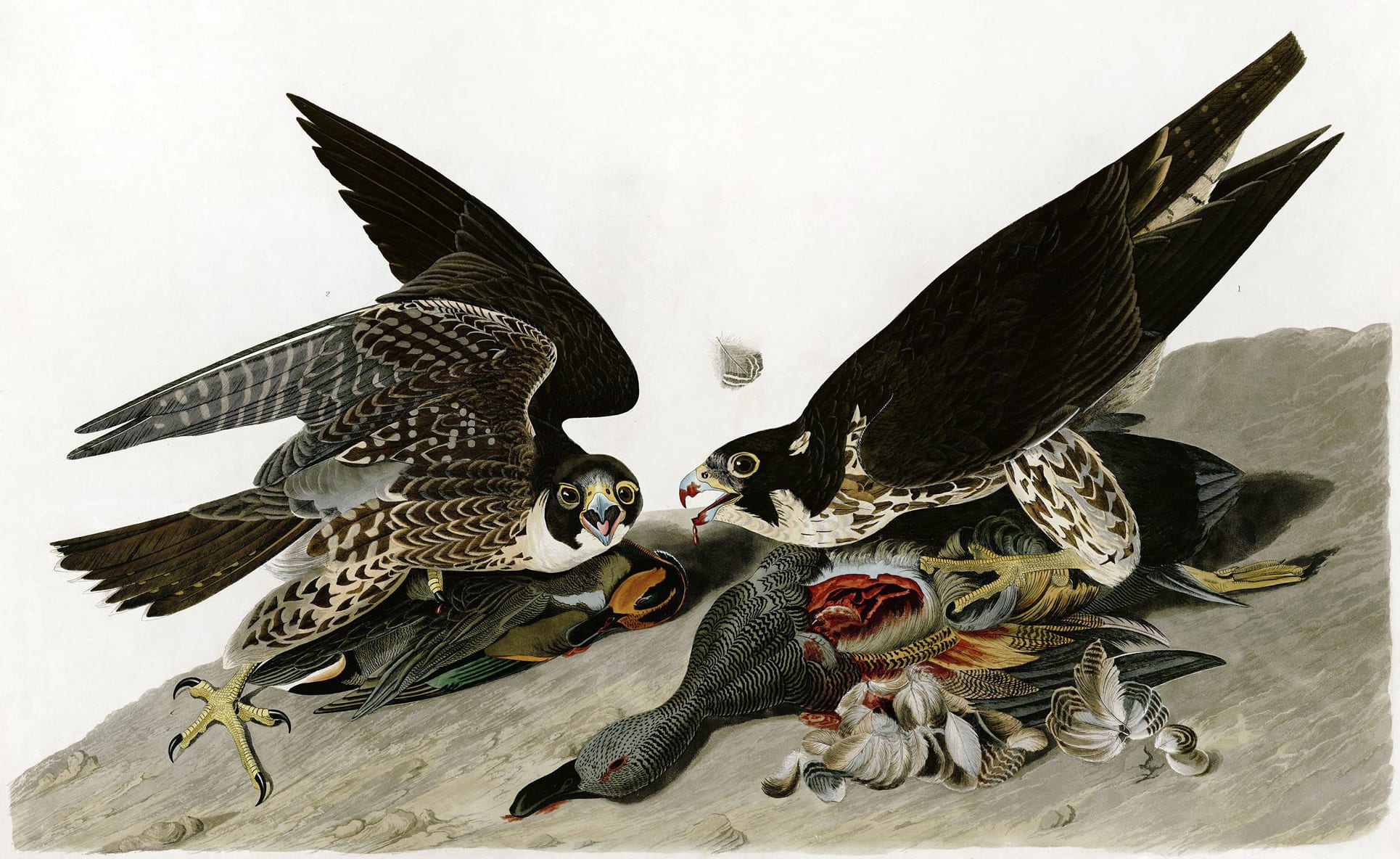
The peregrine falcon's characteristic hunting stoop (high-speed dive) involves soaring to a great height and then diving steeply at very high speeds, hitting one wing of its prey so as not to harm itself on impact. The air pressure from such a dive could possibly damage a bird's lungs, but small bony tubercles on a falcon's nostrils are theorized to guide the powerful airflow away from the nostrils, enabling the bird to breathe more easily while diving by reducing the change in air pressure.
To protect their eyes, the falcons use their nictitating membranes (third eyelids) to spread tears and clear debris from their eyes while maintaining vision.
Relationship with humans
The peregrine falcon is a highly admired falconry bird, and has been used in falconry for more than 3,000 years, beginning with nomads in central Asia. Its advantages include not only its athleticism and eagerness to hunt, but an equable disposition that leads to it being one of the easier falcons to train. The peregrine falcon has the additional advantage of a natural flight style of circling above the falconer ("waiting on") for game to be flushed, and then performing an effective and exciting high-speed diving stoop to take the quarry. The speed of the stoop not only allows the falcon to catch fast flying birds, it also enhances the falcon's ability to execute maneuvers to catch highly agile prey, and allows the falcon to deliver a knockout blow with a fist-like clenched talon against game that may be much larger than itself.
Taxonomy and systematics
Falco peregrinus was first described under its current binomial name by English ornithologist Marmaduke Tunstall in his 1771 work Ornithologia Britannica. The scientific name Falco peregrinus is a Medieval Latin phrase that was used by Albertus Magnus in 1225. Peregrinus is Latin, meaning "one from abroad" or "coming from foreign parts". It is likely the name was used as juvenile birds were taken while journeying to their breeding location (rather than from the nest), as falcon nests are often difficult to get at. The Latin term for falcon, falco, is related to falx, meaning "sickle", in reference to the silhouette of the falcon's long, pointed wings in flight.
The peregrine falcon belongs to a genus whose lineage includes the hierofalcons and the prairie falcon (F. mexicanus). This lineage probably diverged from other falcons towards the end of the Late Miocene or in the Late Pliocene, about 3–8 million years ago (mya). As the peregrine-hierofalcon group includes both Old World and North American species, it is likely that the lineage originated in western Eurasia or Africa. Its relationship to other falcons is not clear, as the issue is complicated by widespread hybridization confounding mtDNA sequence analyses. One genetic lineage of the saker falcon (F. cherrug) is known to have originated from a male saker ancestor producing fertile young with a female peregrine ancestor, and the descendants further breeding with sakers.
Cultural significance
Due to its striking hunting technique, the peregrine has often been associated with aggression and martial prowess. The Ancient Egyptian solar deity Ra was often represented as a man with the head of a peregrine falcon adorned with the solar disk, although most Egyptologists agree that it is most likely a Lanner falcon. Native Americans of the Mississippian culture (c. 800–1500) used the peregrine, along with several other birds of prey, in imagery as a symbol of "aerial (celestial) power" and buried men of high status in costumes associating to the ferocity of raptorial birds. In the late Middle Ages, the Western European nobility that used peregrines for hunting, considered the bird associated with princes in formal hierarchies of birds of prey, just below the gyrfalcon associated with kings. It was considered "a royal bird, more armed by its courage than its claws". Terminology used by peregrine breeders also used the Old French term gentil, "of noble birth; aristocratic", particularly with the peregrine.
Since 1927, the peregrine falcon has been the official mascot of Bowling Green State University in Bowling Green, Ohio. The 2007 U.S. Idaho state quarter features a peregrine falcon. The peregrine falcon has been designated the official city bird of Chicago.