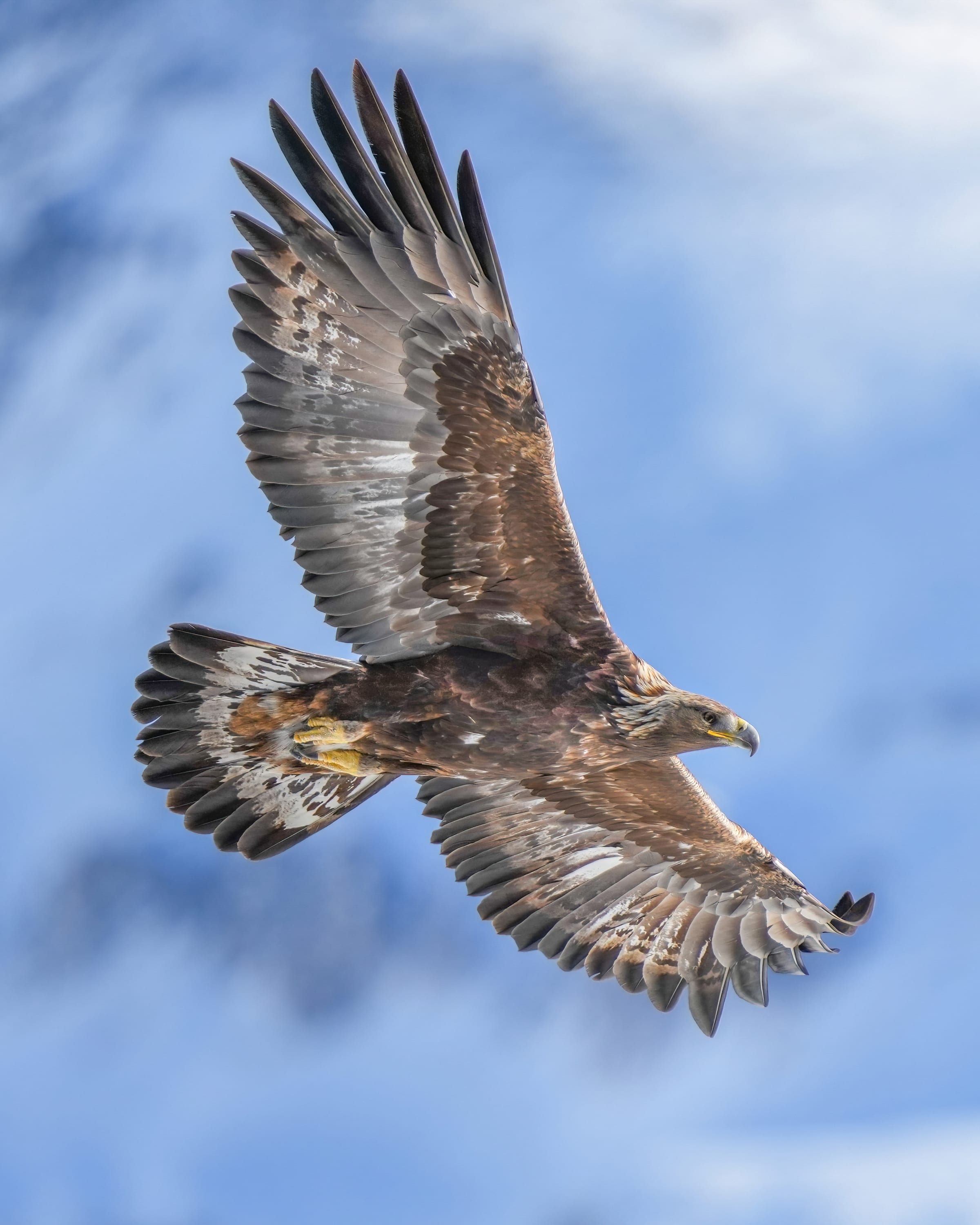
The golden eagle (Aquila chrysaetos) is a bird of prey living in the Northern Hemisphere. It is the most widely distributed species of eagle. Like all eagles, it belongs to the family Accipitridae. They are one of the best-known birds of prey in the Northern Hemisphere. These birds are dark brown, with lighter golden-brown plumage on their napes. Immature eagles of this species typically have white on the tail and often have white markings on the wings. Golden eagles use their agility and speed combined with powerful feet and large, sharp talons to hunt a variety of prey, mainly hares, rabbits, and marmots and other ground squirrels.
Golden eagles maintain home ranges or territories that may be as large as 200 km2 (77 sq mi). They build large nests in cliffs and other high places to which they may return for several breeding years. Most breeding activities take place in the spring; they are monogamous and may remain together for several years or possibly for life. Females lay up to four eggs, and then incubate them for six weeks. Typically, one or two young survive to fledge in about three months. These juvenile golden eagles usually attain full independence in the fall, after which they wander widely until establishing a territory for themselves in four to five years.
Hunts wolves and deer with a two-metre wingspan.
Description
The golden eagle is a very large raptor, 66 to 102 centimetres (26 to 40 in) in length. Its wings are broad and the wingspan is 1.8 to 2.34 metres (5 ft 11 in to 7 ft 8 in). The wingspan of golden eagles is the fifth largest among living eagle species. Females are larger than males, with a bigger difference in larger subspecies. Females of the large Himalayan golden eagles are about 37% heavier than males and have nearly 9% longer wings, whereas in the smaller Japanese golden eagles, females are only 26% heavier with around 6% longer wings. In the largest subspecies (A. c. daphanea), males and females weigh typically 4.05 and 6.35 kg (8.9 and 14.0 lb), respectively. In the smallest subspecies, A. c. japonica, males weigh 2.5 kg (5.5 lb) and females 3.25 kg (7.2 lb). In the species overall, males average around 3.6 kg (7.9 lb) and females around 5.1 kg (11 lb).
Habitat and distribution
Golden eagles are fairly adaptable in habitat but often reside in areas with a few shared ecological characteristics. They are best suited to hunting in open or semi-open areas and search them out year-around. Native vegetation seems to be attractive to them and they typically avoid developed areas of any type from urban to agricultural as well as heavily forested regions. In desolate areas (e.g., the southern Yukon), they can occur regularly at roadkills and garbage dumps. The largest numbers of golden eagles are found in mountainous regions today, with many eagles doing a majority of their hunting and nesting on rock formations. However, they are not solely tied to high elevations and can breed in lowlands if the local habitats are suitable. Below are more detailed descriptions of habitats occupied by golden eagles in both continents where they occur.
Feeding
Golden eagles usually hunt during daylight hours, but were recorded hunting from one hour before sunrise to one hour after sunset during the breeding season in southwestern Idaho. The hunting success rate of golden eagles was calculated in Idaho, showing that, out of 115 hunting attempts, 20% were successful in procuring prey. A fully-grown golden eagle requires about 230 to 250 g (8.1 to 8.8 oz) of food per day but in the life of most eagles there are cycles of feast and famine, and eagles have been known to go without food for up to a week and then gorge on up to 900 g (2.0 lb) at one sitting.
The diet of golden eagles is composed primarily of small mammals such as rabbits, hares, ground squirrels, prairie dogs, and marmots. They also eat other birds (usually of medium size, such as gamebirds), reptiles, and fish in smaller numbers. Golden eagles occasionally capture large prey, including seals, ungulates, coyotes, and badgers. They have also been known to capture large flying birds such as geese or cranes, as well as other raptors, including owls and falcons.
Reproduction
Golden eagles usually mate for life. A breeding pair is formed in a courtship display. This courtship includes undulating displays by both in the pair, with the male bird picking up a piece of rock or a small stick, and dropping it only to enter into a steep dive and catch it in mid-air, repeating the maneuver 3 or more times. The female takes a clump of earth and drops and catches it in the same fashion. Golden eagles typically build several eyries within their territory (preferring cliffs) and use them alternately for several years. Their nesting areas are characterized by the extreme regularity of the nest spacing. Mating and egg-laying timing for golden eagle is variable depending on the locality. Copulation normally lasts 10–20 seconds. Mating seems to occur around 40–46 days before the initial egg-laying. The golden eagle chick may be heard from within the egg 15 hours before it begins hatching. After the first chip is broken off of the egg, there is no activity for around 27 hours. Hatching activity accelerates and the shell is broken apart in 35 hours. The chick is completely free in 37 hours.
Status and conservation
At one time, the golden eagle lived in a great majority of temperate Europe, North Asia, North America, North Africa, and Japan. Although widespread and quite secure in some areas, in many parts of the range golden eagles have experienced sharp population declines and have even been extirpated from some areas. The number of golden eagles from around the range is estimated to be between 170,000 and 250,000 while the estimates of breeding pairs are from 60,000 to 100,000. It has the largest known range of any member of its family, with a range estimated at 140 million square kilometers. If its taxonomic order is considered, it is the second most wide-ranging species after only the osprey (Pandion haliaetus). Few other eagle species are as numerous, though some species like the tawny eagle, wedge-tailed eagle and bald eagle have total estimated populations of a similar size to the golden eagle's despite their more restricted distributions. The world's most populous eagle may be the African fish eagle (Haliaeetus vocifer), which has a stable total population estimated at 300,000 and is found solely in Africa. On a global scale, the golden eagle is not considered threatened by the IUCN.