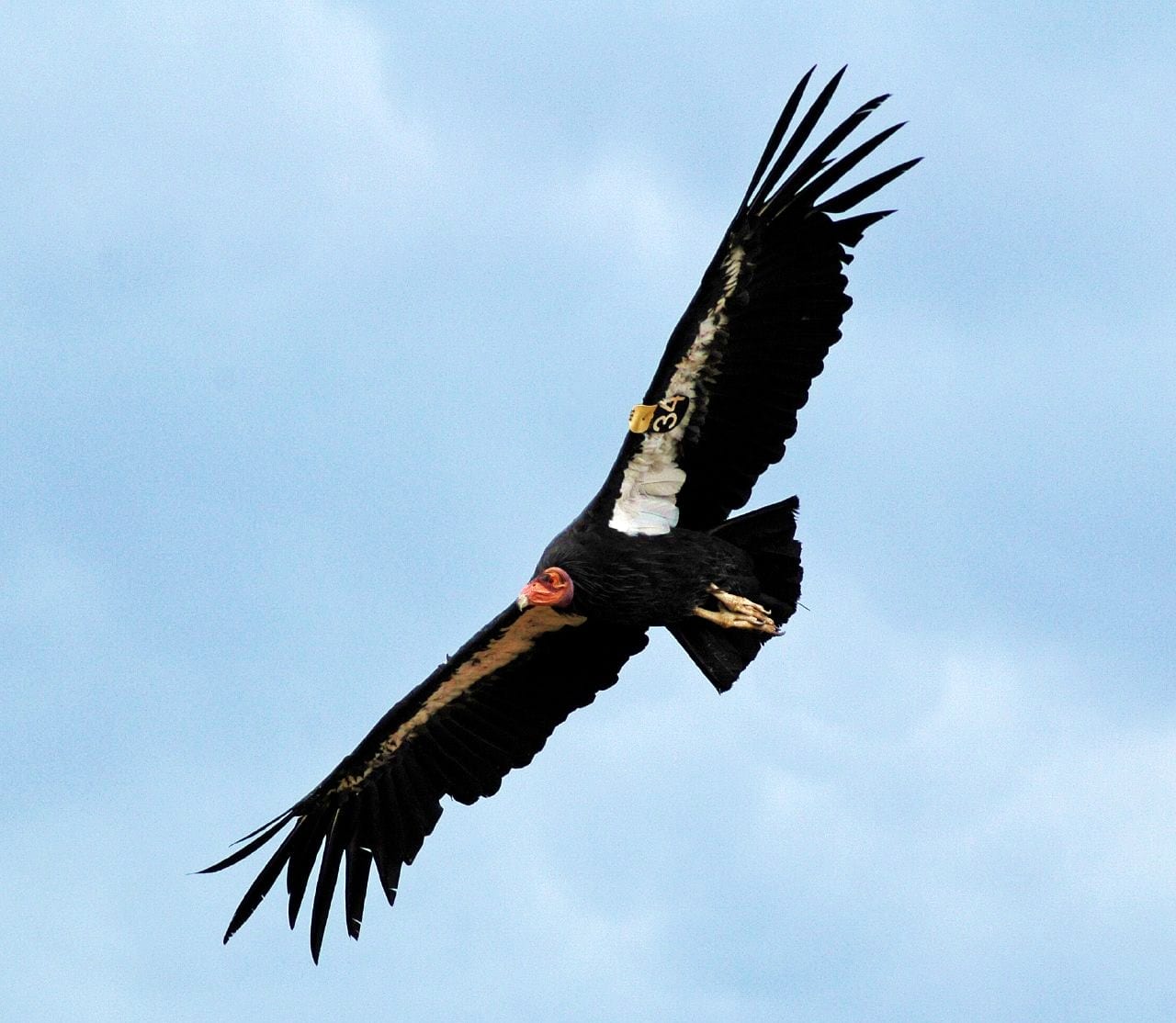
The California condor (Gymnogyps californianus) is a New World vulture and the largest North American land bird. It became extinct in the wild in 1987 when all remaining wild individuals were captured, but has since been reintroduced to northern Arizona and southern Utah (including the Grand Canyon area and Zion National Park), the coastal mountains of California, and northern Baja California in Mexico. It is the only surviving member of the genus Gymnogyps, although four extinct members of the genus are also known. The species is listed by IUCN as critically endangered, and similarly considered Critically Imperiled by NatureServe.
The plumage is black with patches of white on the underside of the wings; the head is largely bald, with skin color ranging from gray on young birds to yellow and bright orange on breeding adults. Its 3.0 m (9.8 ft) wingspan is the widest of any North American bird, and its weight of up to 14 kg (31 lb) nearly equals that of the trumpeter swan, the heaviest among native North American bird species. The condor is a scavenger and eats large amounts of carrion. It is one of the world's longest-living birds, with a lifespan of up to 60 years.
Brought back from twenty-two birds to soar Californian canyons again.
Description
The adult California condor is a uniform black with the exception of large triangular patches or bands of white on the underside of the wings. It has gray legs and feet, an ivory-colored bill, a frill of black feathers surrounding the base of the neck, and brownish red eyes. The juvenile is mostly a mottled dark brown with blackish coloration on the head. It has mottled gray instead of white on the underside of its flight feathers.
The condor's head has little to no feathers, which helps keep it clean when feeding on carrion. The skin of the head and neck is capable of flushing noticeably in response to emotional state. The skin color varies from yellowish to a glowing reddish-orange. The birds do not have true syringeal vocalizations. They can make a few hissing or grunting sounds only heard when very close.
The female condor is smaller than the male, an exception to the rule among birds of prey (the related Andean condor is another exception). Overall length ranges from 109 to 140 cm (43 to 55 in) and wingspan from 2.49 to 3 m (8 ft 2 in to 9 ft 10 in). Their weight ranges from 7 to 14.1 kg (15 to 31 lb), with estimations of average weight ranging from 8 to 9 kg (18 to 20 lb). Wingspans of up to 3.4 m (11 ft) have been reported but no wingspan over 3.05 m (10.0 ft) has been verified. Most measurements are from birds raised in captivity, so it is difficult to determine if major differences exist between wild and captive condors.
Historic range
At the time of human settlement of the Americas, the California condor was widespread across North America; condor bones from the late Pleistocene have been found at the Cutler Fossil Site in southern Florida. However, at the end of the last glacial period came the extinction of the megafauna that led to a subsequent reduction in range and population. Five hundred years ago, the California condor roamed across the American Southwest and West Coast. Faunal remains of condors have been found documented in Arizona, Nevada, New Mexico, and Texas.
The Lewis and Clark Expedition of the early 19th century reported on their sighting and shooting of California condors near the mouth of the Columbia River. The species was observed as far north as Lulu Island, British Columbia in the late 1880s; it was described as once being "common" in the area up until that point. Its 19th century presence at the mouth of the Fraser River was corroborated by John Keast Lord.
In the 1970s, two Condor Observation Sites were established in the Santa Clara River Valley to host hopeful birders interested in the endangered species: one about 15 miles north of Fillmore, California, near the Sespe Wildlife Area of Los Padres National Forest, and one atop Mount Pinos, "accessible from a dirt road off the highway in from Gorman".
Habitat
The California condor lives in rocky shrubland, coniferous forest, and oak savanna. They are often found near cliffs or large trees, which they use as nesting sites. Individual birds have a huge range and have been known to travel up to 250 km (160 mi) in search of carrion.
There are two sanctuaries chosen because of their prime condor nesting habitat: the Sisquoc Condor Sanctuary in the San Rafael Wilderness and the Sespe Condor Sanctuary in the Los Padres National Forest.
The Los Padres Condor Range and River Protection Act of 1992 expanded existing wilderness by 34,200 hectares (84,400 acres) and designated 127,900 hectares (316,050 acres) of new wilderness that provide habitat for the condor in the Los Padres.
Ecology and behavior
The California condor's large flight muscles are not anchored by a correspondingly large sternum, which restricts them to being primarily soarers. The birds flap their wings when taking off from the ground, but after attaining a moderate elevation they largely glide, sometimes going for miles without a single flap of their wings. They have been known to fly up to speeds of 90 km/h (56 mph) and as high as 4,600 m (15,100 ft). They prefer to roost on high perches from which they can launch without any major wing-flapping effort. Often, these birds are seen soaring near rock cliffs, using thermals to aid them in keeping aloft.
The California condor has a long life span, reaching up to 60 years. If it survives to adulthood, the condor has few natural threats other than humans. Because they lack a syrinx, their vocal display is limited to grunts and hisses. Condors bathe frequently and can spend hours a day preening their feathers. Condors also perform urohidrosis, or defecate on their legs, to reduce their body temperature. There is a well-developed social structure within large groups of condors, with competition to determine a pecking order decided by body language, competitive play behavior, and a variety of hisses and grunts. This social hierarchy is displayed especially when the birds feed, with the dominant birds eating before the younger ones.
Conservation
The California condor conservation project may be one of the most expensive species conservation projects in United States history, costing over $35 million, including $20 million in federal and state funding, since World War II. As of 2007, the annual cost for the condor conservation program was around $2.0 million per year. Successful reintroduction of captive-bred condors into the wild has become a multi-step and complex process, fraught with the need to periodically recapture the birds to test for lead poisoning and sometimes the necessity for lead removal by chelation.
As the condor's population continued to decline, discussion began about starting a captive breeding program for the birds. Opponents to this plan argued that the condors had the right to freedom and that capturing all of the condors would change the species' habits forever, and that the cost was too great. The project received the approval of the United States government, and the U.S. Fish and Wildlife service established the California Condor Recovery Program in 1979. The capture of the remaining wild condors was completed on Easter Sunday 1987, when AC-9, the last wild condor, was captured. At that point, there were only 22 surviving condors, all of them in captivity. The goal of the California Condor Recovery Plan was to establish two geographically separate populations, one in California and the other in Arizona, each with 150 birds and at least 15 breeding pairs.